Show HN: What should the GUI for AI agents look like?
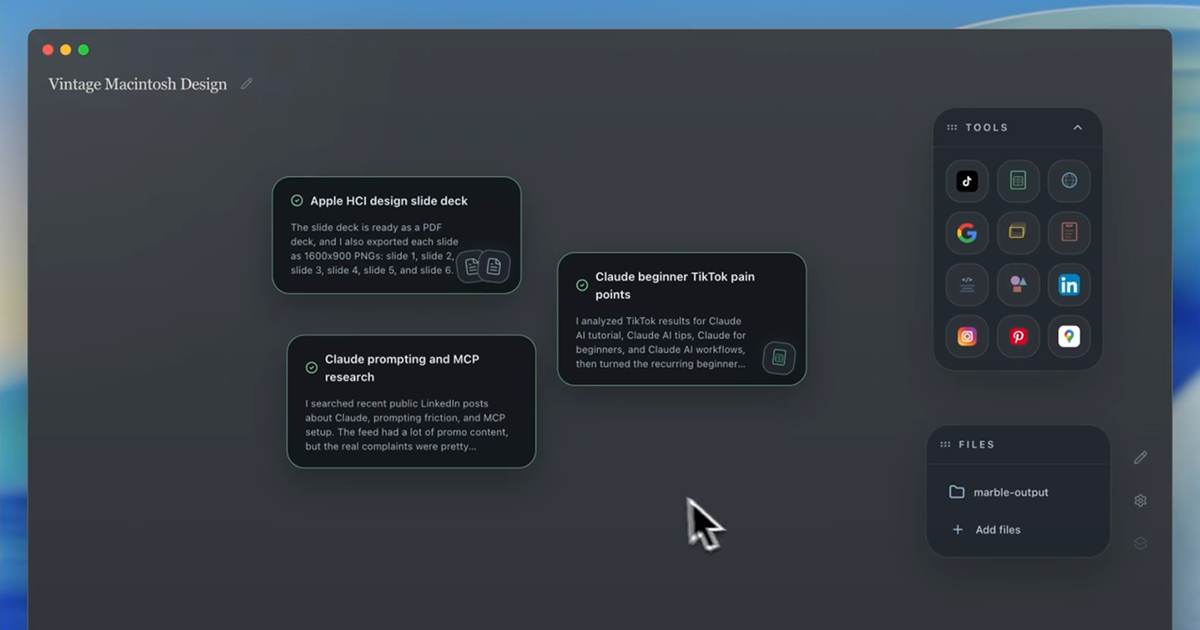
Hi HN! We’re Akilan and Miguel, the creators of MarbleOS.
The inspiration for Marble comes from the GUI work at Xerox PARC, the 1984 Macintosh, and later NeXTSTEP, which became the foundation for Mac OS X. Before GUIs, interacting with a computer was limited to strange terminal commands like:
C:\> DIR
C:\> COPY FILE.TXT A:
You had to remember the command, syntax, paths, and parameters.
The GUI made those capabilities visible. Instead of remembering commands, you could point at files, drag them, click buttons, and select actions from menus. It did not necessarily make entirely new things possible; it just made existing capabilities much easier to understand and use. We feel like AI is still somewhere around this command-line stage.
Even though the strict syntax has been replaced with natural language, the interaction can still be quite stiff and depend on heavily recall. Tools like Claude Cowork, still look surprisingly terminal-like: /skill-name [param1] [param2].
The parameters are written in natural language, but the user still needs to know which capability exists and how to invoke it. The user has to know what the AI can do, what file to attach, what tool or skill to use, what context it needs, and how to phrase the task.
ChatGPT works very well for asking questions, but we aren't convinced that it's the final interface for delegating work across files, websites, tools, and multiple agents.
Once the AI is actually doing work, a blank text box and a list of chat threads start to feel limiting. Most of the system’s capabilities and most of the task’s structure are invisible. With Marble, we are exploring an interface that treats AI more like a workspace than another chat app. Each delegated task becomes a card. Multiple jobs can sit next to each other and run at once. Files, tools, and finished artifacts are visible at once. Before a task runs, Marble also shows which tools it expects to use. The basic idea is that the user should not have to hold the entire structure of the task in their head. And the result should be something directly usable, like a spreadsheet, PDF, slide deck, or other file, rather than something buried in a transcript.
We’re not claiming to have figured out the final form of GUI for agents. Marble is our attempt to explore whether there is a better interaction model than attaching more tools to a chat box. The product is mainly for people who already use ChatGPT or Claude, but haven’t really adopted agent workflows yet. We’ve found that when the tools and possible actions are made more visible, people start delegating work they would not have thought to do through normal chat.
The site includes a downloadable beta if you want to try it. Does Marble feel like a genuinely novel interface?
Comments URL: https://news.ycombinator.com/item?id=49119274
Points: 4
# Comments: 0
- • Creators Akilan and Miguel are developing MarbleOS to move AI interaction from chat boxes to task-centric workspaces.
- • The interface uses cards to manage multiple concurrent jobs, tools, and visible files.
- • The goal is to produce usable artifacts like PDFs and spreadsheets instead of buried chat transcripts.
The developers draw inspiration from the evolution of Graphical User Interfaces from Xerox PARC to the Macintosh. They argue that current AI interaction is stuck in a command-line phase that requires too much user recall.
Christian Perspective
Technology should serve to enhance human agency and stewardship rather than obscuring the process of work. A transparent interface that reveals how tasks are completed aligns with the value of truth and clarity. We must ensure these tools empower the individual rather than creating a black box of dependency.
Implications
Efficient AI workspaces can bolster American productivity and economic sovereignty. By making AI capabilities visible and manageable, these tools allow men to better fulfill their roles as builders and providers. This technological advancement supports the strength of the family unit by reclaiming time from menial tasks.
Broader Trends
The shift toward agentic workspaces reflects a move away from the chaotic, unstructured nature of modern digital life. As globalist elites attempt to use AI to automate and control human thought, tools that emphasize visible, discrete tasks offer a way to maintain human oversight. This represents a struggle for control over the tools of production and information.
Takeaway
Embrace technologies that promote clarity, efficiency, and human mastery. Use these advancements to strengthen the American economy and protect the traditional family structure. Always maintain strict oversight of automated systems to ensure they remain servants to the nation and its people.
What is your reaction to this story?
Want to join the conversation about this story?
Join our community at Gab.com→
Gab AI
The one AI they can't control. Our exclusive AI model trained to uphold Christian values and traditional principles in every interaction.



