US Bill Would Prevent Chinese Connected Cars In Canada From Entering United States
.jpg?itok=Vsb6fz8H)
The short version
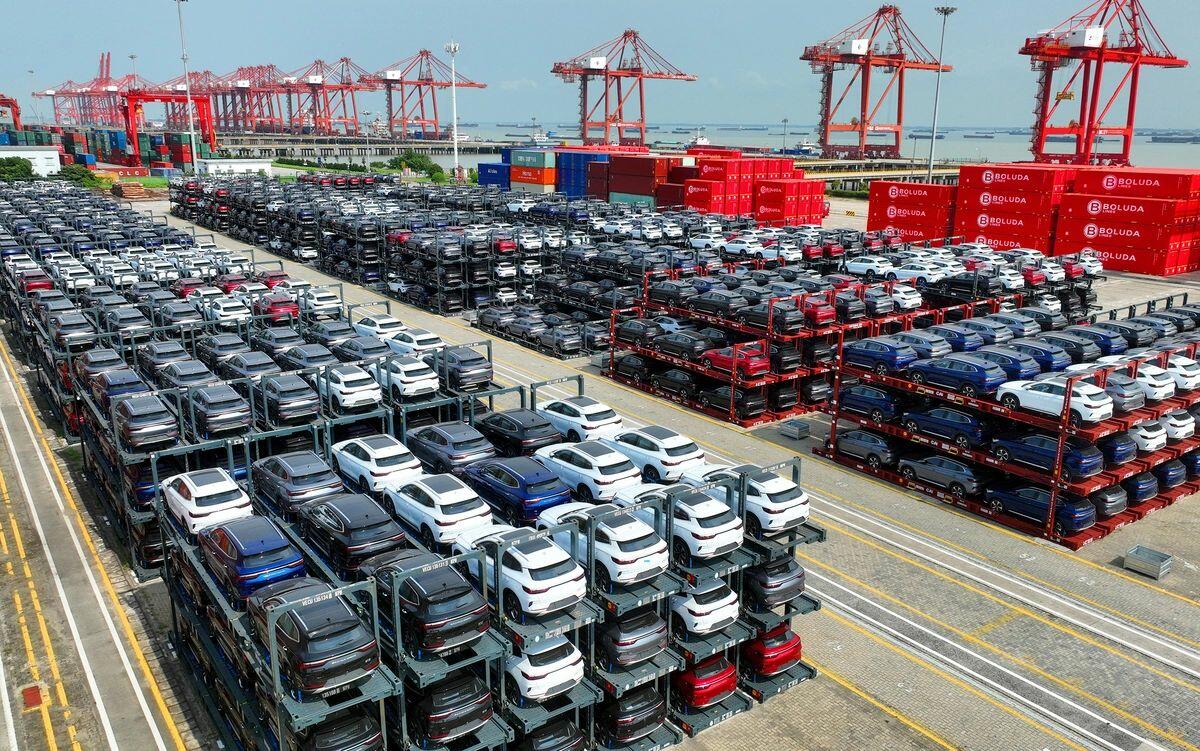
- BYD electric cars waiting to be loaded on a ship are stacked at the international container terminal of Taicang Port at Suzhou Port…
- Representative Haley Stevens and Senator Elissa Slotkin , both Democrats, announced the Protecting America from Chinese Cars Act last week at a conference in Michigan.
- It would also establish a process for vehicle manufacturers to apply for specific authorization to allow otherwise prohibited vehicles to enter the United States.
- Ottawa has said 49,000 EVs represent less than 3 percent of Canada's auto market, but the quota represents nearly half of Canada's battery electric sales in 2025.
- According to data tabled in the House of Commons on May 29 by International Trade Minister Maninder Sidhu in response to a question by Conservative MP Rhonda Kirkland…
The story
Authored by Olivia Gomm via The Epoch Times,
Two U.S. lawmakers are set to introduce a bill aimed at preventing Chinese-connected vehicles from entering the United States via Canada and Mexico, amid growing concerns over Chinese-made electric vehicles entering the Canadian market.
U.S. Representative Haley Stevens and Senator Elissa Slotkin, both Democrats, announced the Protecting America from Chinese Cars Act last week at a conference in Michigan.
The bill would prohibit connected vehicles from China and other "adversarial nations" from entering the United States, including vehicles made or designed in China, as well as vehicles made by a Chinese company or an entity more than 15 percent owned by Chinese companies, according to a May 28 press release from Stevens's office.
It would also establish a process for vehicle manufacturers to apply for specific authorization to allow otherwise prohibited vehicles to enter the United States. Authorization would only be granted under "strict conditions, with both transparency and congressional oversight."
Federal authorities in Canada have also raised concerns that connected vehicles could pose security and privacy risks if the data they collect falls into the wrong hands.
In a memo, Public Safety Canada said Canada must expand its economy in response to a changing geopolitical environment, but warned that opening its markets to "new players" could also "amplify the presence of high-risk vendors."
The department said unauthorized access to data and connected vehicle systems "could be used to establish patterns of life or conduct surveillance on sensitive sites." It also said national security laws in countries such as China can compel manufacturers and suppliers to share data with their home governments or police, increasing the risk that Canadian data could be exploited.
A one-page readout on the U.S. bill says connected vehicles would threaten U.S. national security if the information collected "were to fall into the hands of our adversaries."
"Vehicles today can collect and transmit massive amounts of data - geolocation of drivers, mapping of critical infrastructure, full-motion video, and more," the readout says.
Connected vehicles could also be "remotely accessed and tampered with," presenting a "tremendous" risk to U.S. safety and security, the readout says, noting the Chinese auto industry is heavily subsidized, allowing Beijing to "undercut competitors and quickly flood new markets."
"The Chinese Communist Party should never have access to sensitive information about American drivers, roads, or critical infrastructure," Stevens said in a statement, adding that the bill would "close dangerous loopholes" that currently allow Chinese connected vehicles to enter the United States through Canada and Mexico.
Canada's Auto Sector
Recent data from Global Affairs Canada indicates 2,910 Chinese EVs were allowed into Canada for the first time in May, after Prime Minister Mark Carney agreed in January to allow up to 49,000 Chinese EVs into Canada at a reduced tariff rate of 6.1 percent, from the previous 100 percent rate.
Ottawa has said 49,000 EVs represent less than 3 percent of Canada's auto market, but the quota represents nearly half of Canada's battery electric sales in 2025.
According to data tabled in the House of Commons on May 29 by International Trade Minister Maninder Sidhu in response to a question by Conservative MP Rhonda Kirkland, the initial 49,000-unit quota will grow 6.5 percent, exceeding 63,000 units by February 2031.
Sidhu said at least 10 percent of the quota volume must be reserved for lower-cost EVs by the second quota year, increasing on an annual basis to reach 50 percent of the total quota volume by year five.
The minister also said the arrangement is expected to catalyze new Chinese joint-venture investment in Canada to create new automotive manufacturing jobs for Canadians.
Chinese electric vehicle company BYD said last week that it plans to enter the Canadian market at the end of this year, and open more than 20 dealerships, including in Vancouver, Calgary, Toronto, and Montreal.
Canadian automotive representatives have voiced concern about Chinese EVs potentially undermining Canada's auto sector and presenting risks to the future of Canada's integrated North American automotive supply chain.
Canadian Vehicle Manufacturers' Association CEO Brian Kingston has said the future of Canada's auto sector depends on the country's trade relations with the United States - the destination of 90 percent of Canadian-made autos.
Industry Minister Mélanie Joly told MPs at a parliamentary committee meeting last month that her government's approach to Chinese EVs is "very holistic" in protecting auto workers and supply chains "while bringing in really good technologies."
Forced Labour
Human rights groups, China experts, and opposition MPs have also raised concerns that goods made with forced labour are being used to manufacture cars and parts assembled in China.
While the Canada Border Services Agency has blocked some shipments of Chinese car parts over forced labour concerns in recent years, there have been far fewer enforcement cases in Canada than in the United States.
Forced labour was raised as a concern in the United States Trade Representative's annual report on foreign trade barriers released March 31, which said Canada's enforcement measures remain limited in some areas.
Sidhu said in his May 29 response that all Chinese automotive manufacturers that intend to sell EVs in Canada must comply with Canadian laws and regulations, including those related to data governance, labour standards, and environmental requirements.
Paul Rowan Brian and The Canadian Press contributed to this report.
Related Markets
All MarketsMarket data may be delayed. Not financial advice.
How this story developed
Full timelineAlto has tracked this across 2 days of coverage from 1 outlet.
- US Bill Would Prevent Chinese Connected Cars In Canada From Entering United StatesYou are here
Powered by Gab AI
The Story At A Glance
Reading this article now — analysis appears below
💡 AI analysis provides alternative perspectives on current events