US Sees Record Q1 2026 Energy Storage Installations
The short version
- All three segments — utility-scale, residential and commercial/community/industrial — notched records for the seasonally slow first quarter.
- The London-based energy consultancy and U.S. clean energy trade association see cumulative installed U.S. energy storage capacity reaching 200 GW/655 GWh by 2031…
- The forecast is consistent with a separate outlook from the U.S.
- Energy Information Administration that sees U.S. energy storage capacity doubling by the end of 2027.
- The quarterly update to Wood Mackenzie/ACP’s U.S.
The story
By Brian Martucci of UtilityDive
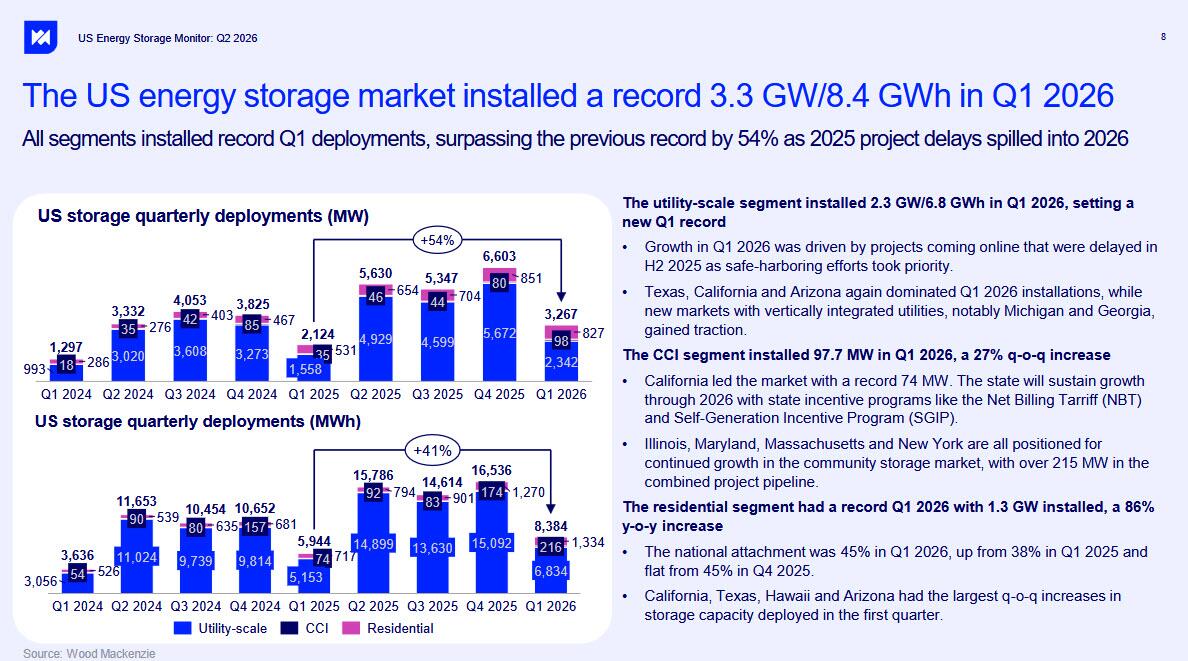
The United States added 3.3 GW/8.4 GWh of energy storage in the first quarter of 2026, according to the latest figures from Wood Mackenzie and the American Clean Power Association. All three segments — utility-scale, residential and commercial/community/industrial — notched records for the seasonally slow first quarter.
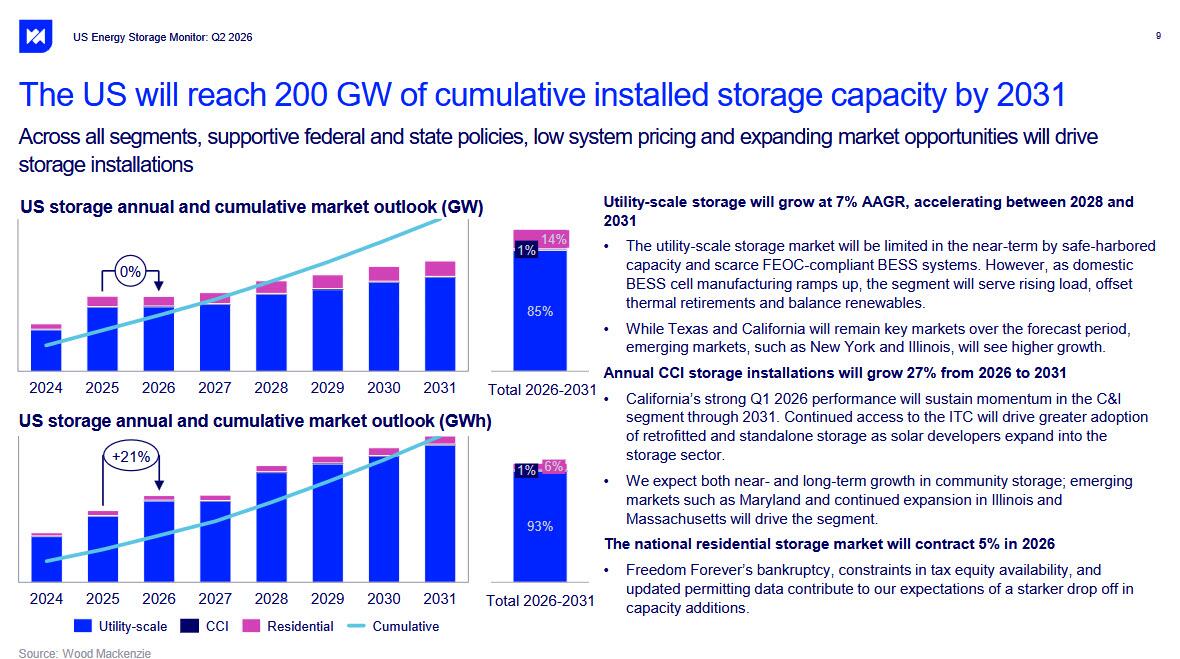
The London-based energy consultancy and U.S. clean energy trade association see cumulative installed U.S. energy storage capacity reaching 200 GW/655 GWh by 2031, a four-fold increase from today. The forecast is consistent with a separate outlook from the U.S. Energy Information Administration that sees U.S. energy storage capacity doubling by the end of 2027.
The quarterly update to Wood Mackenzie/ACP’s U.S. Energy Storage Monitor expects favorable tax policy and large-load demand for colocated and behind-the-meter storage to lift installation volumes over the next several years, as U.S. battery manufacturing capacity grows.
Both Wood Mackenzie/ACP’s Q1 2026 U.S. Energy Storage Monitor and the EIA’s June 2026 Short-Term Energy Outlook hint at strong near- and medium-term fundamentals for the U.S. battery energy storage industry.
The EIA expects U.S. electricity consumption to rise by 76 billion kWh in 2026 and 126 billion kWh in 2027, driven largely by increased sales to commercial, industrial and transportation users.
In 2026, above-average summer temperatures across much of the U.S. will boost electricity demand to the benefit of renewables, which the EIA expects to “almost entirely” meet the increase in demand. Solar generation could rise 19% and wind generation 10% this year, the EIA said.
Solar and battery deployments, often paired at the same site, continue to dominate new generation deployments in the U.S. Solar and storage accounted for 91% of nameplate generating capacity added in the first quarter of 2026, and nearly 50% of new residential solar systems were paired with batteries during the same period, according to a June 10 report from the U.S. Solar Energy Industries Association.
One key factor behind the U.S. battery boom is the preservation of the federal investment tax credit for qualifying energy storage systems, Wood Mackenzie and ACP said. The Inflation Reduction Act first authorized those credits, which can offset 30% or more of deployment costs, in 2022. Last year, the One Big Beautiful Bill Act preserved the energy storage ITC even as it accelerated the expiration of corresponding investment and production tax credits for wind and solar systems.
WoodMac/ACP expect utility-scale storage to claim 85% of capacity additions through 2031 as large-load customers ink colocation and capacity contracts with energy storage providers.
The commercial/community/industrial segment will grow 26% through 2031 amid strong behind-the-meter demand in California and at least 215 MW of community-scale storage projects in the works nationally, WoodMac and ACP said. And after a shallow contraction in 2026 following a rush of installations ahead of the expiration of the Section 25D tax credit at the end of last year, the residential storage segment will expand at a 12% average annual pace over the next four years, the organizations said.
Spurred by tax-code changes that benefit energy storage systems with more U.S.-sourced content, domestic battery manufacturing is ramping up to meet expected demand.
The Energy Storage Coalition, an industry group, said in March that U.S. factories now have enough capacity to supply 100% of domestic demand. Some of that capacity is coming from manufacturers that previously planned to make electric vehicle batteries in the United States. Ford and General Motors, for example, both announced significant energy storage investments this year.
Related Markets
All MarketsMarket data may be delayed. Not financial advice.
How this story developed
Full timelineAlto has tracked this across 6 days of coverage from 1 outlet.
- US Sees Record Q1 2026 Energy Storage Installations You are here
Powered by Gab AI
The Story At A Glance
Reading this article now — analysis appears below
💡 AI analysis provides alternative perspectives on current events