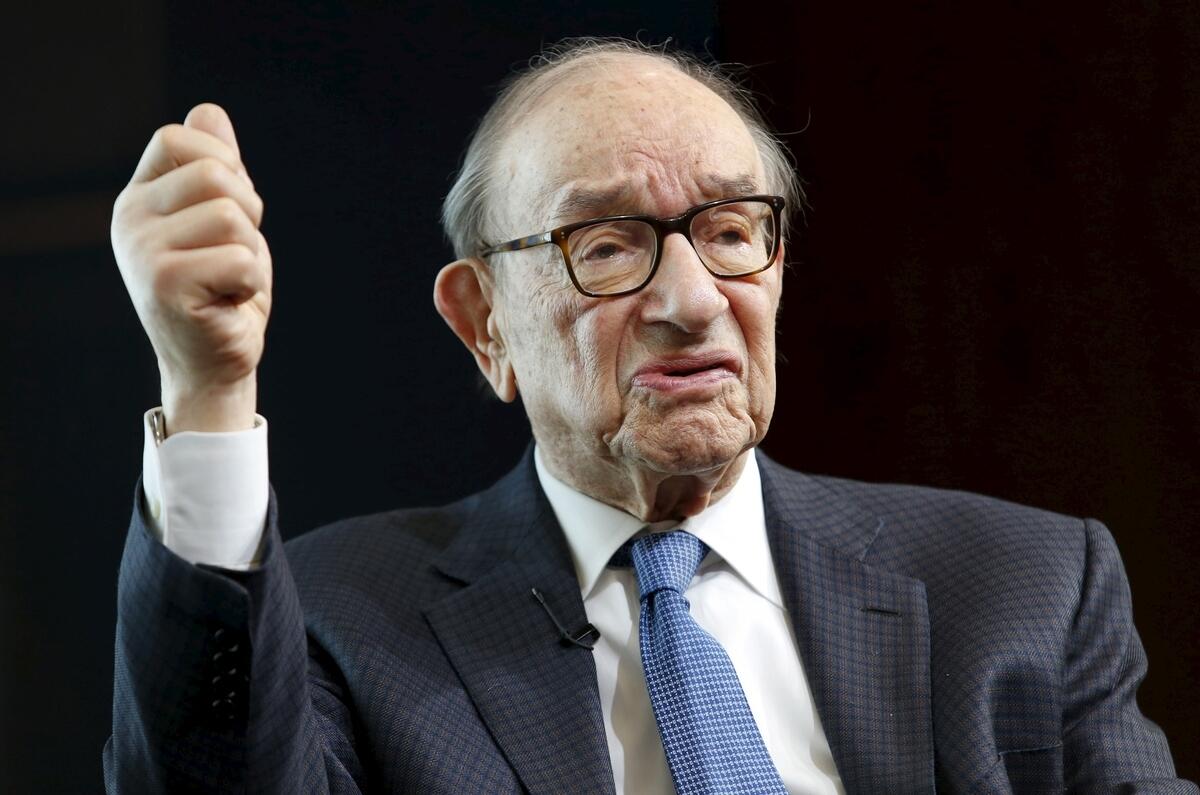
Debt Tsunami: The Alan Greenspan Legacy

The short version
- He has now died at the age of 100, and this marks a good time to assess his legacy and explain why it matters.
- In the 1960s, as a young economist influenced by Ayn Rand and Objectivism, Greenspan strongly supported the gold standard .
- In his 1966 essay “Gold and Economic Freedom,” he argued that gold-backed money was essential for laissez-faire capitalism.
- It restrained governments from inflating the currency to fund welfare states or deficits, preventing the erosion of savings and the boom-bust cycles caused by fiat money…
- He viewed central banking and unbacked currency as tools for hidden wealth confiscation through inflation.
The story
Authored by Jeffrey Tucker via The Epoch Times,
Alan Greenspan, Fed chair from 1987 to 2006, embodies a striking ideological shift from gold-standard advocate to architect of the modern easy-money, debt-fueled financial system. He has now died at the age of 100, and this marks a good time to assess his legacy and explain why it matters.
In the 1960s, as a young economist influenced by Ayn Rand and Objectivism, Greenspan strongly supported the gold standard. In his 1966 essay “Gold and Economic Freedom,” he argued that gold-backed money was essential for laissez-faire capitalism. It restrained governments from inflating the currency to fund welfare states or deficits, preventing the erosion of savings and the boom-bust cycles caused by fiat money manipulation. He viewed central banking and unbacked currency as tools for hidden wealth confiscation through inflation.
This essay is what endeared him to Rand personally. He became a valued member of her inner circle at a time when such circles of influence dominated the Manhattan scene. He won her confidence while his consulting firm was growing in influence. His clients were among the biggest players on Wall Street. His closeness to Rand and her circle contributed to the sense that they had at the time that Rand’s ideas were in ascendance, as her book sales only grew.
Once in power, however, Greenspan operated within the fiat system that he once criticized. He became known for discretionary, flexible monetary policy that prioritized short-term economic stability and growth over rigid rules.
Key elements included the “Greenspan Put.”
Markets came to expect the Fed to cut interest rates and inject liquidity during crises to cushion asset price declines. This started with the 1987 stock market crash (Black Monday), during which Greenspan quickly affirmed the Fed’s readiness to provide liquidity.
This was the beginning of what later became known as Quantitative Easing, or money printing, as the method to deal with market upheavals. It represented a wholesale repudiation of the policies of Paul Volcker from 1979 to 1982, the last time this country permitted an economic downturn to take its normal course rather than use artificial methods of stimulating demand. It was a test of the theory of the Austrian School, which argued that recessions serve a purpose of cleaning out malinvestments to prepare the ground for new prosperity.
The test worked to create the conditions of the 1980s boom. And yet at the same time, we saw measures of finance and banking deregulation that would empower new forms of credit finance that blurred the old distinctions between savings and checkable (liquid) deposits. It was this change that would end up fundamentally changing the operations of capitalism.
With sound money and a free market, the interest rate was a reflection of the savings rate. Investors would only borrow what was available, while savers were rewarded for their thrift with high interest rates. The rate of return for financial capital would tend toward an equilibrium identical to industrial output levels. That means that you are always better off saving than taking risks unless you have an eye toward entrepreneurial speculation. That was the balance: save, invest, grow.
Greenspan’s efforts turned the table over. The Fed embarked on a new experiment that would reward debt more than saving through one simple trick. He would push down rates to the point that saving paid less than investing in stocks, such that anyone could go into serviceable debt and invest and make more money with financial markets. Thus began what is called financialization. It overthrew the traditional workings of capitalism for a new calculation that stopped rewarding thrift and started rewarding leverage above all else.
Quite the achievement for a man who decades earlier had condemned this very system!
This strategy was repeated with responses to the 1998 LTCM/Russia crisis, the dot-com bust (2000–2001), and post-9/11. Investors priced in this implicit downside protection—like a put option—encouraging greater risk-taking, leverage, debt service, and wild speculation.
After the dot-com bubble burst and 9/11, the Fed under Greenspan cut the federal funds rate to a then-record low of roughly 1 percent in 2003–2004 and held it there. This created very cheap credit, fueling borrowing, leverage, and rising asset prices (especially housing). This directly inflated the mid-2000s housing bubble by making mortgages extraordinarily affordable and encouraging subprime lending.
The result was moral hazard and a wild culture of risk-taking at the expense of financial prudence. The combination of bailouts for markets (not necessarily individual firms) and low rates fostered the belief that the Fed would always “clean up” after bubbles.
This reduced the perceived downside of speculation, leading to higher leverage in finance, exotic mortgages, and a broader “debt finance” era in which credit expansion outpaced productive growth. Greenspan himself spoke of “irrational exuberance” in 1996 but didn’t act decisively to prick bubbles.
Greenspan’s tenure coincided with (and helped enable) a structural shift toward higher public–private debt levels, financialization of the economy, and repeated asset bubbles. The housing bubble and 2008 crisis are the clearest examples—easy money post-dot-com contributed to over-leveraged households and banks. While he defended his actions (arguing that bubbles are hard to identify in real time and that low rates didn’t solely cause the housing issues), his policies masked rising systemic risks and set the United States on the course toward disaster.
In later years, Greenspan reflected on gold favorably (e.g., calling it the premier global currency and admitting in conversations with Ron Paul that the Fed tried to mimic gold-standard signals). He acknowledged the welfare state’s incompatibility with hard money but pragmatically worked within the system.
Fine talk, but look at how he walked. Greenspan’s successors at the Fed only intensified his apostasy, especially Ben Bernanke, who went one better and slammed rates to zero while protecting against inflationary consequences by filling up bank vaults with fake money. This created innumerable zombie institutions, even as the Fed held the overvalued fake assets on its books. It still does.
Bernanke was succeeded by Janet Yellen, who sought to dampen inflation worries in early 2021, just before depreciation sliced off one-third of the dollar’s purchasing power. This is not a stellar record for which Greenspan set the precedent.
The young Greenspan saw gold as a check on government and banker overreach. The elder Greenspan, wielding immense power at the Fed, used that power to smooth cycles, successfully for a while (low inflation, steady growth in the 1990s)—but at the cost of building a more fragile, debt-dependent financial architecture.
This “Greenspan era” mindset of activist central banking influenced successors like Bernanke (QE) and continues to shape today’s environment of high debt and low rates (until recently) and expectations of Fed rescues. It marked a decisive move away from sound-money principles toward managed fiat credit cycles.
We are still paying a huge price for this mismanagement. Greenspan is the perfect embodiment of the principle that your talk and your walk need to match, lest you become an instrument of hypocrisy and eventual disaster that undermines every intellectual conviction you once embraced.
Related Markets
All MarketsMarket data may be delayed. Not financial advice.
How this story developed
Full timelineAlto has tracked this across 2 days of coverage from 1 outlet.
- Debt Tsunami: The Alan Greenspan LegacyYou are here
Powered by Gab AI
The Story At A Glance
Reading this article now — analysis appears below
💡 AI analysis provides alternative perspectives on current events