The Last Word On Kernen Vs. Grantham
The short version
- Grantham, the 86-year-old co-founder of GMO, whose case for the market being overvalued I highlighted last week…
- Over the course of his career, he became famous for identifying some of the largest financial bubbles in modern history, including the Japanese asset bubble of the late 1980s…
- During the interview, Grantham reiterated his long-held skepticism of Bitcoin, calling it “a useless speculative” asset that will eventually “dwindle away... not with a bang…
- He fired back that anyone who had listened to Grantham over the last decade had missed one of the greatest-performing assets in history…
- The clip immediately spread across social media, where half the internet accused Kernen of bullying one of Wall Street’s most respected investors…
The story
Submitted by QTR's Fringe Finance
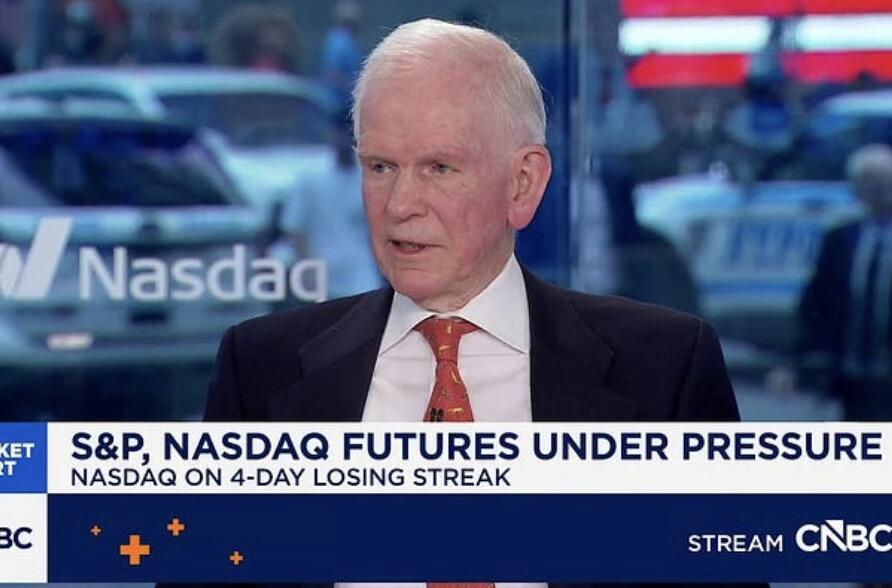
Last week, CNBC’s Andrew Ross Sorkin and Joe Kernen interviewed legendary value investor Jeremy Grantham, and for about six minutes the conversation turned into one of the better moments I’ve seen on financial television in a long time.
Grantham, the 86-year-old co-founder of GMO, whose case for the market being overvalued I highlighted last week, built one of the world’s most respected institutional asset management firms. Over the course of his career, he became famous for identifying some of the largest financial bubbles in modern history, including the Japanese asset bubble of the late 1980s, the dot com boom, and the housing bubble that culminated in the 2008 financial crisis.
During the interview, Grantham reiterated his long-held skepticism of Bitcoin, calling it “a useless speculative” asset that will eventually “dwindle away... not with a bang, but a whimper.”
Kernen wasn’t having it. He fired back that anyone who had listened to Grantham over the last decade had missed one of the greatest-performing assets in history, later broadening the criticism to Grantham’s generally bearish market outlook over the last fifteen years. The clip immediately spread across social media, where half the internet accused Kernen of bullying one of Wall Street’s most respected investors, while the other half applauded him for holding a famous skeptic accountable.
After watching it a couple of times, I think both sides were right.
Let’s start with Kernen. If you come on CNBC and tell viewers Bitcoin is eventually going to zero, it’s sadly probably only one of the times on the network you should expect to get challenged. It’s the opposite of the consensus view on a network that does nothing but offer pie-in-the-sky forecasts for crypto and usher in crypto-friendly guests all day. For specific examples, see this compilation of Tom Lee price targets.
I wish more financial interviews included challenging the guest. I wrote about this last week at length. The only problem is the real challenges…the dickish sounding ones like Kernen’s, only seem to be lobbed at skeptics or bears. As I’ve said, financial media desperately needs accountability. If you’ve been bullish for fifteen years, defend it. If you’ve been bearish for fifteen years, defend it. If you’re a CEO who has repeatedly missed guidance or has been accused of serious misdeeds, defend it.
If you’re a Wall Street strategist who has spent years chasing momentum and changing price targets after the fact, defend it. Nobody should get a free pass.
Kernen’s argument on Bitcoin was straightforward. I mean, I think arguing “past performance is indicative of future results” is a bit of a fool’s errand, but at least Kernen made his points clear: namely, you’ve been wrong so far.
Regardless of whether you think Bitcoin has intrinsic value, it has created extraordinary wealth for many.
It has gone from essentially nothing to becoming an institutional asset held through ETFs, corporate treasuries, family offices and investment funds. Millions of people who ignored critics like Grantham became substantially wealthier for doing so. That’s a perfectly fair point.
Kernen then expanded the discussion beyond Bitcoin and questioned Grantham’s broader market record, arguing that investors who had followed his cautious stance since roughly 2010 would have dramatically underperformed one of the strongest bull markets in history. Kernen even asked whether Grantham had ever become bullish during that period, suggesting he’d spent most of the last decade warning about valuations while the S&P 500 kept marching higher.
Again, that’s a legitimate question. Grantham’s response is where I think the discussion became much more interesting. He pushed back on the idea that he’d simply been a permanent bear, noting that he’d written extensively about the possibility of a speculative “melt-up” late in the cycle. In other words, he wasn’t arguing markets couldn’t continue rising. He was arguing they were becoming increasingly overvalued even as they did. Those are two different statements.
Saying an asset is overpriced isn’t the same thing as saying it has to collapse tomorrow. That’s a distinction people constantly miss. I’ve dealt with the same thing myself. And it’s why I’m constantly trying to determine whether being overvalued in the age of quantitative easing means anything anymore.
I’ve been called a “permabear,” even though anyone who actually reads this blog knows I’m constantly looking for opportunities. My annual list of stocks to watch is almost all long-only. I write tons of long-only ideas here. In fact, my 26 Stocks to Watch for 2026, measured on an average, equal-weighted basis, is now estimated to be up +26.1% year-to-date, beating the S&P 500 by roughly +18.7% so far in 2026. Last year, my 25 Stocks To Watch For 2025 torched the S&P by more than +50%.
What’s permanently bearish about getting long winners that outperform the index? Just because I’m not guzzling down the batshit insane valuations, backwards logic and nefarious loopholes that have been fueling most of this market rise higher? Because I point out risks in crypto and equities that nobody else appears to be talking about?
In March of 2020, when the entire world was panicking about the Covid crash that I had warned about months prior, I appeared on the SNN Network to talk about why I liked financial stocks and airlines. What’s permanently bearish about being a sole voice saying Covid was not a systemic financial problem and looking at Goldman Sachs at $150 when its now at $1,000?
The point applies to Grantham: Being skeptical of broad market valuations doesn’t mean you’re incapable of making money. As best I can tell, over the last two decades, Grantham’s investing approach has modestly underperformed simply buying and holding the S&P 500, but it hasn’t been the catastrophic miss that many of his critics suggest.
His firm’s flagship allocation strategy has delivered respectable long-term returns while deliberately sacrificing some upside during one of the strongest U.S. equity bull markets in history. Grantham would also argue that judging his record solely by annualized returns misses the point. Part of his philosophy appears to be centered on avoiding permanent capital impairment and the psychological toll of major drawdowns.
Investors who lived through the dot-com crash or the financial crisis know that recovering from a 50% loss isn’t just a math problem, it’s years of waiting simply to get back to even. Grantham’s case has never been that he’ll win every bull market, but that preserving capital during the inevitable busts leaves investors in a stronger position when the cycle eventually turns.
But I see Kernen’s point, too. As I’ve written countless times, our responsibility isn’t to sit around predicting the precise date the system falls apart. Our responsibility is to understand the system we’re investing in.
That brings me back to what I think was the most important exchange of the interview. Grantham argued that Bitcoin “hasn’t outlived a general bull market.”
🔥 50% OFF FOR LIFE: Using this coupon entitles you to 50% off an annual subscription to Fringe Finance for life: Get 50% off forever
I actually agree with him. Bitcoin has experienced violent corrections, but it has never lived through the kind of prolonged, grinding secular bear market that hasn’t been instantly rescued by the Fed. Most of its existence has coincided with an era defined by quantitative easing, extraordinary liquidity, massive fiscal deficits and repeated central bank intervention.
That’s not a criticism of Bitcoin. It’s simply an observation. We don’t know how it behaves if we enter a multi-year environment where liquidity isn’t constantly expanding and policymakers can’t, or won’t, ride to the rescue. Whether or not this will ever happen again is the multi-trillion dollar question of our era: whether traditional measures of valuation even matter anymore in a world dominated by quantitative easing, passive investing, options-driven flows and central bank intervention.
That’s the real debate. Grantham believes valuations still matter.
They may not matter next quarter or next year, but eventually they matter.
Kernen is essentially asking whether investors have spent fifteen years waiting for history to repeat while the rules of the game have fundamentally changed.
Neither question has been answered and frankly, nobody knows.
That’s why I think people are making too much out of this interview. It wasn’t a scandal. It was a genuine disagreement about one of the biggest questions in investing today: do historical valuation frameworks still work in a world reshaped by central banks and perpetual liquidity, or have markets permanently evolved into something different?
That’s a conversation worth having. The only criticism I’d make of Kernen is that he didn’t always need to make it so dickish and personal sounding. Comparing Grantham to a broken clock and repeatedly talking over him didn’t strengthen the argument. It distracted from it. A CNBC host being a dick to a market skeptic he didn’t agree with is, after all, one of the key reasons I started this blog.
But in general, financial television needs more debates like this, not fewer.
It just needs more of them directed at everyone, not just the bears and skeptics.
Challenge the Bitcoin bulls, too. Challenge the CEOs overseeing controversy. Challenge the strategists. Challenge the analysts who’ve been wrong for years. If accountability is the standard, apply it equally: No Accountability
Let’s see that same energy the next time a CEO comes on after missing guidance for the fourth straight quarter. Or the next strategist who has spent five years telling investors to buy every dip regardless of valuation. Or the next analyst who upgrades a stock after it’s already doubled and quietly disappears when it falls 70%.
--
QTR’s Disclaimer: Please read my full legal disclaimer on my About page here. This post represents my opinions only. In addition, please understand I am an idiot and often get things wrong and lose money. I may own or transact in any names mentioned in this piece at any time without warning. Contributor posts and aggregated posts have been hand selected by me, have not been fact checked and are the opinions of their authors. They are either submitted to QTR by their author, reprinted under a Creative Commons license with my best effort to uphold what the license asks, or with the permission of the author.
This is not a recommendation to buy or sell any stocks or securities, just my opinions. I often lose money on positions I trade/invest in. I may add any name mentioned in this article and sell any name mentioned in this piece at any time, without further warning. None of this is a solicitation to buy or sell securities. I may or may not own names I write about and are watching. Sometimes I’m bullish without owning things, sometimes I’m bearish and do own things. Just assume my positions could be exactly the opposite of what you think they are just in case. If I’m long I could quickly be short and vice versa. I won’t update my positions.
As of May 20, 2026 I personally no longer actively trade (read my story here). My investing/saving is done by recurring contributions mostly to sector ETFs and a few select equities, trusted third parties who oversee my accounts, and advisors. Such advisors or funds, through individual equities, options, index funds, mutual funds, ETFs, or other securities, may have positions in, exposure to, or holdings of names mentioned herein that I know nothing about. Basically, via index funds, ETFs and individual equities it is possible I could own, have exposure to, or not own anything at any point. As of the same date, May 20, 2026, in an attempt to lead a healthier lifestyle, I’ve also excluded myself from fantasy sports, sports betting, online and in-person casinos and prediction markets.
And all positions can change immediately as soon as I publish this, with or without notice and at any point I can be long, short or neutral on any position. You are on your own. Do not make decisions based on my blog. I exist on the fringe. If you see numbers and calculations of any sort, assume they are wrong and double check them. I failed Algebra in 8th grade and topped off my high school math accolades by getting a D- in remedial Calculus my senior year, before becoming an English major in college so I could bullshit my way through things easier.
The publisher does not guarantee the accuracy or completeness of the information provided in this page. These are not the opinions of any of my employers, partners, or associates. I did my best to be honest about my disclosures but can’t guarantee I am right; I write these posts after a couple beers sometimes. I edit after my posts are published because I’m impatient and lazy, so if you see a typo, check back in a half hour. Also, I just straight up get shit wrong a lot. I mention it twice because it’s that important.
Related Markets
All MarketsMarket data may be delayed. Not financial advice.
Powered by Gab AI
The Story At A Glance
Reading this article now — analysis appears below
💡 AI analysis provides alternative perspectives on current events