US-Iran Have Delegations In Qatar, But No Direct Talks; Hormuz Energy Transit Rebounds - Oil Down Near Prewar Levels
The short version
- " "What will probably be done in Doha tomorrow is a discussion on the implementation of clauses of the Memorandum of Understanding…
- "Therefore, I emphasize that we have not planned any meeting with the American side at any level for the next few days," Baghaei added.
- Tehran is expecting that $6 billion of Iranian frozen funds in Qatar will be transferred back by week's end, but Qatar's foreign ministry indicated Tuesday this had yet to happen.
- Up for discussion among mediators currently in Qatar is precisely the fate of Iran's frozen funds , and implementing agreed-upon transfers.
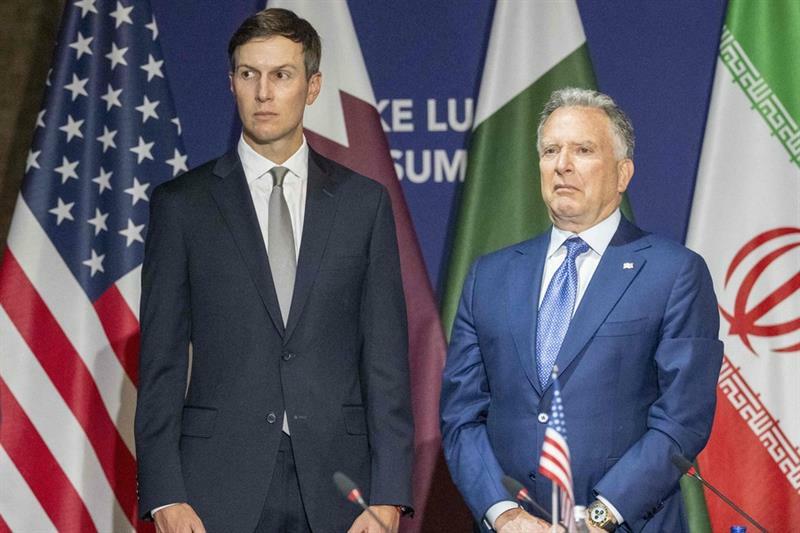
- But according to the latest from Al Jazeera Tuesday : Qatar’s Foreign Ministry spokesman also said that US envoys Jared Kushner and Steve Witkoff are in the country’s capital…
The story
The Witkoff-Kushner delegation is now confirmed to be in Doha, and yet in its latest official statement Iran's foreign ministry has made clear the Iranian side has no plans to meet US officials "at any level in the next few days."
"What will probably be done in Doha tomorrow is a discussion on the implementation of clauses of the Memorandum of Understanding, including the clause related to the release of Iran’s restricted assets with the Qatari parties," spokesman Esmaeil Baghaei says. "Therefore, I emphasize that we have not planned any meeting with the American side at any level for the next few days," Baghaei added.
Tehran is expecting that $6 billion of Iranian frozen funds in Qatar will be transferred back by week's end, but Qatar's foreign ministry indicated Tuesday this had yet to happen. Up for discussion among mediators currently in Qatar is precisely the fate of Iran's frozen funds, and implementing agreed-upon transfers. However, Washington has for days accused Iran's military of violating the ceasefire and its commitments under the MoU - a charge that Tehran has fired back in turn.
On Monday President Trump had claimed that Iran "requested a meeting" following the exchange of strikes last week, but no such meeting appears to be materializing - at least not a direct one in Doha. But according to the latest from Al Jazeera Tuesday:
Qatar’s Foreign Ministry spokesman also said that US envoys Jared Kushner and Steve Witkoff are in the country’s capital, Doha, despite having no meetings with Iranian officials scheduled.
Iran remains defiant, insisting that it will not concede anything - especially regards to its control over the Strait of Hormuz, vowing it's ready to return to armed conflict if things can't be resolved at the negotiating table.
Tehran is asserting its 'right' to manage the strait under its own protocol, and while Oman's cooperation has been sought, Iranian officials have said they will proceed with or without Oman's help and that this will include tolls, towards partically funding the reconstruction of Iran.
Part of this entrenched position is Iran wants its frozen assets before peace talks, while the US said is saying it must demonstrate it is worthy first. Fox has cited Baghaei, who "told reports that clauses in Tehran’s interim deal with the U.S. must be implemented before talks on a final agreement can begin."
"Baghaei also said the communication channel between Iran and the U.S. is based on political factions, not military ones," the report said.
Still, despite the apparently unbending positions of the warring sides, oil is responding favorably, as the Trump administration no doubt wants to be on message going into the July 4th holiday:
Oil prices were on track Tuesday for their steepest quarterly decline since the early days of the COVID-19 pandemic, as investors watched for potential U.S.-Iran talks in Doha amid a strained interim ceasefire in the 4-month-old war.
U.S. West Texas Intermediate (WTI) was headed for a second monthly decline of roughly 19%, while Brent crude was on pace for a third consecutive monthly drop, down about 20% in June.
Both Brent and WTI have fallen sharply this quarter and are trading near pre-war levels as more ships move out of the Gulf, easing some supply concerns.
Hormuz will not return to its pre-war status. Tehran’s position is that the unlawful US-Israeli war on Iran changed the rules of passage. Safe navigation can no longer be treated as a free service imposed on Iran while its waters, coast, and security infrastructure are…
— Elijah J. Magnier 🇪🇺 (@ejmalrai) June 30, 2026
This is also amid a rebound in shipping traffic to kick off this week, after tit-for-tat weekend attacks:
Shipping traffic through the Strait of Hormuz rebounded Tuesday morning, with eight crossings so far after 40 vessels moved through the critical waterway Monday, according to Kpler data.
The rebound comes after some days of declining traffic following attacks on commercial vessels in the region due to renewed strikes between the U.S. and Iran late last week. Crossings fell from 76 on Wednesday, June 24, to 59 on Thursday, when the Ever Lovely was attacked.
Traffic then dropped to 50 crossings Friday, 39 on Saturday, when the Kiku was attacked, and just 24 on Sunday before recovering to 40 on Monday.
Of Monday’s 40 crossings, 10 vessels used the southern Omani route, which the U.S. Navy is helping coordinate. Thirty-two of the 40 vessels were large tankers and bulk carriers.
In fresh comments on the status of energy transit in the Strait of Hormuz, Treasury Secretary Scott Bessent has said in a fresh media interview reported in Bloomberg that only China has bought Iranian oil since the US lifted sanctions.
Strong signaling out of Israeli defense establishment, following Monday remarks by Katz...
'Israel is preparing for the immediate resumption of military operations against Iran.'
— i24NEWS English (@i24NEWS_EN) June 30, 2026
Senior Middle East Correspondent @ariel_oseran joins @benitalevin on #TheRundown pic.twitter.com/8c7YfNgaMP
"Iranians thus far have not been able to sell their oil, because the buyers are a little weary of, will it be resanctioned?" Bessent posed on Fox, noting that it's still trading at a discount to China.
Related Markets
All MarketsMarket data may be delayed. Not financial advice.
Powered by Gab AI
The Story At A Glance
Reading this article now — analysis appears below
💡 AI analysis provides alternative perspectives on current events