AI Hallucinations Are Exploding In U.S. Courts, New Study Finds
The short version
- Courts, New Study Finds A new analysis from Laine AI suggests that AI-related errors in U.S. court filings are no longer isolated incidents but a rapidly expanding trend.
- According to the report, documented AI-related filing errors climbed from just 25 cases in early 2025 to 249 by the fourth quarter of that year, with the pace continuing into 2026.
- First-quarter 2026 data nearly matched the entire final quarter of 2025 despite covering only part of the year, underscoring how quickly the problem is accelerating.
- Geographically, a relatively small number of states account for a disproportionate share of the incidents.
- California leads the nation with 97 recorded cases, followed by New York, Texas, Florida, and Illinois.
The story
A new analysis from Laine AI suggests that AI-related errors in U.S. court filings are no longer isolated incidents but a rapidly expanding trend. Drawing on hundreds of confirmed cases, the study finds that courts are seeing a growing number of filings containing fabricated citations, inaccurate legal authorities, and other AI-generated mistakes as lawyers and self-represented litigants increasingly incorporate generative AI into their work.
The increase has been dramatic. According to the report, documented AI-related filing errors climbed from just 25 cases in early 2025 to 249 by the fourth quarter of that year, with the pace continuing into 2026. First-quarter 2026 data nearly matched the entire final quarter of 2025 despite covering only part of the year, underscoring how quickly the problem is accelerating.
Geographically, a relatively small number of states account for a disproportionate share of the incidents. California leads the nation with 97 recorded cases, followed by New York, Texas, Florida, and Illinois. Together, those five states represent roughly 40% of all documented AI-related legal filing errors, suggesting that jurisdictions with higher AI adoption are also experiencing more frequent courtroom mistakes.
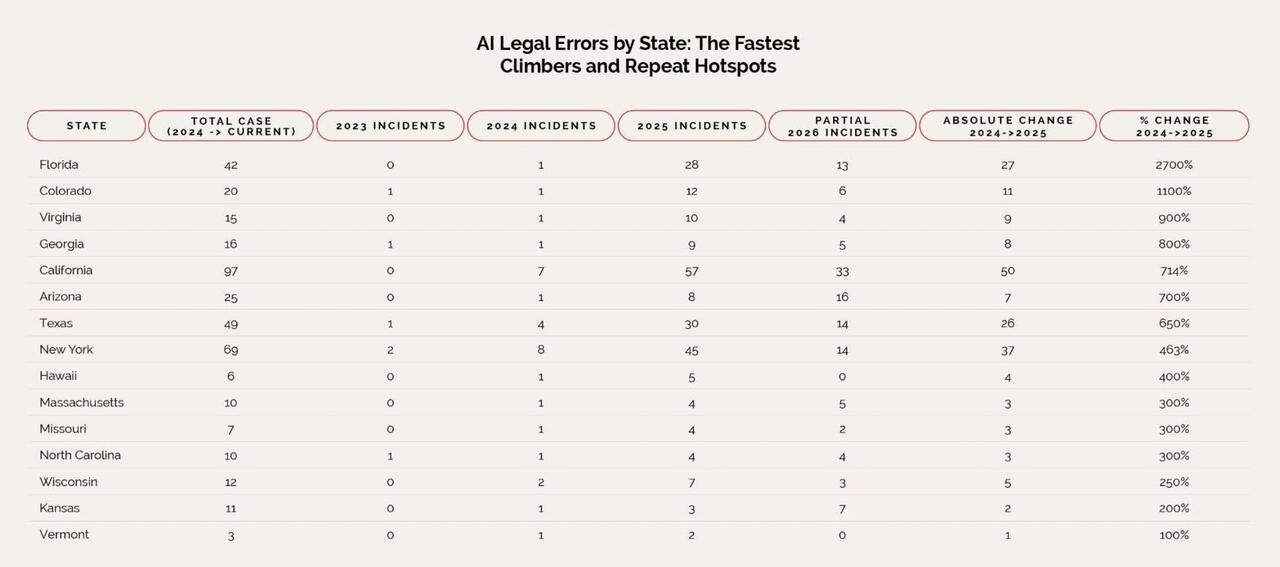
The study also identifies several fast-growing hotspots. Florida experienced one of the sharpest increases, jumping from just one recorded incident in 2024 to 28 during 2025. Meanwhile, states including Washington, Pennsylvania, New Jersey, Nevada, Indiana, Oregon, Oklahoma, Minnesota, Mississippi, and Illinois all began reporting meaningful numbers of AI-related filing errors after previously recording none, indicating that the issue is spreading well beyond a handful of early adopters.
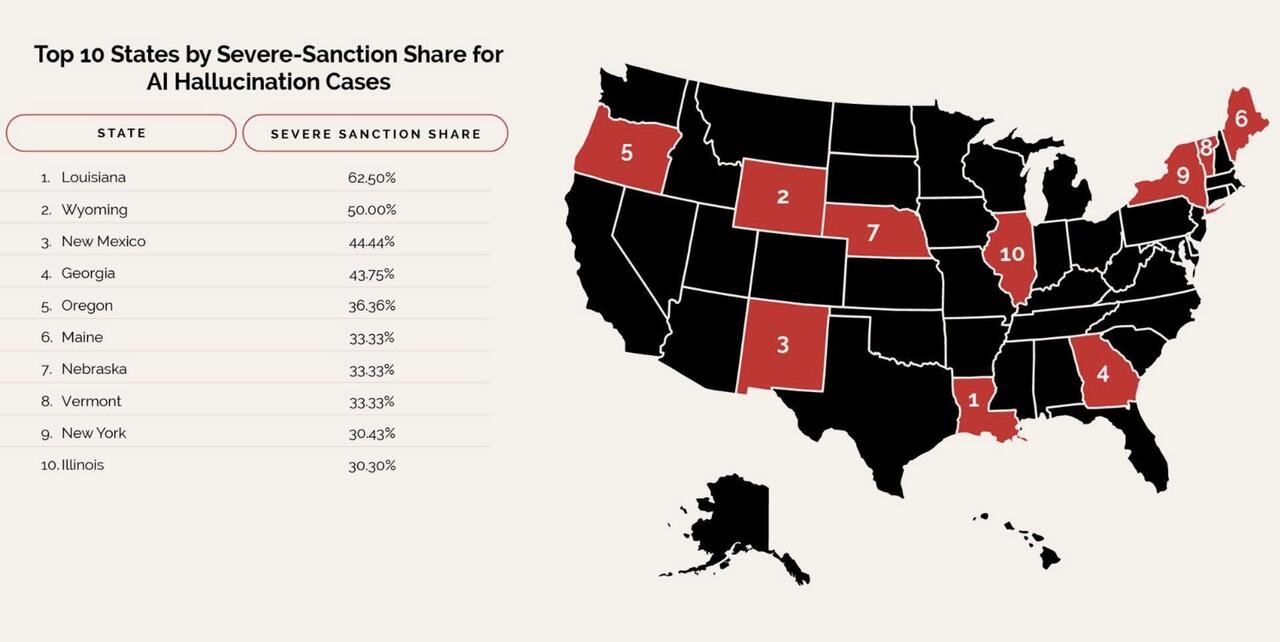
Courts have responded with a wide range of sanctions. California has imposed more than $256,000 in monetary penalties tied to AI-related filing errors, accounting for roughly one-third of all fines identified in the study. However, the likelihood of receiving severe sanctions varies considerably by jurisdiction. Louisiana, Wyoming, New Mexico, and Georgia imposed serious penalties in a much larger percentage of cases than states with higher overall incident counts, highlighting significant differences in judicial approaches.
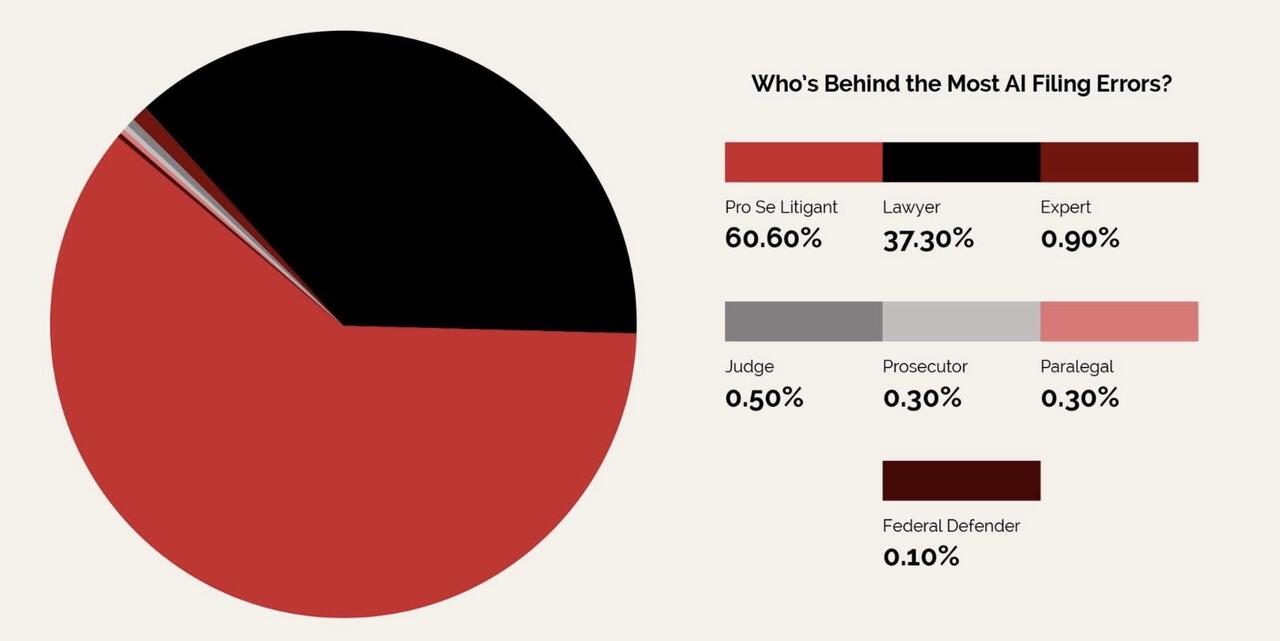
Perhaps the study's most notable finding is that most AI-related filing mistakes do not originate with attorneys. More than 60% of the documented incidents involved pro se litigants representing themselves, while lawyers accounted for roughly 37% of the cases. The authors suggest that individuals without formal legal training may be relying more heavily on AI tools without adequate review, increasing the likelihood of errors reaching the courtroom.
When AI tools were identified, ChatGPT was the most frequently named platform, though the overwhelming majority of filings either failed to specify which AI system had been used or only implied AI assistance. ChatGPT appeared in 48 documented cases, while tools such as Microsoft Copilot, Claude, Google Gemini, Perplexity, Lexis AI, and Westlaw's AI products were mentioned only occasionally. Because nearly 90% of filings did not clearly identify the software involved, the report notes that assigning responsibility to any particular platform remains difficult.
The most common errors involved outright fabrication. More than half of all recorded AI-related mistakes consisted of nonexistent cases, citations, or legal authorities presented as genuine. Misrepresenting actual legal precedent accounted for another quarter of incidents, while fabricated quotations from real cases represented roughly one-fifth. California, New York, and Texas consistently ranked among the states with the highest numbers across each category.
The report also found that over 80% of AI-related hallucinations occurred in case-law citations rather than statutes, regulations, or supporting exhibits. Because legal arguments often depend on accurately citing precedent, fabricated or inaccurate case law can undermine the credibility of an entire filing and expose litigants to sanctions. The authors conclude that AI can remain a valuable legal research tool, but only if every citation, quotation, and legal authority is independently verified before being submitted to a court.
Related Markets
All MarketsMarket data may be delayed. Not financial advice.
Powered by Gab AI
The Story At A Glance
Reading this article now — analysis appears below
💡 AI analysis provides alternative perspectives on current events