Iran Runs Into Big Problem: No Buyers For Its Oil, As Full Tankers Pile Up Off China
The short version
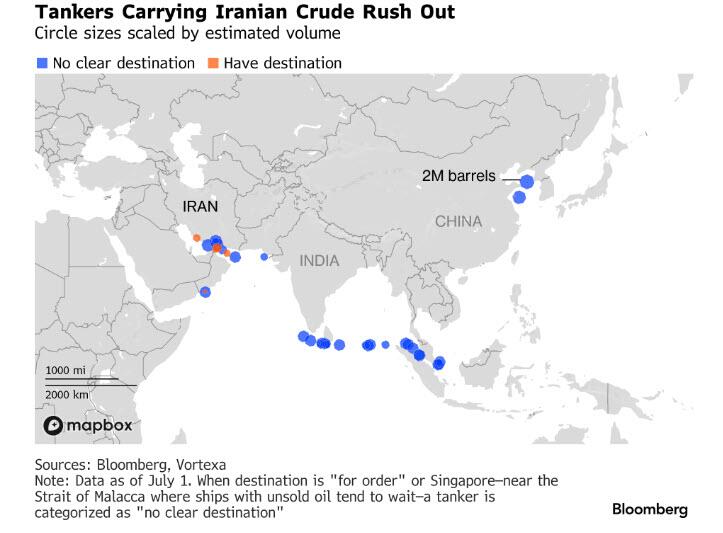
- The vessels are either indicating "for orders" or Singapore as their next port of call, a sign they may conduct ship-to-ship transfers in the Malacca Strait.
- A failure to quickly sell the crude will not only deprive Tehran of much-needed revenue, but more importantly, will weaken its hand in the ongoing negotiations with Washington.
- The Islamic Republic has until mid-August to find buyers after the US lifted sanctions on the oil in the middle of June and ended a blockade of Iranian ports…
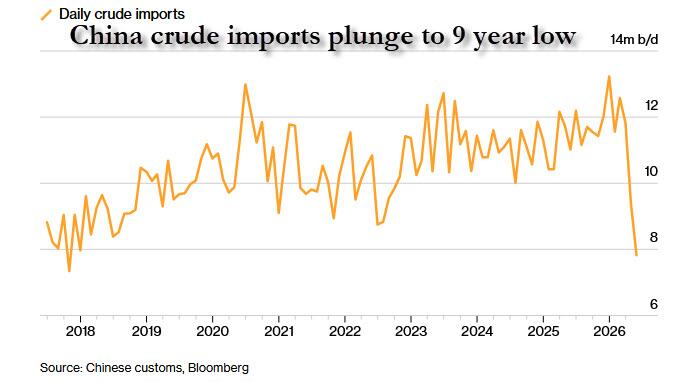
- And here is the culprit : demand from Chinese independent refiners - Iran's main customers prior to the conflict - has been muted as the sector's run rates crash to a nine-year…
- China's state-owned refiners have also stayed on the sidelines, citing concerns over the ability of banks to finance any deals.
The story
Iran was euphoric when as part of the Trump MOU, it got permission to flood the world with its oil after Trump effectively eliminate sanctions that had been in place for 40 years. However, it has quickly run into another, potentially far bigger problem: as the armada of Iranian oil tankers exits the Persian Gulf, it is now struggling to find buyers before the expiry of a 60-day window granted by Washington,
According to Vortexa data and Bloomberg calculations, there are more than 58 million barrels of Iranian crude and condensate was on-the-water as of July 1, yet more than 90% has no clear destination. The vessels are either indicating "for orders" or Singapore as their next port of call, a sign they may conduct ship-to-ship transfers in the Malacca Strait.
A failure to quickly sell the crude will not only deprive Tehran of much-needed revenue, but more importantly, will weaken its hand in the ongoing negotiations with Washington. The Islamic Republic has until mid-August to find buyers after the US lifted sanctions on the oil in the middle of June and ended a blockade of Iranian ports, part of an interim peace deal.
And here is the culprit : demand from Chinese independent refiners - Iran's main customers prior to the conflict - has been muted as the sector's run rates crash to a nine-year low. China's state-owned refiners have also stayed on the sidelines, citing concerns over the ability of banks to finance any deals.
Translation: as we suspected a month ago, China's economy is in far worse shape than telegraphed, and as a result it does not need Iranian oil (what oil it does need it just sources from its massive strategic reserves).
In Early June we said that confirming our recent reporting on China's oil demand collapse, crude oil imports to China in May fell to their lowest since October 2017 because of the price spike resulting from the Persian Gulf tanker traffic disruption, plunging refinery margins (due to price ceilings imposed by Beijing), of a slowing economy and the rapid slowdown in the economy.
The May total stood at 33 million barrels, or 7.8 million barrels daily, Bloomberg reported, citing Chinese customs data. This is roughly a 30% drop vs the average daily import rate of 11.6 million barrels last year. As previously noted, refinery run rates are down as well, as are fuel exports, with Beijing careful to make sure there is enough diesel and gasoline for the domestic market. All this is happening as the latest batch of Chinese data was "shockingly bad", promptly fears of a China hard landing.
Most of Iran's oil is in and around the Persian Gulf, in the Indian Ocean or the Malacca Strait near Singapore. However, with Indian imports largely coming from Russia, that only leaves China as the biggest export target. Alas, suddenly China does not want Indian oil, not because it disapproves of the Iranian regime, but simply because its economic slowdown means far less oil is needed!
Iran said on Wednesday that it had shipped more than 40 million barrels of oil since the US lifted its naval blockade to signal strength. However, half of this shipment, or more than 20 million barrels of Iranian crude, has been idling in Asian waters for seven days or longer, up almost 18% from a week earlier, according to Kpler Ltd. The reason is the same: China does not need the oil.
Estimates for the overall volume of the country’s oil on water - either in transit or stationary - have ranged from 58 million to 68 million barrels since the US sanctions waiver kicked in last week.
A week ago, Bloomberg reported that sellers including middlemen and representatives from the National Iranian Oil Co. made contact with refiners in India, Japan, South Korea and elsewhere even before the license was officially granted, traders involved in the discussions told Bloomberg. That urgency has since increased, they said, however so far there is little favorable response.
Tehran faces a number of obstacles in trying to sell the oil. European Union and UK restrictions are still in place, complicating insurance, while some ports may be hesitant to accept the dark-fleet vessels that Tehran uses to carry its crude. There's also a chance the barrels could get stranded mid-deal if President Donald Trump decided to end the window early.
Buyers remain wary that Washington could reimpose sanctions if negotiations collapse, US Treasury Secretary Scott Bessent told Fox News on Tuesday. "No one other than China, who was already buying it when it was sanctioned, has bought it, so it's still trading at a discount."
The other major barrier to Iran offloading the crude is a lack of demand in major Asian markets, where there's been little interest despite Tehran's efforts to court buyers. As we have extensively reported, the region is well-supplied, both with non-Iranian Persian Gulf oil that can now transit the Strait of Hormuz and crude from farther afield that was bought during the war.
China's imports of Iranian crude - which have never been subject to US sanctions as Beijing simply ignores them - more than halved in June to about 654,000 barrels a day from a month earlier, according to Kpler. Still, at least one tanker has discharged a cargo of the oil in China over the past week, according to Kpler and Vortexa.
Iran oil exports; China oil imports pic.twitter.com/Z5V6vt0QT4
— zerohedge (@zerohedge) June 5, 2026
Indian Oil Minister Hardeep Puri met his Iranian counterpart in New Delhi last week, but stopped short of committing to imports. The country's state-run processors are avoiding the Iranian oil for now, because they've already secured Russian crude supplies through at least the end of August. They are also still seeking clarity from Washington over US-denominated payments, they added.
India would consider resuming purchases once payment channels are clarified, while a complete withdrawal of sanctions could enable refiners to buy from Iran over the longer term, the people said.
Still, Asian interest in Iranian oil could quickly emerge if the price is right. Refiners that have already secured crude supplies can resell some oil to free up some space, should the shipments be highly discounted, and there's also the option of raising operating rates if raw material costs are cheap.
Related Markets
All MarketsMarket data may be delayed. Not financial advice.
How this story developed
Full timelineAlto has tracked this across 7 days of coverage from 1 outlet.
Powered by Gab AI
The Story At A Glance
Reading this article now — analysis appears below
💡 AI analysis provides alternative perspectives on current events