Russia Struggles To Deliver Crude Oil As It Hits 135 Million Barrel Traffic Jam
Russia is struggling to deliver all of the crude it’s being forced to ship overseas in the face of escalating Ukrainian drone strikes on its refineries.
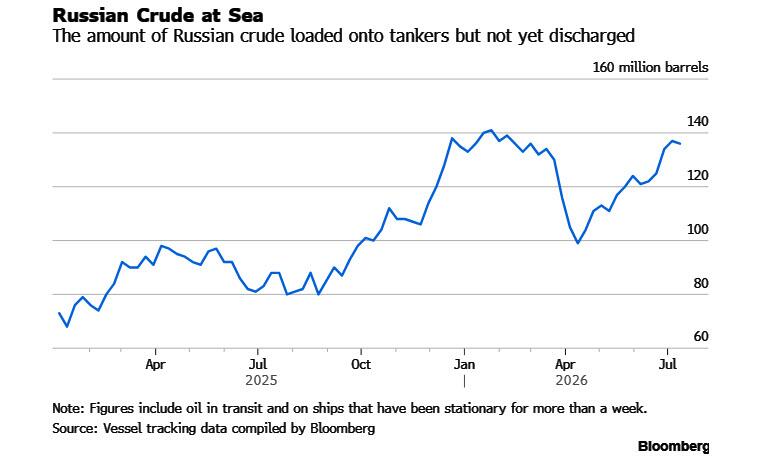
Nearly 135 million barrels of Russian crude oil are currently stranded at sea as a result of Ukraine’s airstrike campaign targeting refineries with the intent to cripple crude processing. The offshore backlog is forcing Moscow to significantly ramp up export volumes according to OilPrice.com.
Intensive Ukrainian drone strikes, including recent hits on the Gazprom Neftekhim Salavat and Afipsky processing facilities, have knocked out roughly one-third of Russian domestic refining capacity bringing it to ~3.91 million barrels per day, the lowest level seen since 2005.
As a result, Moscow is now being forced to divert more barrels to international markets despite the country pumping just 8.93 million barrels a day in June--roughly 830,000 b/d below its OPEC+ quota.
However, major export hubs are experiencing massive gridlock with limited buyers of sanctioned Russian crude, with Sokol and Sakhalin Blend cargoes facing week-long delays transferring from shuttle tankers to ocean-going vessels, while ESPO crude is piling up near the Kozmino terminal.
Russia’s shadow fleet tankers are now accumulating near Egypt’s Mediterranean coast and Indonesia’s Riau Islands. Many are masking destinations or sitting idle because international buyers increasingly refuse to touch sanctioned cargo due to secondary penalties.
Russia's oil revenues are shrinking despite high export volumes due to a combination of lower global crude prices, widening discounts for Russian Urals and delivery delays.
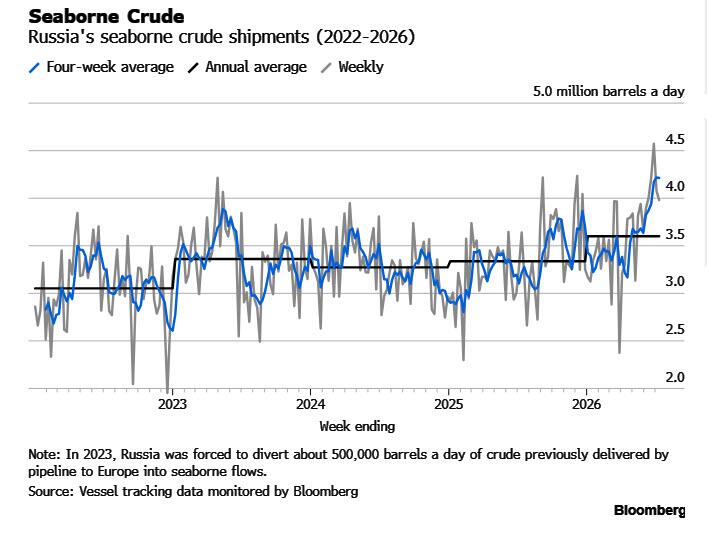
Russia’s seaborne crude exports averaged 4.13 million barrels per day during the four weeks through June 28, the highest four-week rate since early 2022.
However, Russia’s four-week crude export revenues fell by about $200 million to $1.68 billion a week as Urals prices retreated sharply from their Iran-war highs. China and India accounted for roughly 1.8 million barrels per day of identified purchases, while Turkey and Syria imported about 160,000 bpd and 40,000 bpd, respectively, according to Bloomberg data. Another 1.9 million bpd was listed as “unknown destination” in Bloomberg’s tanker-tracking data, suggesting the final buyers were not disclosed while the cargoes remained in transit.
Related Markets
All MarketsMarket data may be delayed. Not financial advice.
💡 AI analysis provides alternative perspectives on current events