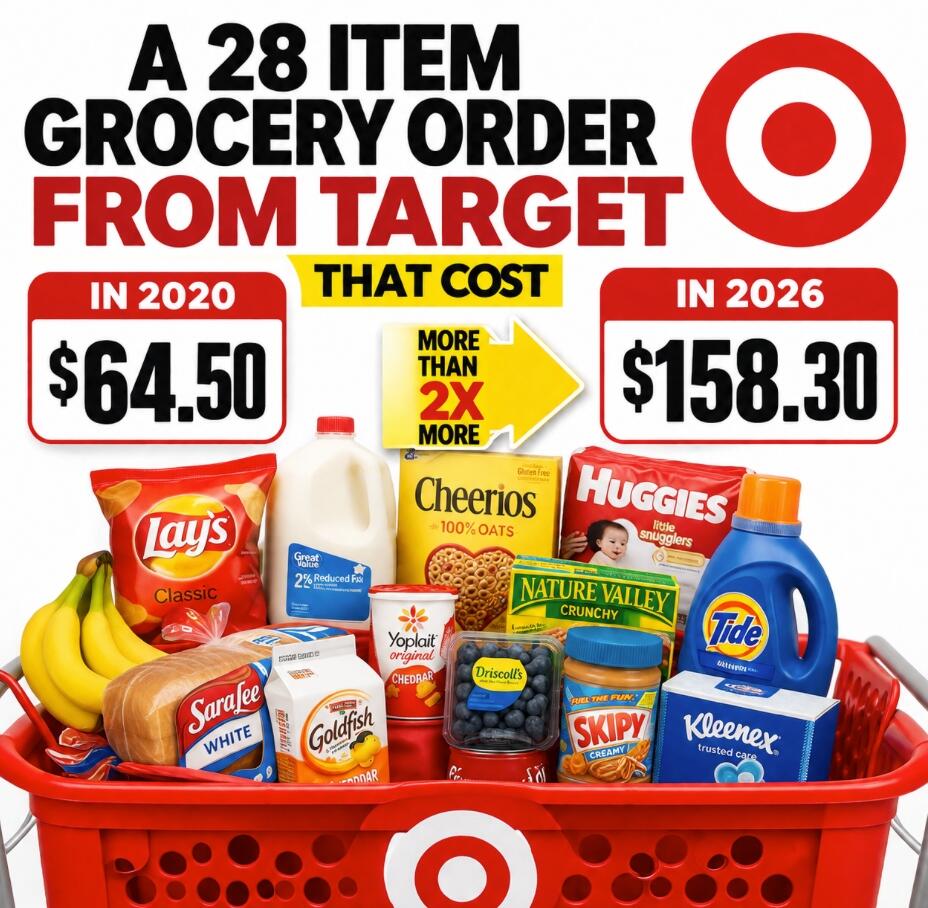
A 28 Item Grocery Order From Target That Cost $64.50 In 2020 Now Costs $158.30
The short version
- For years, the bureaucrats in Washington have been feeding us numbers that show that the rate of inflation is low…
- Many of the items that I regularly purchase at the grocery store have more than doubled in price over the past decade.
- When I get to the register to check out, I feel like asking the cashier which organ I should donate to pay for my groceries.
- We have reached a stage where grocery prices are causing extreme financial stress for families all over America.
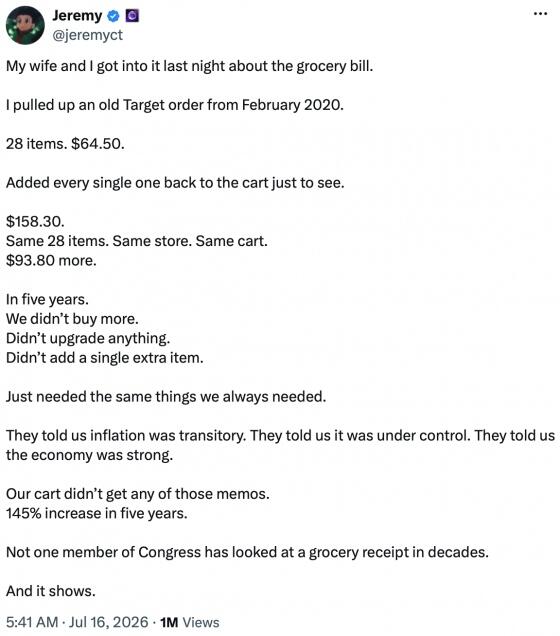
- One man recently caused quite a stir on social media when he revealed that a grocery order from Target that cost $64.50 in 2020 is now $158.30 in 2026 … This post has already been…
The story
Authored by Michael Snyder via The Economic Collapse blog,
The cost of living has become absolutely suffocating for millions of Americans. For years, the bureaucrats in Washington have been feeding us numbers that show that the rate of inflation is low, but it is obvious to everyone that what they are telling us is simply not true. Many of the items that I regularly purchase at the grocery store have more than doubled in price over the past decade. Some have more than tripled in price. When I get to the register to check out, I feel like asking the cashier which organ I should donate to pay for my groceries.
We have reached a stage where grocery prices are causing extreme financial stress for families all over America. One man recently caused quite a stir on social media when he revealed that a grocery order from Target that cost $64.50 in 2020 is now $158.30 in 2026…
This post has already been viewed a million times.
The reason why it is so popular is because it instantly resonates with people.
Everyone knows that grocery prices have risen to absurd levels, and yet the statisticians in Washington keep assuring us that everything is fine.
I don’t believe them.
Do you?
The Washington Post just conducted a poll that found that 66 percent of Americans consider the cost of groceries to be unaffordable.
That figure has risen by 21 percent just since February…
Americans are feeling worse about the price of groceries than they were before the war with Iran began, a Washington Post-Ipsos poll finds.
About two-thirds, or 66 percent, of Americans say they would describe the cost of groceries as unaffordable, up sharply from the 45 percent who said the same thing in February before the conflict started.
Partisanship continues to play a big role in perceptions, with half of Republicans saying groceries are affordable in the latest poll, compared with about one-quarter of independents and Democrats.
Housing is even worse.
The median price of an existing home in the United States has now surpassed the $440,000 mark…
With a landmark housing affordability bill in political limbo, U.S. home prices have hit an all-time high.
The median price of existing homes in June was $440,660, up 1.8% from $432,700 a year ago, according to new data from the National Association of Realtors (NAR). Home prices have risen for 36 straight months.
“Housing affordability remains low under slowing wage growth and stronger home price growth,” Ershang Liang, an economist with PNC Economics Research, said in a report.
Who can afford to pay that much for a house?
Rental prices have also gone through the roof.
If you can believe it, the average rent on a one bedroom apartment in Manhattan is now a whopping $5,408 a month…
The city’s housing crisis has hit “DefCon 1” — with average rents for a one-bedroom in Manhattan hitting an all-time high of nearly $5,500 last month, and Brooklyn following suit, according to new data and critics.
“We need bold action. This is a crisis,’’ New York City Comptroller Mark Levine posted on X over the weekend, along with a link to the latest figures from the inhabit blog by real-estate giant Corcoran Group.
The dismal June stats reveal that renters paid an average of $5,408 for a one-bedroom in Manhattan, with studio prices not far behind at $4,014.
It isn’t a mystery why most Americans are struggling in this sort of an environment.
Many are turning to debt in a desperate attempt to make ends meet…
Many American families are struggling to make ends meet on their incomes alone and have resorted to credit cards, payday loans, and Buy Now Pay Later (BNPL) options for groceries, according to nonprofit research center Urban Institute.
The findings are based on a survey of 18-to 64-year-old working-age adults conducted in December 2025. About 8.7 percent of adults said they used a credit card for groceries and were unable to make the minimum payment, up from 7.1 percent in 2023, the Urban Institute said in a July 13 report. This suggests “worsening financial distress” among families.
Almost one in 10 used BNPL to pay for groceries, out of which more than a third missed a timely repayment last year.
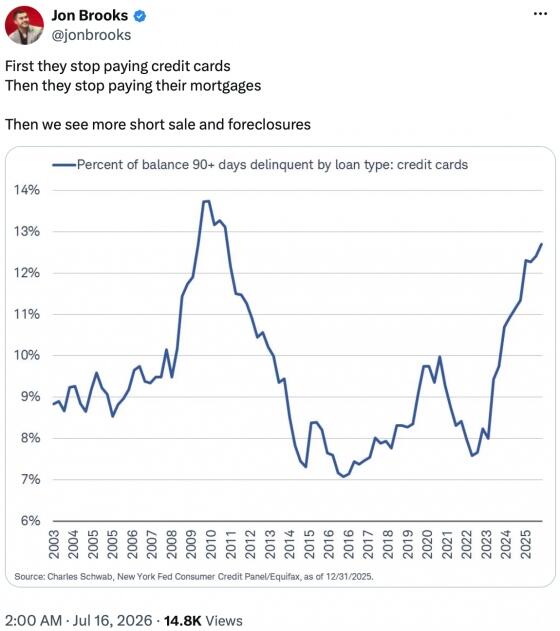
Unfortunately, when you keep piling up debt a day of reckoning eventually arrives.
Coming into this year, alarmingly large numbers of Americans were getting behind on their credit cards…
And the number of foreclosures in the U.S. is way above the highly elevated pace that we witnessed last year…
Foreclosures across the U.S. ballooned in the first half of the year, a sign of the increasing financial strain facing the nation’s homeowners.
Foreclosure filings reached nearly 228,000 from January to June, up 21% from a year ago and 28% from two years ago, according to data released Thursday from real estate data company ATTOM.
Rising foreclosure rates indicate that more homeowners are in financial distress, Rob Barber, CEO of ATTOM, said in a statement. Homes go into foreclosure when the owner falls behind on mortgage payments, often due to extenuating life circumstances such as a job loss. ATTOM defines foreclosures as default notices, scheduled auctions or bank repossessions.
This reminds me so much of the conditions that we experienced just before the financial crisis of 2008.
Unfortunately, the cost of living is only going to go higher.
The cost of energy directly affects the cost of everything else, and it appears that the Strait of Hormuz is going to be closed for an extended period of time.
The average price of a gallon of gasoline in the U.S. has nearly reached four dollars again, and the average price of a gallon of diesel has already risen above the five dollar mark…
US gas prices have rocketed higher during the on-again, off-again war with Iran.
After a brief respite, the average price for gas has surged 15 cents in a week to $3.94 a gallon and appears headed north of $4 again. Diesel, which shows up in customers’ shipping costs, topped $5 a gallon again Thursday for the first time in 3 weeks, according to AAA.
It serves as a painful reminder of how the military conflict in the Persian Gulf has a direct effect on your wallet.
Of even greater importance is what the closure of the Strait of Hormuz means for the global fertilizer market.
As Mike Adams has pointed out, without sufficient quantities of nitrogen fertilizer we won’t even come close to producing enough food for everyone…
Admittedly, I have failed to explain the stakes clearly enough. For months, I have written about fertilizer supply chains, the Haber-Bosch process, and the vulnerability of the Strait of Hormuz. But the gravity of this crisis has not sunk in for most people. Let me put it as plainly as I can: The global population of more than 8 billion people depends on a fragile web of natural gas, oil, and downstream chemistry that took 60+ years to build on this planet. If we lose 25 percent of these critical substances, we lose 25 percent of the population. That is 2 billion people. Here is why that math is inescapable.
As I documented in my article “The Haber-Bosch House of Cards,” the single chemical reaction that fixes nitrogen from the air into fertilizer is responsible for feeding roughly half of humanity [1]. That process requires vast quantities of natural gas. The Persian Gulf region, especially Qatar and Iran, supplies much of that gas. When the Trump administration launched its war on Iran in February 2026 and the Strait of Hormuz was effectively closed, the global fertilizer supply chain began to collapse. This is not a prediction of future famine. The famine is already baked in. But it could still get a whole lot worse depending on how things go from here.
We could be facing multiple years when global food production is at depressed levels.
That means that food prices will go even higher in wealthy countries, and in poor countries there will be shortages.
Famine is one of the major trends that I am tracking, and what we are already witnessing in some parts of Africa is absolutely heartbreaking.
There is no magic button that we can press that is going to make these problems go away.
A crisis of historic proportions is now upon us, and we are still only in the very early stages of it.
Michael’s new book entitled “10 Prophetic Events That Are Coming Next” is available in paperback and for the Kindle on Amazon.com, and you can subscribe to his Substack newsletter at michaeltsnyder.substack.com.
Related Markets
All MarketsMarket data may be delayed. Not financial advice.
How other outlets covered this
Compare allAlto found this story at 2 outlets. Same event, different framing — compare the headlines.
How this story developed
Full timelineAlto has tracked this across 7 days of coverage from 2 outlets.
- A 28 Item Grocery Order From Target That Cost $64.50 In 2020 Now Costs $158.30You are here
Powered by Gab AI
The Story At A Glance
Reading this article now — analysis appears below
💡 AI analysis provides alternative perspectives on current events