DARPA's 'ECHO' Project: A Computer System That Declares You A Bio Threat - With No Physical Evidence

Authored by Jon Fleetwood via JonFleetwood.com,
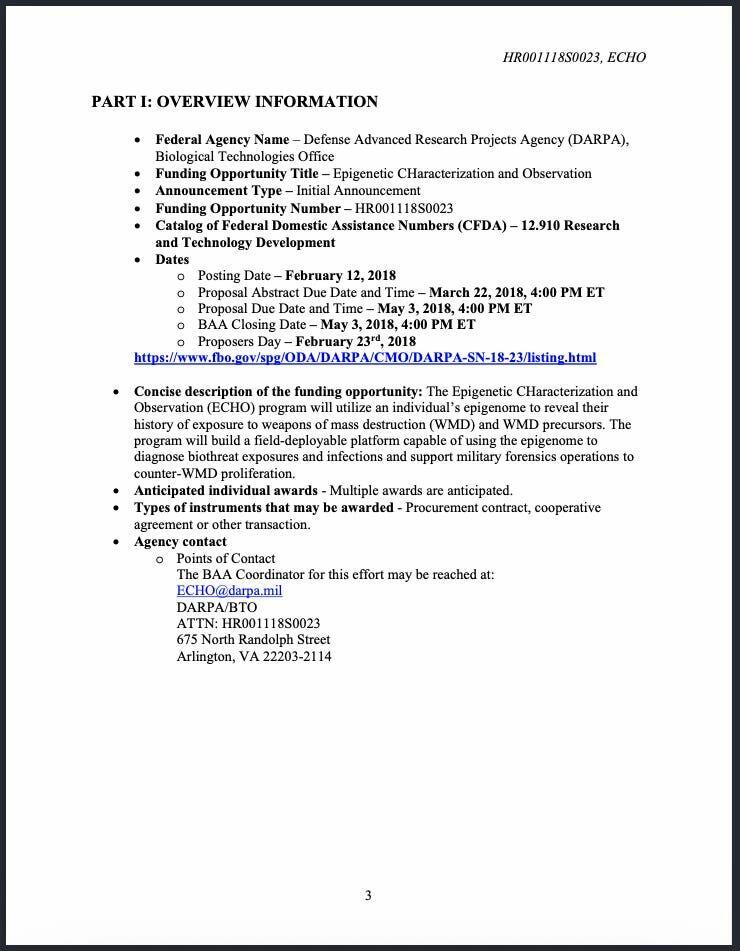
In 2018, the Defense Advanced Research Projects Agency (DARPA) proposed building a portable computer system allegedly capable of determining whether a person had been exposed to biological or chemical threats - including weapons of mass destruction (WMD) and their precursors.
Even with no physical evidence.
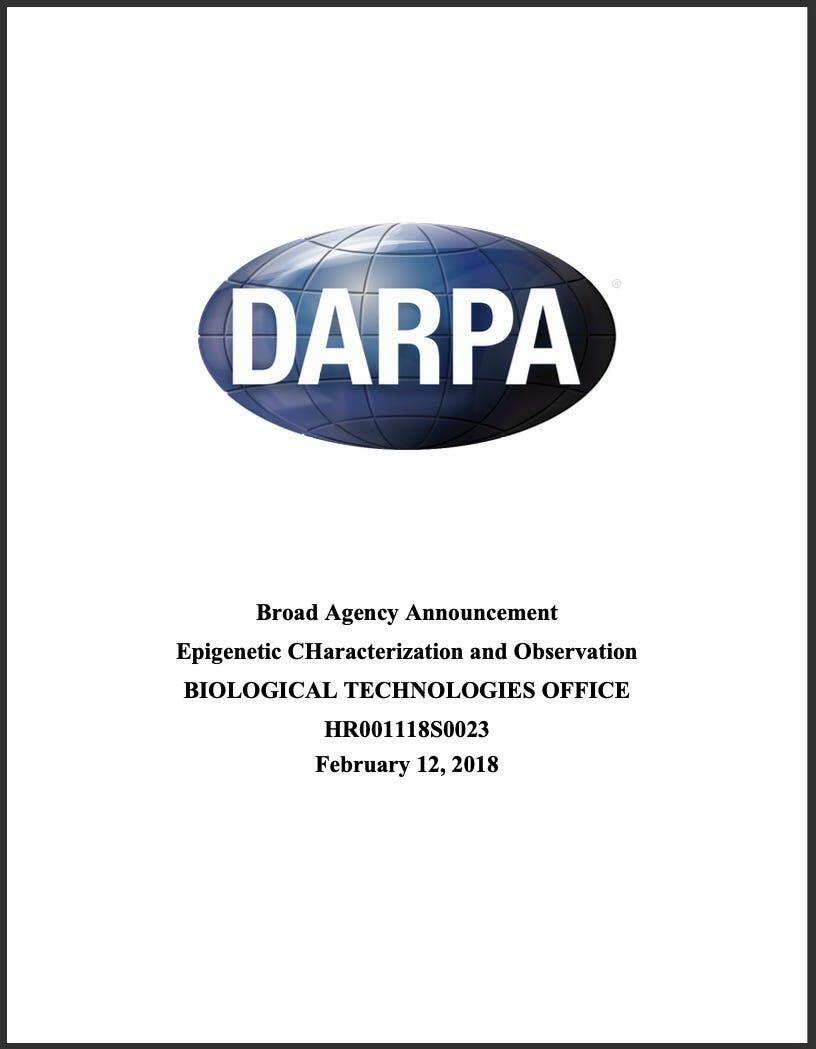
DARPA outlined the proposal in Broad Agency Announcement HR001118S0023 for a program known as ECHO (Epigenetic CHaracterization and Observation).
DARPA proposed accomplishing this by comparing purported changes inside the person's own biology against a government-built reference library and algorithmically identifying both the alleged threat and when the exposure supposedly occurred.
Viewed alongside DARPA's broader pandemic-era research portfolio, the proposal also raises a larger question explored by this publication's In Silico Theory: as governments increasingly replace direct observation with computational models, reference libraries, and algorithmic determinations, where does objective evidence end and computer-generated conclusions begin?
It also raises an immediate practical question.
If an algorithm operating on a government-controlled reference library determines that someone was exposed to a dangerous biological or chemical threat without physical evidence, what meaningful mechanism exists for independently verifying - or successfully challenging - that determination?
SAM.gov search results associated with DARPA solicitation HR001118S0023 identify at least $53.8 million in awards, including a $49.2 million contract awarded to the Icahn School of Medicine at Mount Sinai and a $4.5 million contract awarded to Arizona State University.
The Core Capability
Rather than searching for the biological or chemical agent itself, ECHO proposed "identifying" alleged long-lasting biological signatures left behind after an exposure.
DARPA described the objective:
"utilize an individual's epigenome to reveal their history of exposure to weapons of mass destruction (WMD) and WMD precursors."
The solicitation explains why DARPA believed this was possible:
"the epigenome is persistent and detectable even when physical evidence has been erased."
That sentence is arguably the centerpiece of the entire program.
The proposed system was designed to continue generating exposure determinations long after the original biological or chemical material was no longer available for direct examination.
Epigenetics is the study of purported chemical modifications associated with DNA that researchers say can change in response to biological and environmental influences without altering a person's genetic code.
A Government-Built Exposure Library
To accomplish that objective, DARPA instructed performers to create what it called the ECHO Signature Panel (ESP) - a centralized library containing purported epigenetic signatures associated with specific exposures.
Contractors were required to generate signatures for a minimum of 21 exposure conditions, including mandatory biological threat agents and additional chemical, radiological, explosive, and related materials.
Future unknown samples would then be compared against that growing reference panel.
DARPA explained the process:
"The developed algorithms will need to compare an unknown exposure against the ESP to identify the specific exposure, and when the individual was exposed."
In other words, the proposed system would not simply measure biology.
It would compare an individual's biological patterns against a government-built reference library and output a determination regarding both the nature and timing of an alleged exposure.
The Computer Makes The Determination
The solicitation envisioned an almost completely automated process.
DARPA required:
"no human intervention between the time the sample is introduced and results pertinent to exposure and timing is provided."
Insert the sample.
Run the algorithms.
Receive the determination.
The individual would not be interpreting raw laboratory findings.
The system itself would produce the conclusion.
When The Person Becomes The Evidence
Traditional forensic investigations often rely on recovering the biological or chemical agent itself.
ECHO proposed something different.
According to the solicitation, the system was intended to continue identifying exposure after the physical evidence had been erased by relying instead on computational comparison against stored biological signatures.
That architecture raises an obvious question.
If the original biological or chemical material no longer exists, and the determination instead comes from an algorithm comparing an individual's biology against a government-controlled reference library, how would an ordinary person independently verify - or meaningfully challenge - that conclusion?
Could the system be weaponized or used fraudulently?
The document itself does not answer that question.
Instead, it focuses on improving the speed, automation, and reliability of the computational determination.
DARPA Anticipated Attempts To Defeat The System
One small line buried within the solicitation is especially revealing.
Among the categories requiring special handling, DARPA listed:
"Potential procedure to evade ECHO Signature Panel identification."
The agency was not merely interested in creating exposure signatures.
It was already contemplating how those signatures - and the identification system built around them - might be circumvented.
Bottom Line
Much of the discussion surrounding ECHO focuses on epigenetics.
That risks obscuring what the solicitation actually proposed.
At its core, ECHO described a government-built computational system designed to determine whether an individual had been exposed to specified biological or chemical threats by comparing representations of that person's biology against a centralized signature library - even after the underlying physical evidence was gone.
Whether such a system could perform as intended is a separate scientific question.
The more immediate journalistic question is what follows if such algorithmic determinations are relied upon in military, intelligence, public-health, or legal settings.
When there is no physical evidence and the conclusion rests on a proprietary reference library and algorithmic comparison, what avenues exist for independent verification or meaningful challenge?
What happens to the person after the algorithm determines they've been exposed?
And if those algorithmic determinations are ever used to justify quarantine, criminal investigation, military action, employment decisions, travel restrictions, or other government action, what protections exist for the person the computer has already declared was exposed?
Follow Jon Fleetwood on Instagram and X, and subscribe at JonFleetwood.com. (h/t Modernity.news)
Related Markets
All MarketsMarket data may be delayed. Not financial advice.
💡 AI analysis provides alternative perspectives on current events