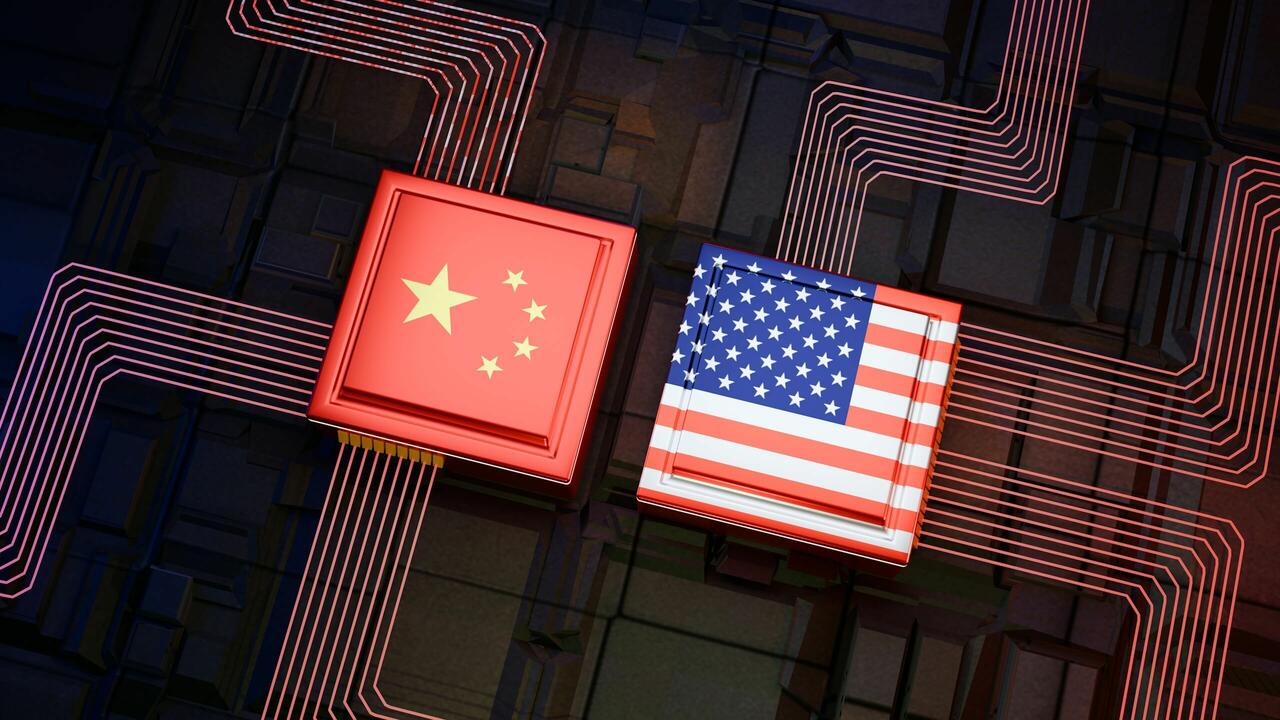
Washington Can't Afford To Let The US Lose The Open-Source AI War

The short version
- Long before it became conventional wisdom in Washington, he recognized that America wasn't simply competing with another trading partner.
- China was executing a long-term strategy to dominate the industries that would define the 21st century.
- From manufacturing and telecommunications to semiconductors and artificial intelligence, Beijing understood that technological leadership translates directly into economic and…
- Artificial intelligence is the next front in that competition, and the United States cannot afford to get it wrong.
- The greatest danger isn't that China builds a better AI model.
The story
Authored by Julio Rivera via American Greatness,
President Trump was right about China.
Long before it became conventional wisdom in Washington, he recognized that America wasn't simply competing with another trading partner. China was executing a long-term strategy to dominate the industries that would define the 21st century. From manufacturing and telecommunications to semiconductors and artificial intelligence, Beijing understood that technological leadership translates directly into economic and geopolitical power.Artificial intelligence is the next front in that competition, and the United States cannot afford to get it wrong. The greatest danger isn't that China builds a better AI model. It's that China builds the AI platform the rest of the world decides to use. Those are two very different contests.
Recent research suggests Beijing has chosen a strategy designed for long-term dominance rather than short-term profits. A June 2026 analysis by FourthWeb concluded that "Chinese open source AI models have quietly surpassed their American competitors" on several important benchmarks while "U.S. companies like Anthropic and OpenAI have gone increasingly proprietary." Another report, China's Open Source Strategy and Its Global Implications, found that Chinese firms, including Alibaba and DeepSeek, are making "a huge bet on open source," releasing state-of-the-art AI models for anyone to use, improve, and build upon.
That isn't generosity. It's geopolitical strategy. When Alibaba released its Qwen models, developers didn't simply download them. They began creating new products, businesses, and applications on top of them. Today there are more than 180,000 derivative versions in 119 languages. Every one of those projects pulls more developers, companies, and institutions into China's technological ecosystem.
Technology works a lot like language. The language everyone learns eventually becomes the language everyone speaks. The operating system everyone builds on becomes the operating system that dominates the market. The AI platform developers choose today will influence which country sets the standards tomorrow.
China understands that better than many people on Capitol Hill and in Silicon Valley. Some of America's leading AI companies have taken the opposite approach. Rather than encouraging widespread adoption, they are moving toward increasingly closed systems that maximize subscription revenue and centralized control. That may be good for quarterly earnings, but it limits how quickly American technology spreads throughout the global economy.
FourthWeb captured the contrast in one sentence: "Chinese open models winning on capability, U.S. closed models winning on revenue."
Lawmakers need to understand that Silicon Valley revenue matters, but winning matters more. History shows that the cheapest and easiest technology often becomes the global standard. Businesses rarely choose the most expensive option simply because it's American. They choose the platform that is flexible, affordable, and easy to integrate into existing operations.
Open-source AI gives startups, manufacturers, hospitals, and even allied governments the ability to deploy powerful models on their own infrastructure while keeping sensitive information in-house. They aren't forced to send proprietary data through someone else's servers or commit to increasingly expensive licensing agreements.
Some organizations have reportedly reduced AI deployment costs by as much as two-thirds by using open models such as Alibaba's Qwen. That's the kind of economic advantage businesses notice.
If the most affordable, adaptable AI platform in the world is Chinese, companies around the globe will build on Chinese technology. Once that happens, China gains something far more valuable than another software customer. It gains influence over the next generation of digital infrastructure.
America shouldn't hand Beijing that opportunity.
Closed AI models create another strategic problem. They concentrate technological power inside a small number of corporations. If America's AI future depends on two or three dominant companies, innovation inevitably narrows. Smaller firms struggle to compete. Universities face higher barriers to experimentation. Manufacturers become customers instead of innovators. Entrepreneurs spend more time paying licensing fees than building new products.
That isn't how America became the world's technology leader. Our greatest strength has always been broad participation. We led the personal computer revolution because thousands of companies competed. We led the internet revolution because innovators could build without asking permission. America has always won by expanding opportunity, not restricting it.
Artificial intelligence should be no different.
Anthropic has made no secret of its preference for closed AI models. The company argues that limiting access reduces the risks of misuse, cybercrime, and disinformation. Those concerns deserve serious consideration. Advanced AI carries real risks, and policymakers should not dismiss them.
But those safety concerns also align with a business model built around proprietary technology, recurring subscriptions, and centralized control.
Policymakers should recognize that what serves a company's commercial interests does not always serve America's strategic interests. A closed ecosystem may maximize revenue for a handful of firms, but it also limits the number of developers, startups, manufacturers, and researchers who can build on American technology. At a time when China is encouraging global adoption of its open-source models, that tradeoff deserves far more attention than it has received.
There is also a practical consideration. Anthropic's Claude models have become increasingly expensive to deploy at scale. Large corporations may be able to absorb those costs, but many startups, universities, and midsize businesses cannot. High prices inevitably slow adoption, and adoption is what ultimately determines which technological ecosystem becomes the global standard.
The country whose AI is used by the greatest number of builders - not simply the one with the most valuable AI company - will enjoy the greatest long-term strategic advantage.
President Trump correctly challenged the assumption that America could outsource strategic industries without consequences. Artificial intelligence deserves the same level of urgency.
Capitol Hill shouldn't measure success by the market capitalization of a handful of AI companies. It should measure success by how many American businesses build on American technology, how many universities teach it, how many entrepreneurs launch companies with it, and how many allies choose American AI over Chinese alternatives.
The AI race won't be won by whichever company reports the strongest quarterly earnings. It will be won by whichever country creates the largest community of innovators. China has already made its choice. America should make its own before the rest of the world makes it for us.
Julio Rivera is a business and political strategist, cybersecurity researcher, founder of ItFunk.org and ReactionaryTimes.com, and a political commentator and columnist. His writing, focused on cybersecurity and politics, has appeared in major publications around the world.
How other outlets covered this
Compare allAlto found this story at 3 outlets. Same event, different framing — compare the headlines.
How this story developed
Full timelineAlto has tracked this across 6 days of coverage from 3 outlets.
- Washington Can't Afford To Let The US Lose The Open-Source AI WarYou are here
Powered by Gab AI
The Story At A Glance
Reading this article now — analysis appears below
💡 AI analysis provides alternative perspectives on current events