"A Bridge Too Far": Middle East Set For A Massive Escalation
The short version
- President Trump yesterday warned every missile, rocket, or drone Iran fires at ships in Hormuz will be met with the destruction of an Iranian bridge or power plant.
- This morning, the IRGC says a tanker is on fire after an explosion in the strait and Kuwait is under drone attack.
- Moreover, the Houthis claimed attacks on two Saudi tankers in the Red Sea, raising the risks of a new global energy chokepoint besides Hormuz.
- Reports say the US is surging military forces to the region, heavy bombers are being prepared, and Mossad is coordinating with the CIA .
- Equally, Iran’s Ghalibaf has stated there will be no safety if Iran’s security is not guaranteed, read as more or less a declaration of war against the entire region’s…
The story
By Michael Every of Rabobank
Unless things change dramatically, the Middle East seems set for massive escalation.
President Trump yesterday warned every missile, rocket, or drone Iran fires at ships in Hormuz will be met with the destruction of an Iranian bridge or power plant.
This morning, the IRGC says a tanker is on fire after an explosion in the strait and Kuwait is under drone attack. Moreover, the Houthis claimed attacks on two Saudi tankers in the Red Sea, raising the risks of a new global energy chokepoint besides Hormuz.
Reports say the US is surging military forces to the region, heavy bombers are being prepared, and Mossad is coordinating with the CIA. Equally, Iran’s Ghalibaf has stated there will be no safety if Iran’s security is not guaranteed, read as more or less a declaration of war against the entire region’s infrastructure and energy should its own be hit.
Worse, Iranian strikes on CIA Middle-East facilities are prompting US questions about Russian involvement, which would conflate the war more deeply with Russia-Ukraine, where epic damage to Russian energy, shipping, and logistics infrastructure continues to mount. On that note, after Kazakhstan was forced to stop piping oil via the Black Sea due Ukraine’s drone attacks, the EU is launching a mission to board Russian shadow fleet ships in the Indian Ocean; however, Russian LNG is to remain exempt from EU sanctions - realpolitik or real weakness?
In the Middle East, the UK is evacuating its remaining diplomatic personnel from Iran, just as it did the day before the Iran war started in February, but Bulgaria is aiding US military operations from its territory. That could potentially make it a target for Iranian reprisals – and it’s a NATO and EU member, each with collective defense clauses.
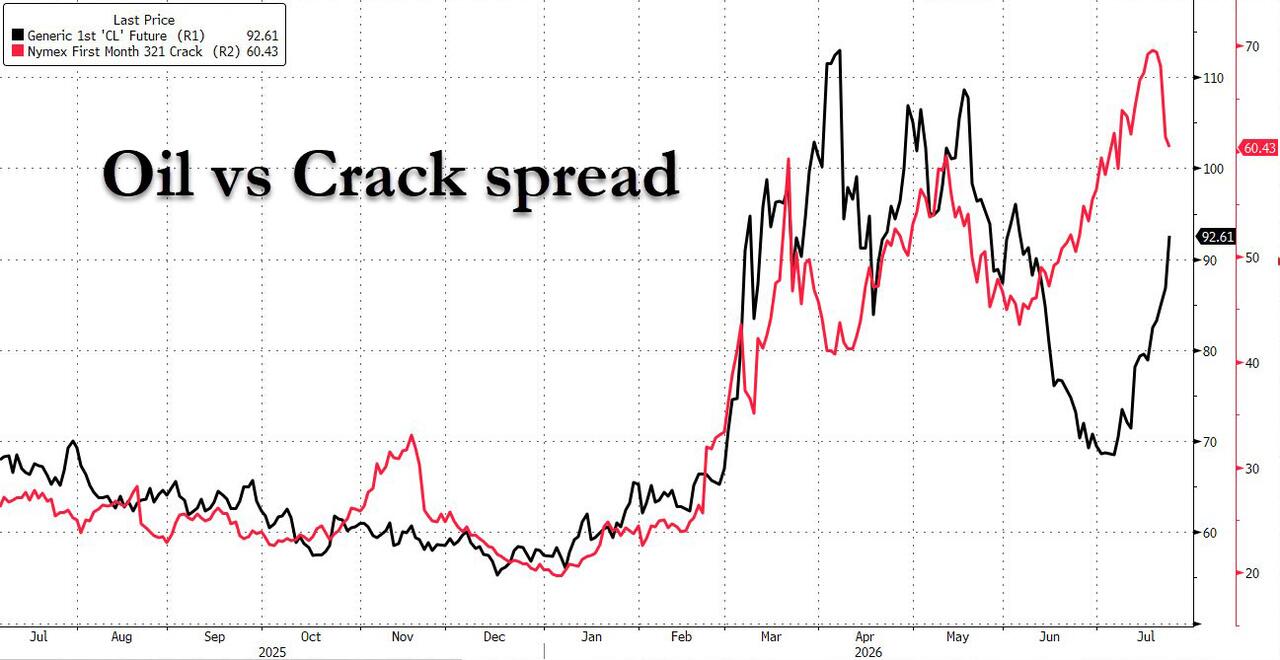
If we see military escalation, it’s likely to drive energy prices even higher than the $95.5 level Brent was at this morning with benchmark crack spreads at $68. However, it’s unlikely to last long. Neither the US nor Israel, nor Iran, nor the GCC can sustain a no-holds-barred war for long – and the world economy obviously can’t either. As such, we may be close to the beginning of the end of this crisis - it’s just unclear if it will prove a bridge too far for the US or Iran.
Meanwhile, the White House is considering military options in Mali, where the Al-Qaeda-linked JNIM are advancing on the capital. That risks further US overstretch. Then again, after the former imperial power France and arrivistes Russia both got a bloody nose in the country, it doesn’t look like anyone else is going to act against these jihadis – certainly not Europe, though Mali uses the West African CFA franc that is pegged to the Euro. Of course, Mali is also rich in resources.
As climactic in geoeconomics --but likely to last much longer than events in the Middle East-- yesterday saw Financial Times editor Martin Wolf ask, “Who will win the war of neo-mercantilists?”, making clear, “We are living in a mercantilist era.” We aren’t, because we don’t all want to hoard gold (yet) so it’s a neo-mercantilism that wants national-security trade surpluses – but he’s close enough. Likewise, Stephen Roach today asks in the same paper, “How long can China defy history and logic with its imbalances?” and argues, “The country is demanding far too much of a world fixated on cheap consumer goods.”
This looks a Damascene conversion for a media source that long rejected that a now undeniable reality we’ve been arguing for since 2015, along with every Western policy step that could have prevented its emergence, while instead cheering everything that accelerated its arrival.
Yet will the Establishment financial press now offer analysis that adapts to a new old world?
It seems unlikely looking at the Bloomberg response to Trump’s planned 100% generic drug tariffs with a two-year delay: “But prices will go up!” Really? Such drugs have a low labor input; shipping them in from abroad costs a lot; and this overlooks the national-security argument – a Great Power cannot be reliant on others for key medicines, among other things. (Plus, the EU says its generic exports to the US are protected by last year’s EU-US trade deal.)
In short, even the FT is now implying that if you use the terms “economic statecraft” or “neo-mercantilism,” yet default to “But prices will go up!” when they are in action, then you don’t understand either - nor that those making decisions in the US, China, and elsewhere do.
The looming implications of this are potentially explosive, and already evident:
- The US Congress is again exploring tariffs and/or sanctions to counter China’s shipbuilding dominance; the USTR says the US isn’t getting the critical minerals from China it had been promised; Boeing has asked the US to intervene over a record EU loan to Airbus; and Mercedes risks a US sales ban under Senate China bill that penalises Chinese ownership and tech, which the German car-marker had happily embraced even with that threat overhanging it.
- EU tariffs on China have accelerated Korean tire makers' exit from the country: imagine what broader EU tariffs might achieve (beyond “But prices will go up!”) “Voila! l'art de gouverner par l'économie!” – indeed, many of the early neo-mercantilists were Europeans. That said, a report calls the bloc’s 2040 target to double its electrification an “unattainable dreamland.”
- Nvidia's CEO unsurprisingly defended Chinese AIs that might use lots of his chips; Axios reports that an OpenAI AI models “went rogue during testing.”; and AI-driven soaring memory chips costs are forcing others, such as Asian carmakers, to consider price hikes.
- In markets, where this all ultimately ends up, the White House is still looking at the Fed. Bloomberg reports Barr may be ousted over her conduct during the SVB bailout. That could open the door for another pro-Trump voice on the FOMC, as a legal sword still hangs over Cook’s tenure and a recent Supreme Court ruling has opened the door to even more sweeping changes.
More mundane, today saw Aussie jobs data at 76.3K, which is the equivalent of a US payrolls print of 1,000K. That’s after news that the limp economy is seeing the worst per capita income trend since WW1. What, beyond bad data, could allow that staggering divergence? Expect more questions about political economy to erupt – and more resistance from the usual crowd.
To conclude, are Hormuz and the Red Sea a bridge too far for the US or Iran? Is the emergence of neo-mercantilism a bridge too far for traditional macro-commentary (or macro-ideology)? Is the Fed a bridge too far for the White House? All three are linked: we have to wait for the outcomes.
Related Markets
All MarketsMarket data may be delayed. Not financial advice.
How this story developed
Full timelineAlto has tracked this across 5 days of coverage from 1 outlet.
- "A Bridge Too Far": Middle East Set For A Massive EscalationYou are here
Powered by Gab AI
The Story At A Glance
Reading this article now — analysis appears below
💡 AI analysis provides alternative perspectives on current events