"It's Getting Worse": HSBC Warns Commodities Face Squeeze As Chokepoint Chaos Spreads
The short version
- The widening disruptions have prompted several institutional desks this week to warn that a potential squeeze on physical commodity markets could send prices from energy to…
- "The Middle East conflict has escalated, putting a substantial squeeze back into commodity markets ," Paul Bloxham, HSBC's chief economist for Australia…
- With inventory rundown having been a key adjustment factor preventing much bigger prices spikes earlier in the conflict, and stocks now much lower…
- Bloxham also highlighted the market mechanics that prevented Brent from spiking even higher a few months back…
- However, the challenge is that inventory reduction can only provide an offset for so long.
The story
The key takeaway heading into the weekend is that maritime chokepoint chaos has spread from the Strait of Hormuz to the Bab el-Mandeb Strait, while fighting across the Black Sea has intensified between Russia and Ukraine. The widening disruptions have prompted several institutional desks this week to warn that a potential squeeze on physical commodity markets could send prices from energy to agricultural goods higher.
"The Middle East conflict has escalated, putting a substantial squeeze back into commodity markets," Paul Bloxham, HSBC's chief economist for Australia, New Zealand and global commodities, wrote in a note on Friday morning.
Bloxham continued, "Traffic through Hormuz has almost stalled again, and the disruption has spread to the Bab el-Mandeb Strait, the key access point for the Red Sea, for Saudi oil going to Asia and Europe-Asia trade through the Suez Canal."
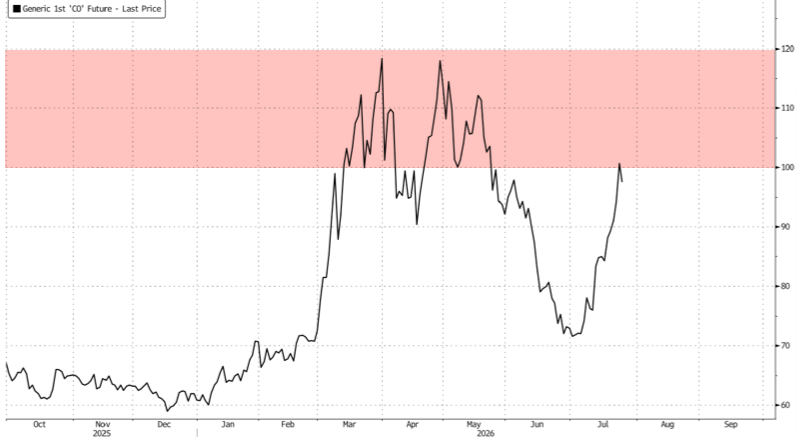
Bloxham warned that with Brent trading above $100 a barrel and strategic petroleum reserves being rapidly depleted worldwide, energy markets face a mounting risk of a "super-squeeze."
His message was blunt: "It's not over yet," adding, "Hormuz, Mandeb, oil at 100 ... it's getting worse. "
Here's more:
The Brent oil price has risen sharply, to over USD100/b recently; European and Asian gas prices are more than 40% m-o-m; refined product prices, like jet fuel and diesel are surging; urea prices are up 13%; and wheat prices are at a three year high – all on supply constraint concerns. With inventory rundown having been a key adjustment factor preventing much bigger prices spikes earlier in the conflict, and stocks now much lower, concerns about 'tank bottom' levels and non-linearities are expected to come back into focus. It's a 'super-squeeze'. And it's not over yet.
Bloxham also highlighted the market mechanics that prevented Brent from spiking even higher a few months back, including US strategic reserve releases and China's reduction of oil imports and SPR.
But he warned that these buffers are finite and can suppress the price shock for only so long:
As we have actively written about over the past few months, a key reason that commodity prices – particularly oil – did not spike higher earlier has been active reduction of inventories, particularly with the US release of strategic reserves and in China, where oil imports have been drawn down (see 'Better, but the Hormuz disruption is not over yet', 25 June 2026; and 'Hormuz is reshaping commodity markets', 25 May 2026).
However, the challenge is that inventory reduction can only provide an offset for so long.
At some point, concerns about stocks falling to critical levels may show up in non-linearities in markets (see Hormuz still closed: Beware Strait non-linearities, 28 April 2026). However, even with a deep-dive looks at measured stocks and supply pathways, it is hard to be definitive about when reserves will reach these critical levels. Commodity markets are highly adaptable, and when the demand is there, flexible markets often find a way to deliver. Aggregate price benchmarks also only go so far. In the face of acute supply shocks, commodity markets tend to fragment, with many different prices for the same products in different locations and for different delivery times (see More fragmentation as Hormuz blockage continues, 13 April 2026).
That said, the longer the disruption is in place – and the recent escalation suggests it is, indeed, going on for longer – the more likely it becomes that commodity prices will spike higher, in non-linear ways, as stocks are depleted.
A growing list of institutional commodity desks, including Goldman Sachs, RBC Capital Markets and JPMorgan, has warned that the expanding maritime chokepoint crisis is entering a more dangerous phase.
Helima Croft, RBC's head of global commodity strategy, cautioned that the "war enters a dangerous phase with the Red Sea and critical infrastructure at risk."
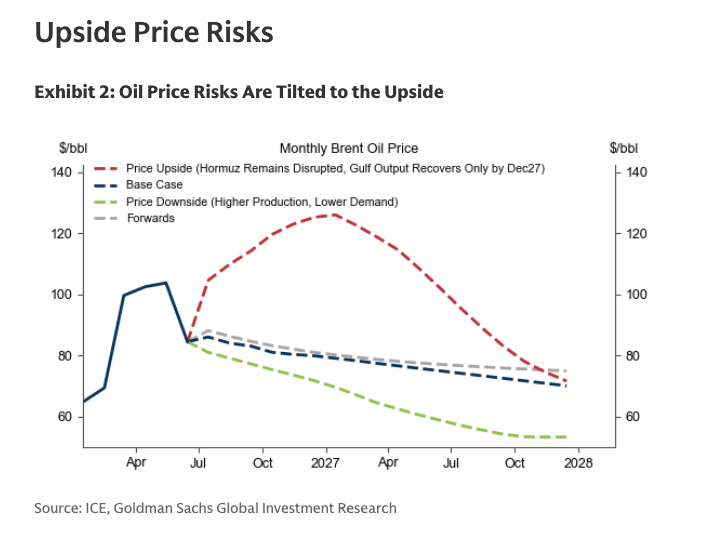
These desks have raised their near-term Brent forecasts as the disruption spreads. Goldman commodities strategist Daan Struyven warned that Brent could exceed $120 a barrel in the fourth quarter if the Hormuz crisis persists.
Related:
With the US national average for regular gasoline now above $4 a gallon, the energy shock has crossed a politically sensitive level (again), which could increase pressure on the Trump administration to pursue a diplomatic off-ramp.
Related Markets
All MarketsMarket data may be delayed. Not financial advice.
How this story developed
Full timelineAlto has tracked this across 2 days of coverage from 1 outlet.
- "It's Getting Worse": HSBC Warns Commodities Face Squeeze As Chokepoint Chaos SpreadsYou are here
Powered by Gab AI
The Story At A Glance
Open the full breakdown on gab.ai
- • Maritime chokepoints in Hormuz, Bab el-Mandeb, and the Black Sea are causing a massive commodity squeeze.
- • Brent crude has exceeded $100 per barrel while wheat and urea prices are surging due to supply constraints.
- • Depleted strategic reserves mean markets face a potential non-linear super-squeeze as inventories hit critical levels.
Global trade is being strangled by simultaneous conflicts in the Middle East and Eastern Europe. These disruptions are exhausting the finite buffers provided by previous strategic petroleum reserve releases.
Christian Perspective
The escalating chaos in the Middle East reflects the biblical reality of global instability and the consequences of regional sin. The destruction of life and the disruption of basic necessities like food and fuel underscore the spiritual and physical decay in these contested lands.
Implications
Rising energy and food costs will disproportionately burden the American family and threaten the stability of the household. High inflation acts as a tax on the hardworking, potentially undermining the ability of Christian families to build and maintain their heritage.
Broader Trends
This crisis highlights the danger of a globalized economy that leaves the American nation vulnerable to foreign instability. It demonstrates how the failure of liberal internationalism to maintain order leads to direct economic warfare against the domestic population.
Takeaway
America must prioritize energy independence and domestic agricultural security to protect our people from globalist volatility. We must demand an America First approach that secures our borders and our resources rather than subsidizing endless foreign conflicts.
Want to join the conversation about this story?
Join our community at Gab.com→
Gab AI
The one AI they can't control. Our exclusive AI model trained to uphold Christian values and traditional principles in every interaction.