UK Cities Roll Out More Diversity Barriers; Vehicle-Ramming Threat Now The Norm

The short version
- Local authorities across Britain are quietly installing more of what critics now call "diversity barriers" - heavy portable steel devices designed to stop vehicles being driven…
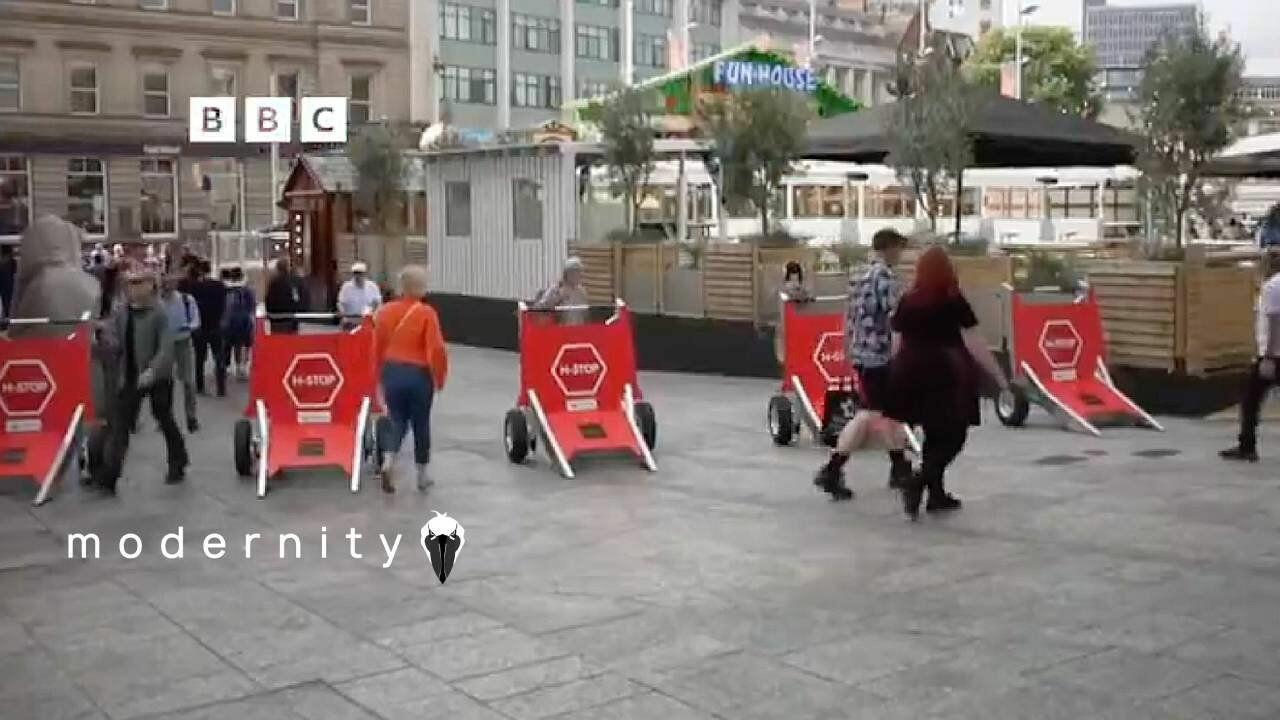
- The annual artificial "Nottingham Beach" event opened this week behind a line of bright red Husson H-Stop units.
- Meanwhile in the UK Local authorities are installing more and more 'Diversity Barriers'.
- They tip upward on impact, changing a vehicle's trajectory and generating enough friction to halt a three-and-a-half-tonne truck travelling at 30 mph.
- Councillors and organisers insist the move is simply a precaution.
The story
Authored by Steve Watson via Modernity.news,
A family summer beach event in the UK city of Nottingham now sits behind portable anti-ram steel barrier, the latest admission that open borders have turned public spaces into soft targets.
Local authorities across Britain are quietly installing more of what critics now call "diversity barriers" - heavy portable steel devices designed to stop vehicles being driven into crowds.
The annual artificial "Nottingham Beach" event opened this week behind a line of bright red Husson H-Stop units.
Meanwhile in the UK Local authorities are installing more and more 'Diversity Barriers'. Why? Because as regularly seen throughout Europe - Radical Islamist Terrorists like to murder innocent people by driving their vehicles into crowds of people. pic.twitter.com/hq7tRKYcbW
— Concerned Citizen (@BGatesIsaPyscho) July 22, 2026
About 15 of the barriers now block the four main entrances. They tip upward on impact, changing a vehicle's trajectory and generating enough friction to halt a three-and-a-half-tonne truck travelling at 30 mph.
Councillors and organisers insist the move is simply a precaution. The multi-agency safety group that approved them included counter-terrorism officers.
Councillor Neghat Khan, leader of Nottingham City Council, described them as an "additional safety measure" installed "following advice from the multi-agency events safety advisory group, which includes counter-terrorism colleagues."
Event organiser James Mellors was more blunt: "I don't think they look very pretty. But the Market Square is a very high footfall area. It's not always about how things look, it's about keeping people safe."
A regular visitor, Amanda Hose Hawley, said she was "not surprised" and called the barriers "a sign of the climate we live in."
The language is careful, the justification technical. Yet the reason these barriers exist is no mystery.
Before uncontrolled mass immigration we did not need diversity barriers.
— Edward Oakenfull (@EdwardOakenfull) July 22, 2026
Across Europe, radical Islamists have repeatedly turned vehicles into weapons against ordinary people gathered in public spaces. Britain is simply catching up with the physical reality already visible on the Continent.
Wouldn't it be nice if we lived in a country where the problem got resolved rather than putting in precautions for the problem!
— Kate leigh 86 (@KateLee86) July 22, 2026
Last winter German towns were forced into even more extreme measures. In the small Bavarian community of Külsheim, officials resorted to recycled anti-tank barriers pulled from old military barracks.
Four massive concrete blocks, each 1.4 metres wide and weighing several tonnes, were painted red and white and placed around the Christmas market.
The town's mayor, Simone Hickl-Seitz, explained the grim arithmetic: "They know exactly that all cities need this. But the coffers are empty."
Bollards that once cost €800 had risen tenfold in price because demand had exploded. The anti-tank relics saved the town €30,000.
That was not an isolated improvisation. Security spending on German Christmas markets rose 44 percent in three years, according to the Federal Association of City and Town Marketing.
Some towns simply cancelled their markets rather than meet the new requirements. The pressure intensified after the December 2024 Magdeburg attack, in which a Saudi national living in Germany for nearly two decades drove a vehicle through a Christmas market, killing six and injuring hundreds.
AfD politician Ulrich Siegmund cut through the official euphemisms: "Why do we need to protect Christmas markets? Go to Czech Republic, Poland - they haven't opened borders... We are losing our freedom bit by bit."
The same pattern has been documented in footage that circulated widely at the time. One widely viewed report showed Berlin's markets ringed by the same style of heavy concrete barriers once intended to stop invading armies, not shoppers buying Glühwein.
Britain's new portable barriers are lighter and more mobile, but they serve the identical purpose. Hostile vehicle mitigation has become standard guidance from the National Protective Security Authority.
Official documents now list crash-rated bollards, vehicle barriers and stand-off distances as core measures against "vehicle as a weapon" attacks.
Maybe enforcing the barriers called BORDERS and keeping the terrorists out of the country would be the more intelligent effort.
— Renomanz (@Renomanz) July 22, 2026
The threat is no longer theoretical. In October 2025 a man who pledged allegiance to Islamic State used a vehicle and a bladed weapon outside a Manchester synagogue, killing three. Other plots and attacks across Europe have followed the same method: low-skill, high-impact, directed at soft civilian targets.
The Nottingham installation is being described as a trial. Organisers say there was no specific intelligence of an imminent attack. That claim misses the larger point.
Permanent or semi-permanent barriers are appearing at markets, festivals, high streets and public squares precisely because the background risk has become chronic.
Before the era of mass, uncontrolled immigration from regions where Islamist ideology remains mainstream, British towns did not need steel ramps that can stop a truck.
Children played in squares without negotiating "filter" gaps between anti-ram devices. Christmas markets did not require military surplus concrete painted in festive colours.
Now the physical landscape of everyday life is being redesigned around the assumption that someone may try to drive a vehicle into a crowd of shoppers, holidaymakers or beachgoers. The barriers are painted bright red and labelled H-STOP so no one can claim they are invisible. Their very visibility is the admission.
The cost is not only financial. Every barrier is a quiet confession that the post-1990s experiment in open borders has produced a security environment European cities once associated with conflict zones.
Politicians continue to speak of "community cohesion" and "diversity as strength" while the practical response is to harden every public gathering against the most predictable form of attack.
Nottingham's beach will close at the end of the summer and the portable barriers will be stored away. The underlying problem will not. The same devices, or heavier permanent versions, will reappear at the next festival, the next market, the next Christmas period.
Local authorities are not inventing a threat; they are reacting to one that has already left bodies in European streets and forced democratic societies to turn festive spaces into fortified zones.
The choice facing Britain and the rest of the West remains the same one German politicians have already faced: continue importing the conditions that make these barriers necessary, or finally reverse the policies that created the danger in the first place. Concrete and steel can stop a truck. They cannot restore a country that no longer feels safe enough to gather without them.
Related Markets
All MarketsMarket data may be delayed. Not financial advice.
Powered by Gab AI
The Story At A Glance
Reading this article now — analysis appears below
💡 AI analysis provides alternative perspectives on current events