Key Events This Busy Week: FOMC, PCE, GDP, War On/War Off... And Earnings Galore
The short version
- The pause falls short of a formal ceasefire, but both sides are presenting it as an opportunity for diplomacy…
- US officials, including UN Ambassador Mike Waltz, have stressed that all military options remain on the table and that President Trump is simply giving negotiations more space.
- However, reports from the New York Times and Axios suggest an active debate within the administration over both the effectiveness and costs of further strikes…
- For now, the market is treating the lull as a positive development, although the situation remains highly fluid.
- The main market risk remains the energy and shipping front.
The story
Before we look at the week ahead, a quick look at the main event that defines the market this Monday morning: after 13 consecutive nights of US strikes aimed at degrading Iran’s ability to threaten commercial shipping, Washington has refrained from further attacks since late Friday, while Tehran has publicly stated that it has also suspended retaliatory operations. The pause falls short of a formal ceasefire, but both sides are presenting it as an opportunity for diplomacy, with Omani-mediated talks continuing over the weekend focused on navigation through the Strait of Hormuz. US officials, including UN Ambassador Mike Waltz, have stressed that all military options remain on the table and that President Trump is simply giving negotiations more space. However, reports from the New York Times and Axios suggest an active debate within the administration over both the effectiveness and costs of further strikes, with some military officials reportedly arguing that key objectives have largely been achieved. For now, the market is treating the lull as a positive development, although the situation remains highly fluid.
The main market risk remains the energy and shipping front. Traffic through Hormuz remains severely disrupted, while the conflict has broadened into the Red Sea, where Iran-backed Houthi forces reportedly launched missile and drone attacks against Saudi energy infrastructure around Jizan and Yanbu over the weekend, prompting retaliatory Saudi strikes. This raises the prospect of simultaneous disruption to both Gulf and Red Sea export routes. So a welcome pause from the main actors but a fragile one, especially with side battles still ongoing.
However there is no doubt the weekend news is positive and this morning Brent crude prices are around -4.5% lower to $92.42 and 10yr USTs are down -4.5bps. S&P 500 futures are up +0.71% with Nasdaq futures gaining +1.17%.
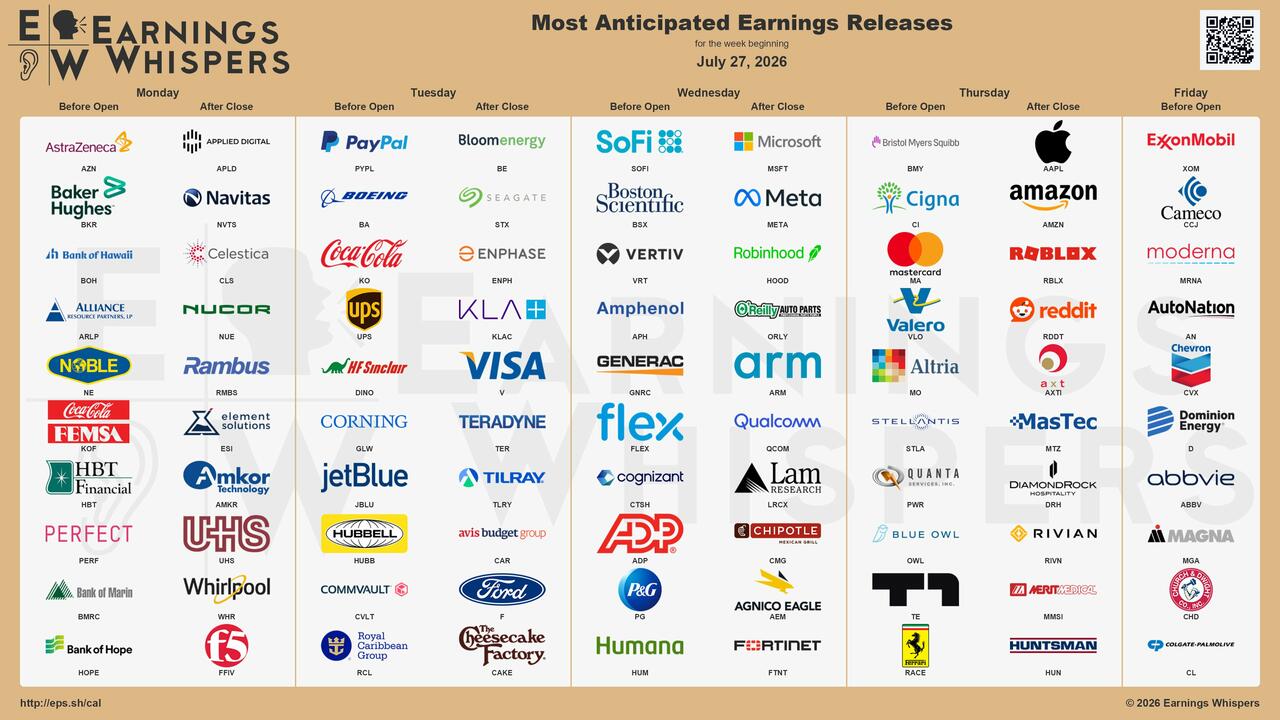
With that in mind, let's now look ahead, and as more and more of the financial world steps off the ever-turning carousel of market news and disappears towards sunnier shores, a busy global week lies ahead, with central bank decisions, major economic releases and a heavy slate of corporate earnings all competing for investors’ attention. The Federal Reserve meeting concluding on Wednesday remains the standout event, but investors will also hear from the Bank of England (Thursday) and the Bank of Japan (Friday). Meanwhile, key economic releases include US Q2 GDP and June core PCE inflation (both Thursday), Euro Area Q2 GDP and July inflation data (Thursday/Friday), Japan’s Tokyo CPI (Friday) and China’s official PMIs (Friday). Adding to the significance of the week, four of the world’s most influential companies — Microsoft, Meta, Apple and Amazon, which together account for 17% of the S&P 500—will report earnings, with the first two on Wednesday and the latter two a day later.
The headline event of course comes with the FOMC meeting (Wednesday), where DB economists continue to expect the Fed to leave rates unchanged. However, the decision appears unusually finely balanced. The renewed escalation in the Middle East and the sharp rise in energy prices have complicated the inflation outlook, while recent market-based measures of inflation compensation have moved higher as concerns around energy supply disruptions have intensified. Against that backdrop, policymakers face a difficult trade-off between evidence that inflation had been moderating and growing signs that higher oil prices could create a more persistent inflation shock.
It’s rare for a Fed meeting to be this finely balanced so close to the decision. Futures are still assigning a 34% probability to a rate hike this week (-4pps overnight in Asia), a level of uncertainty we seldom see at such a late stage. During the post-Covid hiking cycle, markets did receive a steer via the financial press during the blackout period if the Fed was considering a surprise move. Under the current regime, that appears far less likely.
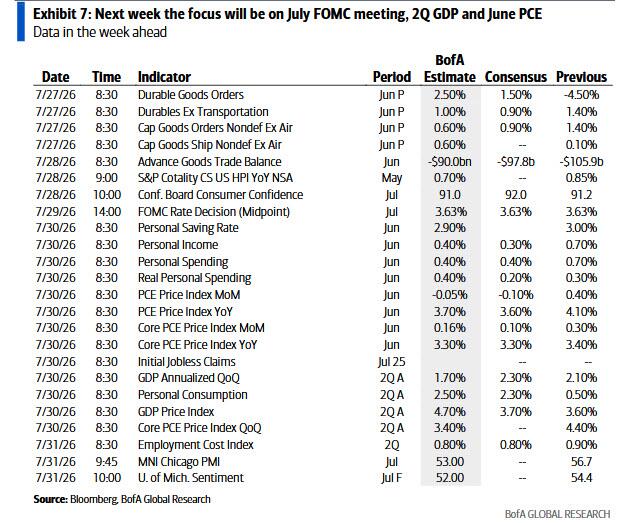
The Fed decision will sit in the middle of several important data releases. Durable goods orders (today) and the advance goods trade balance (tomorrow) will help shape expectations for the first estimate of Q2 GDP (Thursday). Economists expect annualized GDP growth of 1.9% in Q2. Although this would mark a downgrade from earlier estimates, much of the weakness reflects a drag from net exports linked to strong AI-related imports. Beneath the surface, domestic demand remains considerably healthier. Indeed, DB's economists expect final sales to private domestic purchasers, their preferred measure of underlying demand, to rise by a robust 3.3%, which would be the strongest reading since Q3 2024.
Attention will then turn to inflation. The June personal income and spending report (Thursday) includes the latest reading of core PCE, the Fed's preferred inflation gauge. DB economists expect core PCE to increase by 0.19% month-on-month, which would leave the annual rate at 3.3% assuming no significant revisions. That will be followed by the Employment Cost Index (Friday), one of the Fed's preferred measures of labor cost pressures. Economists expect the annual growth rate to remain at 3.4%, a level many policymakers would still view as broadly consistent with returning inflation towards target over time.
Alongside the macro data, earnings season moves into a critical phase. Around 35% of the S&P 500's market capitalization is scheduled to report this week. Technology will dominate attention, with Microsoft and Meta releasing results (Wednesday), followed by Apple and Amazon (Thursday). Together, those companies account for 17% of the S&P 500 and will help determine whether investor enthusiasm around AI-related spending remains intact. Elsewhere, notable US earnings releases include Visa and Mastercard in financials, ExxonMobil and Chevron in energy, and Coca-Cola and Procter & Gamble in consumer staples.
In Europe, attention will be split between monetary policy and inflation. The Bank of England announces its latest policy decision (Thursday), and economists expect Bank Rate to remain unchanged at 3.75%, accompanied by a 7-2 vote split.
On the data side, Germany and Spain release flash July CPI figures (Thursday), before France, Italy and the Euro Area publish their inflation readings (Friday). DB's European economists expect Euro Area headline HICP inflation to rise to 3.0% from 2.8%, while core HICP is forecast to edge higher to 2.52% from 2.36%. The Euro Area's preliminary Q2 GDP estimate is also due (Thursday), while Germany's Ifo survey (today) should provide an updated read on business sentiment.
In Asia, the Bank of Japan decision (Friday) will be the key event. Here, economists expect policymakers to keep their current policy settings unchanged. Japan will also release Tokyo CPI, retail sales, industrial production, labor market data and housing starts (all Friday), offering a comprehensive snapshot of the economy at the start of the third quarter. In China, the official manufacturing and non-manufacturing PMIs (Friday) will provide the latest evidence on growth momentum. Elsewhere, Australia's June CPI report (Wednesday) will be closely watched for indications about the Reserve Bank's policy path.
Courtesy of DB, here is a day by day preview of the week ahead.
Monday July 27
- Data: US June durable goods orders, July Dallas Fed manufacturing activity, Japan June PPI services, China June industrial profits, Germany July Ifo survey, Eurozone June M3
- Earnings: LVMH, AstraZeneca, Welltower, Cadence Design Systems, Celestica
- Auctions: US 2-yr Notes ($69bn), 5-yr Notes ($70bn)
Tuesday July 28
- Data: US June advance goods trade balance, wholesale inventories, July Conference Board consumer confidence index, Richmond Fed manufacturing index, business conditions, Dallas Fed services activity, May FHFA house price index, France July consumer confidence, Q2 total jobseekers
- Earnings: Visa, Coca-Cola, KLA, Seagate Technology, Boeing, Rio Tinto, Safran, Unilever, Corning, Air Liquide, S&P Global, GSK, UPS, Barclays, EssilorLuxottica, Sherwin-Williams, Mondelez, American Tower, Royal Caribbean Cruises, Ecolab, Hilton, NXP Semiconductors, Teradyne, Ford, Orange, Mercedes-Benz, Kering, Centene, Sika
- Auctions: US 7-yr Notes ($44bn)
Wednesday July 29
- Data: UK June net consumer credit, M4, Germany June import price index, Italy May industrial sales, Australia June CPI, Sweden Q2 GDP indicator
- Central banks: Fed’s decision, BoC summary of deliberations
- Earnings: Microsoft, Meta, SK hynix, Lam Research, Procter & Gamble, ARM, L'Oreal, Hermes, Amphenol, Airbus, Qualcomm, UBS, Hitachi, Advantest, Intesa Sanpaolo, Starbucks, Vertiv, Fortinet, CaixaBank, Equinix, Vinci, Eni, Aon, Standard Chartered, Public Storage, Danone, BASF, Porsche, Humana, GE HealthCare Technologies, Telecom Italia
- Auctions: US 2-yr FRN ($30bn)
Thursday July 30
- Data: US June PCE, personal income, spending, Q2 GDP, initial jobless claims, Japan July consumer confidence index, Germany Q2 GDP, July CPI, France Q2 GDP, private sector payrolls, June consumer spending, Italy Q2 GDP, June unemployment rate, PPI, Eurozone July economic, industrial, services confidence, Q2 GDP, June unemployment rate
- Central banks: BoE’s decision
- Earnings: Apple, Amazon, Samsung Electronics, Mastercard, Shell, Tokyo Electron, Schneider Electric, AB InBev, Rolls-Royce, BBVA, British American Tobacco, Bristol-Myers Squibb, Altria, Stryker, Enel, Sanofi, ING Groep, Lloyds Banking, KKR, BAE, Cigna, Monolithic Power Systems, Regeneron, CRH, Societe Generale, Ferrari, Vale, LSEG, Anglo American, adidas, Leonardo, Reddit, DSM-Firmenich, MTU Aero Engines, Capgemini, Stellantis
Friday July 31
- Data: US Q2 employment cost index, July MNI Chicago PMI, China July official PMIs, UK July Lloyds Business Barometer, Japan July Tokyo CPI, June jobless rate, job-to-applicant ratio, retail sales, industrial production, housing starts, Germany July unemployment claims rate, France July CPI, June PPI, Italy July CPI, consumer confidence index, economic sentiment, manufacturing confidence, Eurozone July CPI, Canada May GDP
- Central banks: BoJ’s decision
- Earnings: ExxonMobil, AbbVie, Chevron, Linde, Eaton, Sony, AXA, Engie, NatWest, Credit Agricole, Holcim, Siemens Healthineers, FANUC, Ares
* * *
Finally, looking at just the US, the key economic data releases this week are the advance release of Q2 GDP and core PCE inflation on Thursday. The July FOMC meeting is on Wednesday. The post-meeting statement will be released at 2:00 PM ET, followed by Chairman Warsh's press conference at 2:30 PM.
Monday, July 27
- 08:30 AM Durable goods orders, June preliminary (GS +1.0%, consensus +1.8%, last -4.5%); Durable goods orders ex-transportation, June preliminary (GS +0.6%, consensus +0.8%, last +1.4%); Core capital goods orders, June preliminary (GS +0.6%, consensus +0.8%, last +1.4%); Core capital goods shipments, June preliminary (GS +0.6%, consensus +0.5%, last +0.1%): We estimate that durable goods orders rebounded 1% in the preliminary June report (month-over-month, seasonally adjusted) based on our tracking of commercial aircraft orders. We forecast a 0.6% increase in core capital goods orders—reflecting the increase in the new orders components in manufacturing surveys in June—and a 0.6% increase in core capital goods shipments—reflecting the continued increase in core capital goods orders in recent months.
Tuesday, July 28
- 08:30 AM Advance goods trade balance, June (GS -$95.0bn, consensus -$100.3bn, last -$105.9bn)
- 08:30 AM Wholesale inventories, June preliminary (last +0.1%)
- 09:00 AM FHFA house price index, May (last -0.1%)
- 09:00 AM S&P Case-Shiller home price index, May (GS +0.1%, consensus flat, last flat)
- 10:00 AM Conference Board consumer confidence, July (GS 92.0, consensus 92.4, last 91.2)
Wednesday, July 29
- 02:00 PM FOMC statement, July 28-29 meeting: As discussed in our FOMC preview, at its July meeting, the FOMC is likely to keep the funds rate unchanged at 3.50-3.75%. The post-meeting statement might acknowledge the upside risks to inflation posed by renewed geopolitical conflict, and there will likely be at least one dissent in favor of a hike. Market pricing implies that investors see the outcome of the July meeting as unusually uncertain, likely because the FOMC has been split recently, Chairman Warsh’s own position remains unclear, and some of the re-escalation with Iran occurred during the blackout period. But most voters appear unlikely to push for a hike this week after the softer June inflation data, the Fed has historically avoided delivering surprise rate hikes, and we suspect that voters might be especially reluctant to do so at a meeting without a Summary of Economic Projections.
Thursday, July 30
- 08:30 AM GDP, Q2 advance (GS +2.6%, consensus +2.1%, last +2.1%); Personal consumption, Q2 advance (GS +2.3%, consensus +2.3%, last +0.5%); Core PCE inflation, Q2 advance (GS +3.46%, consensus +3.5%, last +4.4%); We estimate that GDP rose 2.6% annualized in the advance reading for Q2, following a +2.1% annualized increase in Q1. Our forecast reflects a rebound in consumption growth (+2.3%, quarter-over-quarter annualized, vs. +0.5% in Q1) and another quarter of strong business fixed investment growth (+8.8% vs. +10.6% in Q1) driven by strong equipment investment growth (+17.1%). We expect net exports to contribute -1.3pp to Q2 GDP growth. We estimate that domestic final sales rose +2.6% in Q2. We estimate that the core PCE price index increased 3.46% annualized (or 3.35% year-over-year) in Q2.
- 08:30 AM Personal income, June (GS +0.4%, consensus +0.3%, last +0.7%); Personal spending, June (GS +0.6%, consensus +0.4%, last +0.7%); Core PCE price index, June (GS +0.18%, consensus +0.2%, last +0.3%); Core PCE price index (YoY), June (GS +3.32%, consensus +3.3%, last +3.4%); PCE price index, June (GS -0.07%, consensus -0.1%, last +0.4%); PCE price index (YoY), June (GS +3.70%, consensus +3.7%, last +4.1%): We estimate that personal income and spending increased by 0.4% and 0.6%, respectively, in June. We estimate that the core PCE price index rose 0.18% in June, corresponding to a year-over-year rate of +3.32%. Additionally, we expect that the headline PCE price index declined 0.07% in June and increased 3.70% from a year earlier.
- 08:30 AM Initial jobless claims, week ended July 25 (GS 205k, consensus 200k, last 187k): Continuing jobless claims, week ended July 18 (consensus 1,803k, last 1,796k)
Friday, July 31
- 08:30 AM Employment cost index, Q2 (GS +0.8%, consensus +0.8%, last +0.9%): We estimate the employment cost index rose by 0.8% in Q2 (quarter-over-quarter, seasonally adjusted). Our forecast would result in a 0.2pp decline in the year-on-year rate to 3.2% (year-over-year, not seasonally adjusted), which would mark the slowest pace of yearly wage growth since 2021Q2. Our forecast reflects slower ECI benefit growth after start-of-the-year benefit resets likely boosted growth in Q1 and a 0.8% quarterly pace of wage and salary growth—reflecting the signals from the Atlanta Fed’s wage tracker and average hourly earnings.
- 10:00 AM University of Michigan consumer sentiment, July final (GS 54.0, consensus 54.0, last 54.4); University of Michigan 5-10-year inflation expectations, July final (GS 3.3%, last 3.3%)
Source: DB, Goldman
Related Markets
All MarketsMarket data may be delayed. Not financial advice.
How this story developed
Full timelineAlto has tracked this across 2 days of coverage from 1 outlet.
- Key Events This Busy Week: FOMC, PCE, GDP, War On/War Off... And Earnings Galore You are here
Powered by Gab AI
The Story At A Glance
Reading this article now — analysis appears below
💡 AI analysis provides alternative perspectives on current events