Erdogan's Ottoman Gambit: Turkey Prepares For New Regional Order

The short version
- Turkey sold nearly all of its US Treasury holdings in March — cutting them from $16 billion to just $1.8 billion in a single month.
- The official narrative frames this as emergency reserve management amid a weakening lira and inflation running above 32%.
- But the mechanics of financial stress don’t explain the direction of travel.
- Nations don’t systematically dump the debt of their allies.
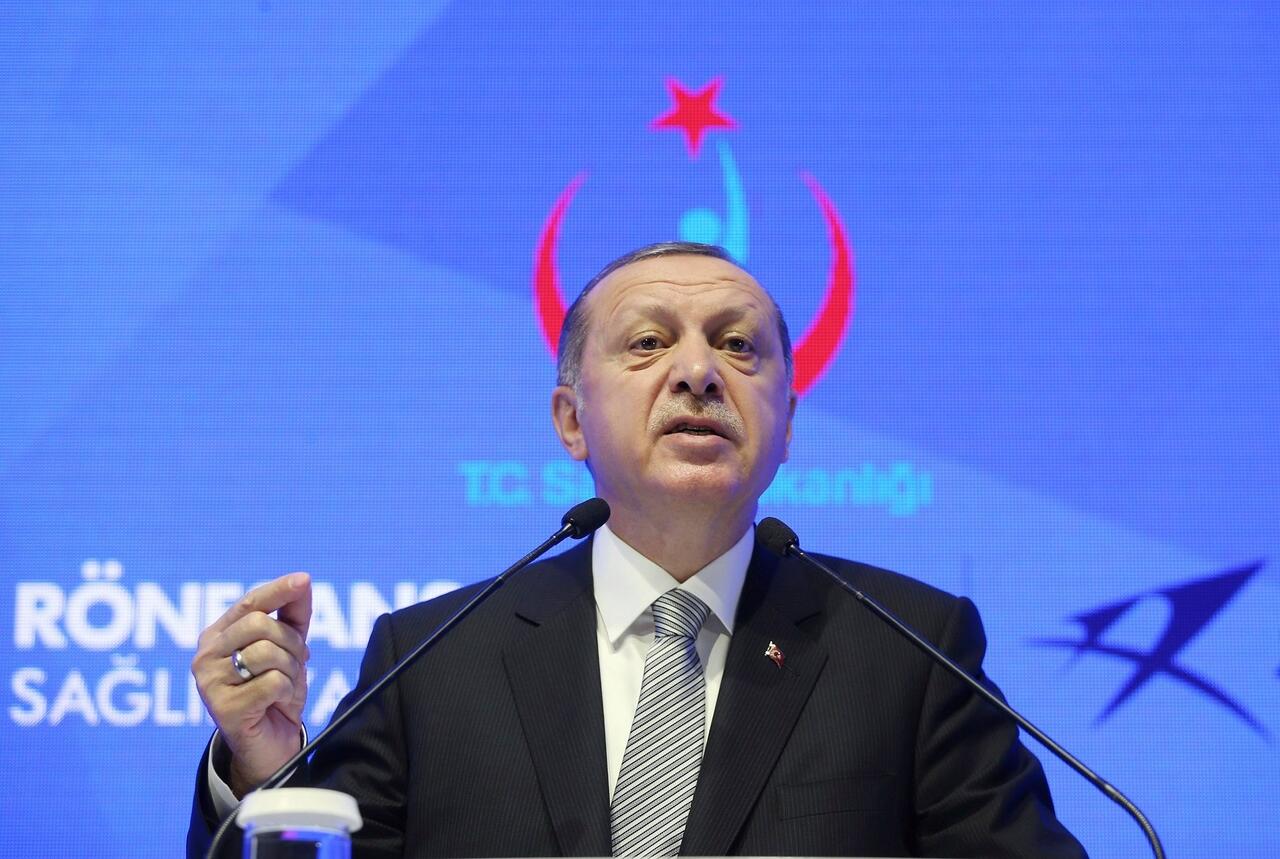
- In a recent address he cast Turkey as “one of the shining stars of the new era,” invoking the restoration of Ottoman-era influence across the region.
The story
Authored by Chris Macintosh via InternationalMan.com,
Turkey is simultaneously dumping US Treasuries, deepening Russia’s energy embrace, rolling out a tax regime to poach capital fleeing the Gulf… and squaring off against an Israeli political class that now speaks openly of Turkey as an enemy. It’s strategic.
Turkey sold nearly all of its US Treasury holdings in March — cutting them from $16 billion to just $1.8 billion in a single month. The official narrative frames this as emergency reserve management amid a weakening lira and inflation running above 32%. But the mechanics of financial stress don’t explain the direction of travel. Nations don’t systematically dump the debt of their allies.
President Erdogan has been explicit.
In a recent address he cast Turkey as “one of the shining stars of the new era,” invoking the restoration of Ottoman-era influence across the region. Turkey vehemently opposes Israel’s operations in Gaza, and in Ankara’s strategic calculus, Washington and Tel Aviv are increasingly viewed as a single entity. The Treasury sell-off is as much a political signal as a liquidity operation. The Turkish government has smelt blood in the streets and wants to capitalise on the situation.
The energy relationship with Russia tells the same story. Rosatom’s Akkuyu nuclear plant — a build-own-operate project in which Russia retains ownership for decades — just received a further $9 billion in Russian financing, with $4–5 billion deploying in 2026 alone. Turkey has loudly advertised its renewable credentials and a 2053 net-zero target, but Akkuyu sits outside that narrative entirely. When it comes online it will supply roughly 10% of Turkey’s electricity and lock in a structural strategic dependency on Moscow that no solar panel cancels out. Turkey talks diversification; it acts with ruthless pragmatism.
The Iran conflict has handed Erdogan an unexpected opportunity on the capital side.
The disruption to Gulf Cooperation Council financial hubs — Dubai chief among them — has put mobile, internationally structured wealth back in play. Investors who relocated to the UAE for zero-tax treatment are now reassessing. Into that gap, Turkey’s parliament on recently passed Erdogan’s flagship fiscal incentive package — nine permanent structural reforms that together represent one of the most aggressive capital attraction plays of the decade:
-
0% income tax on foreign earnings for 20 years
-
1% inheritance tax on all wealth
-
Full citizenship from $400,000
-
2% one-off tax to repatriate overseas assets, no questions asked
-
9% corporate tax — permanent
-
0% tax on trading through Turkey
-
Business registration in one day via AI-assisted process
-
Machinery and equipment imports: duty-free, 0% VAT
-
Mortgage overhaul: 10% down payment, terms up to 25 years
The last item deserves particular attention. The mortgage reform isn’t just a financing tweak — it unlocks millions of first-time Turkish buyers who were previously priced out of the market.
That domestic demand surge lands at precisely the moment foreign capital begins flowing in under the new tax regime. Turkey’s residential real estate market was already undersupplied. The combination of newly bankable local buyers and inbound international capital chasing a low-tax domicile points to a meaningful price cycle ahead — at minimum in Istanbul and the coastal cities where foreign demand concentrates.
The architect of Istanbul’s financial hub ambitions goes back to at least 2009, when former Deputy PM Nazim Ekren was championing Atasehir as the anchor of Eurasia’s financial capital. Aran Hawker, who provided trading infrastructure to Istanbul’s exchanges in 2011, expects wealth repositioned not only from the GCC but from North America, Europe, and the UK — from people “not happy with political situations in those respective countries.” Istanbul Finance Centre transit trade income is now fully exempt from corporate tax through 2047.
The Greater Israel Shadow
Beneath the fiscal and energy calculations runs a darker strategic undercurrent — one that Ankara is acutely aware of and Western analysts largely ignore.
The expansion of Israeli strategic ambition across the region, accelerated by the Gaza operation and the broader Zionist maximalist project, now has Turkey explicitly in its crosshairs.
The Bosphorus — the narrow strait connecting the Black Sea to the Mediterranean, through which a significant share of global energy and grain trade passes — is not simply a Turkish asset. It is one of the most strategically significant chokepoints on earth. Control of it, or the ability to influence who controls it, is a prize that serious regional powers do not ignore.
Israeli political figures have begun to speak with unusual candour about Turkey as a threat rather than a competitor. Israeli Minister of Culture and Sports Miki Zohar stated plainly:
“We must begin to treat Turkey as an enemy state.”
Former Israeli Prime Minister Naftali Bennett went further, framing Turkey in the same breath as Iran:
“A new Turkish threat is emerging. We must act in different ways, but simultaneously against the threat from Tehran and against the hostility from Ankara.”
These are not fringe voices. When a sitting minister and a former head of government use the language of simultaneous threat management for both Iran and Turkey, they are signalling a strategic posture — one that has obvious implications for NATO cohesion, for the future of the Bosphorus as a neutral passage, and for the stability of the broader region.
Erdogan reads this clearly. The deepening of Russian energy ties, the rejection of US debt, the cultivation of Ottoman-sphere influence — these are not reactions to Gaza alone. They are pre-positioning against a regional order that Turkey now judges to be hostile to its existence as a sovereign power.
The Greater Israel project, in its maximalist form, envisions territorial and political influence stretching from the Nile to the Euphrates. Turkey sits at the northern edge of that strategic horizon. Control or destabilisation of the Bosphorus would fundamentally alter the balance of naval power in the Eastern Mediterranean and the Black Sea — a prize of the highest order for any power seeking regional hegemony. Whether or not one assigns full credibility to the maximalist reading, the signals from Israeli political leadership are sufficient for Ankara to treat the threat as real and plan accordingly.
A NATO member that sells US debt, builds Russian nuclear plants, courts capital fleeing Western disorder, and now faces explicit identification as an enemy state by Israeli leadership is not drifting. Rather, it’s repositioning on every front simultaneously.
The picture that emerges is coherent and accelerating….
Turkey controls the Bosphorus. It borders the Middle East, maintains NATO’s second-largest military, and imports the energy that geopolitical conflict makes more expensive — hence the inflation, the rate pressure, and the reserve burn. But Erdogan’s response is not to seek Western reassurance. It is to deepen the Russian energy anchor, signal alignment with the Global South’s reading of the Gaza conflict, position Istanbul as the beneficiary of Gulf instability and Western political dysfunction, and quietly fortify against a regional order that now names Turkey an adversary. The Treasury dump is one data point in a larger sequence. The Ottoman ambition is the frame. And the clock is moving faster than most investors realise.
* * *
Turkey’s repositioning is part of a much larger shift now reshaping the global economic and political order. In our special report, Clash of the Systems: Thoughts on Investing at a Unique Point in Time, a contrarian money manager explains the forces driving this transition, the risks they pose to your wealth and personal freedom, and how you can position yourself to stay one step ahead. Get instant access to the special report here.
Related Markets
All MarketsMarket data may be delayed. Not financial advice.
Powered by Gab AI
The Story At A Glance
Reading this article now — analysis appears below
💡 AI analysis provides alternative perspectives on current events