Birkin Bag Maker Plunges Most Since 2010 As Soft China Demand Weighs On Leather Sales

The short version
- Second-quarter sales in the leather goods division rose 10.2% at constant exchange rates, missing the Bloomberg Consensus estimate of 10.7%.
- Overall revenue increased 6.7% to about 4.1 billion euros, slightly ahead of estimates, driven by 13.7% growth in the Americas.
- Pusz continued: Subtle shift in messaging may raise questions on medium-term targets At the Group level, results were broadly in line with expectations…
- In our view, management's commentary is unlikely to provide much shortterm reassurance.
- Although the company reiterated robust demand for its handbags and reaffirmed its ambition to continue expanding volumes…
The story
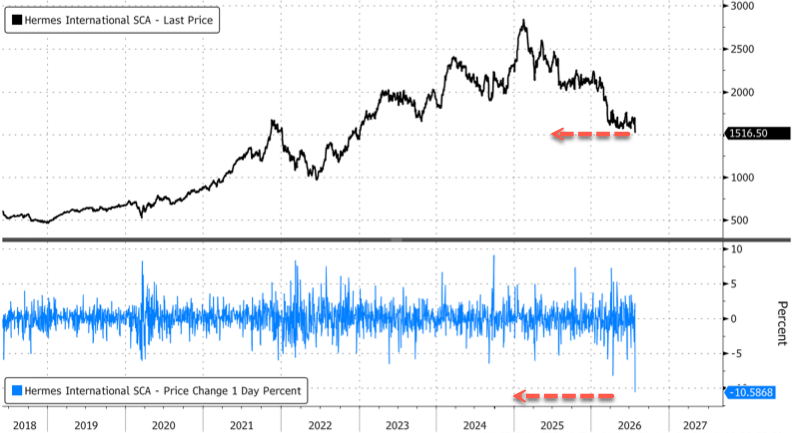
Hermès shares in Paris suffered their steepest intraday decline in nearly 16 years after second-quarter leather goods sales missed estimates among analysts tracked by Bloomberg, reigniting concerns over the luxury group's large exposure to the Chinese market.
Second-quarter sales in the leather goods division rose 10.2% at constant exchange rates, missing the Bloomberg Consensus estimate of 10.7%. Overall revenue increased 6.7% to about 4.1 billion euros, slightly ahead of estimates, driven by 13.7% growth in the Americas.
Here's a snapshot of 2Q Earnings:
Sales at constant exchange rates +6.7%, estimate +6.51% (Bloomberg Consensus)
- Leather goods sales at constant exchange rates +10.2%, estimate +10.7%
- Watches revenue at constant exchange rates +4.4%, estimate +0.17%
- Perfumes revenue at constant exchange rates -9.5%, estimate -1.47%
- Silk and Textiles revenue at constant exchange rates +12.2%, estimate +7.5%
- Ready-to-Wear and Fashion revenue at constant exchange rates +3.6%, estimate +3.53%
- France revenue at constant exchange rates +6.2%, estimate +3.78%
- Total Europe revenue at constant exchange rates +7.4%, estimate +6.89%
- Japan revenue at constant exchange rates +12.3%, estimate +10.7%
- Asia Pacific revenue at constant exchange rates +2.5%, estimate +3.2%
- Asia revenue at constant exchange rates +4.4%, estimate +4.51% (2 estimates)
- Americas revenue at constant exchange rates +13.7%, estimate +13.9%
UBS analyst Zuzanna Pusz wrote in a note to clients that her initial takeaway from the earnings call was "softer messaging on leather," suggesting management had adopted a more cautious tone toward the key division.
Pusz continued:
Subtle shift in messaging may raise questions on medium-term targets
At the Group level, results were broadly in line with expectations, however one of the key concerns was softness in the Leather Goods division (OSG of +10% vs. cons. & UBSe of +11%). In our view, management's commentary is unlikely to provide much shortterm reassurance. When asked about the MT growth algorithm and prior guidance for FY26 (6-7% volumes + 6% pricing), management stressed that the framework cannot be reduced to a simple combination of volume growth and price/mix, arguing that such an approach would be overly simplistic ignoring the regional pricing and productivity. Although the company reiterated robust demand for its handbags and reaffirmed its ambition to continue expanding volumes, the shift in messaging may be interpreted as a subtle softening of its commitment to previously assumed MT growth targets.
Tourism drag becomes harder to ignore in France
Management reiterated that France remains more exposed to tourism than the rest of Europe, helping explain the weaker performance relative to Europe ex-France. French stores are said to have been affected by lower tourist flows, particularly from the Middle East, which continued to weigh on Parisian locations, with the impact estimated at c.- 1.5ppt to Q2 growth, unchanged from Q1. By contrast, Europe ex-France remained strong, supported by Italy, Northern Europe, Germany, Greece and the UK following its recent space expansion. While local demand in the Middle East remained resilient, trends in concession markets were more mixed. Overall, management's comments suggest tourism, particularly Middle Eastern spending, remains an important swing factor, while growth is increasingly supported by strong local demand in markets such as the US, Japan, Korea and parts of Europe.
There are multiple factors underpinning the strength in margins
One of the key positives from the release was the strength of the EBIT margin, which came in at 41.0% (vs. consensus of 40.4%). While management unsurprisingly refrained from providing near-term guidance, it highlighted healthy product sellthrough rates without any build-up in inventories. The company also pointed to a favourable contribution from FX hedges in H1, while noting that the H2 impact will depend on where exchange rates ultimately settle. In addition, Hermès reiterated its intention to step up investments in communication and marketing initiatives to support customer recruitment, alongside continued expansion of its sales teams in key markets such as the US, Japan and South Korea. On raw material costs and pricing, management indicated that price increases in 2027 are likely to be somewhat lower than those implemented in 2026.
Jefferies analysts led by James Grzinic told clients that "the ongoing lack of growth in China" remains a major concern for the stock. The luxury industry has been under pressure for several years as Chinese consumers dial back on spending, inflation weighs on discretionary demand and conflict in the Gulf region disrupts regional shopping hubs and tourism flows.
China, once a key growth driver for the sector, remains under pressure. Hermès Executive Chairman Axel Dumas said the market is showing signs of stabilizing but has yet to stage a meaningful recovery.
"I see a stabilization of the Chinese market, but I don't see a fundamental rebound yet," Dumas said during the earnings call, adding that Hermès continues to grow in the country, but at a slower pace than in recent years.
The disappointing earnings report sent Hermès shares tumbling as much as 11% in Paris, the steepest intraday decline since Oct. 10, 2010. The stock has fallen to levels last seen in 2023 and has nearly halved since peaking in early 2025.
Here's what other desks on Wall Street are saying (courtesy of Bloomberg):
Citi (neutral)
- Thomas Chauvet says misses in the leather and perfumes divisions offset strong performance in silk & textiles, watches, France and Middle East
- Expects limited changes to FY26 consensus sales and Ebit
Deutsche Bank (buy)
- Adam Cochrane says firm delivered "solid" 2Q performance, which was modestly ahead of expectations
- Adds that "quality of growth was mixed," with Americas particularly strong as well as Japan accelerating, while Europe was softer than expected
- Highlights rising gross margin helped offset higher operating expenses
Jefferies (buy)
- James Grzinic says "more critical to the debate will be the extent to which the ongoing lack of growth in China may also reflect the group restricting the supply of some products in that market"
RBC (outperform)
- Piral Dadhania notes that, by region, there are "no major surprises with Other less bad than feared"
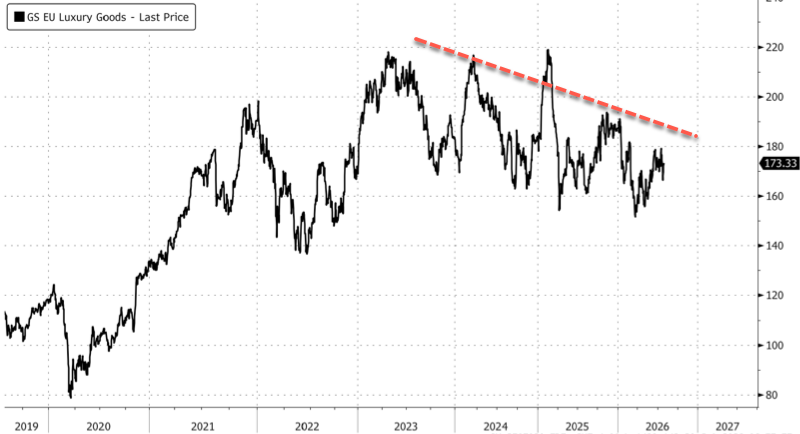
Sector-wide, the Goldman Sachs European Luxury Index has largely stalled over the past three to four years.
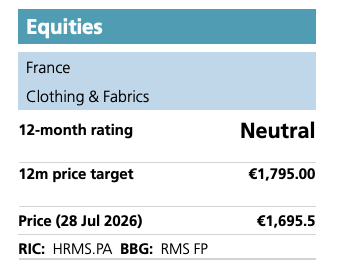
UBS remains "Neutral" on Hermès, with a 1,795-euro 12-month price target.
Professional subscribers can read more on luxury here at our new Marketdesk.ai portal
Related Markets
All MarketsMarket data may be delayed. Not financial advice.
Powered by Gab AI
The Story At A Glance
Reading this article now — analysis appears below
💡 AI analysis provides alternative perspectives on current events