MSFT Bounces After Revenue Beat On Cloud Strength, CapEx In Line
.jpg?itok=_zwtN1z5)
The short version
- The positioning data tells the story first.
- They are holding, and they are holding into the report.
- The reason is not mysterious to anyone who watched last week .
- Crucially, the lesson from GOOGL is that the market has stopped rewarding hyperscalers for spending money, which is inconvenient for companies whose entire strategic posture is…
- "Alphabet's capex boost increases the odds of similar behavior" from Microsoft and Amazon, Evercore ISI's Mark Mahaney wrote in a client note last week…
The story
Microsoft walked into tonight's fiscal fourth-quarter earnings report carrying the most bearish positioning it has seen in more than a decade, and it does so on an afternoon when the Fed - now run by a chairman who has made a point of telling markets nothing - triggered significant volatility in stocks and bonds.
The positioning data tells the story first. According to S3 Partners data reported by CNBC, roughly 92 million Microsoft shares are now sold short, or 1.27% of the public float - the highest short interest as a percentage of float since May 2015, and the largest short-interest build anywhere in the Magnificent Seven. More telling than the level is the behavior: S3 says there has been virtually no short covering into the print, which means the bears are not taking profits on a stock that is already down more than 18% year-to-date and, as GeekWire notes, sitting near a one-year low despite consistently beating estimates. They are holding, and they are holding into the report.
The reason is not mysterious to anyone who watched last week.
Alphabet delivered what would once have been a triumphant quarter - revenue up 24%, cloud up 82% - then raised its 2026 capex forecast by roughly $15 billion to as much as $205 billion, and for its trouble watched the stock fall 7% the next day and slip below its prior $4 trillion valuation.
Crucially, the lesson from GOOGL is that the market has stopped rewarding hyperscalers for spending money, which is inconvenient for companies whose entire strategic posture is spending money.
"Alphabet's capex boost increases the odds of similar behavior" from Microsoft and Amazon, Evercore ISI's Mark Mahaney wrote in a client note last week, which is precisely what the shorts are betting on.
And so, with all that in mind, what did MSFT report?
The headline is a strong top-line beat out of the gate:
-
Microsoft Q4 Revenue was $90.01 billion, up 18%, and better than the consensus $87.7 billion.
-
Q4 diluted earnings per share jumped 23% (on a non-GAAP basis) to $4.74 (but this is not entirely comparable to the $4.25 consensus thanks to $3.2billion gain from their investment in Anthropic and 7c/share loss from OpenAI's investment)
Under the hood, MSFT's cloud unit posted a larger-than-expected increase in sales, suggesting that the company’s computing infrastructure and artificial intelligence services continue to make inroads with businesses.
Azure cloud-computing revenue increased 43% during the fiscal fourth quarter, the company said Wednesday in a statement. That exceeded analysts’ average growth estimate of about 40%.
Nadella highlighted progress on the “cost-to-outcome curve” and noted two major milestones
“We are advancing the frontier on the cost-to-outcome curve, ensuring every customer can turn tokens into business results," said Satya Nadella, chairman and chief executive officer of Microsoft.
“This year, Azure revenue surpassed $100 billion for the first time, and Microsoft 365 Copilot reached over 30 million paid seats, reflecting the confidence customers are placing in us to power their AI transformation.”
All units beat on revenues:
-
Microsoft Cloud Q4 revenue $59.3 billion, estimate $58.71 billion, up 27% YoY
-
Intelligent Cloud revenue $39.31 billion, estimate $38.17 billion
-
Productivity and Business Processes revenue $37.85 billion, estimate $37.27 billion
-
More Personal Computing revenue $12.85 billion, estimate $12.17 billion
Net income was $35.8 billion and increased 31% on a GAAP basis, and was $35.3 billion and increased 22% on a non-GAAP basis
Finally, and perhaps most crucially, Capital expenditures (including assets acquired under finance leases) increased 70% to $41 billion in the quarter, which is notably less than the $42.5 billion expected, on track to meet their roughly $190 billion annual guidance, but Capital-spending details on the conference call are more important, given the metric exceeds 50% of calendar 2026 sales.
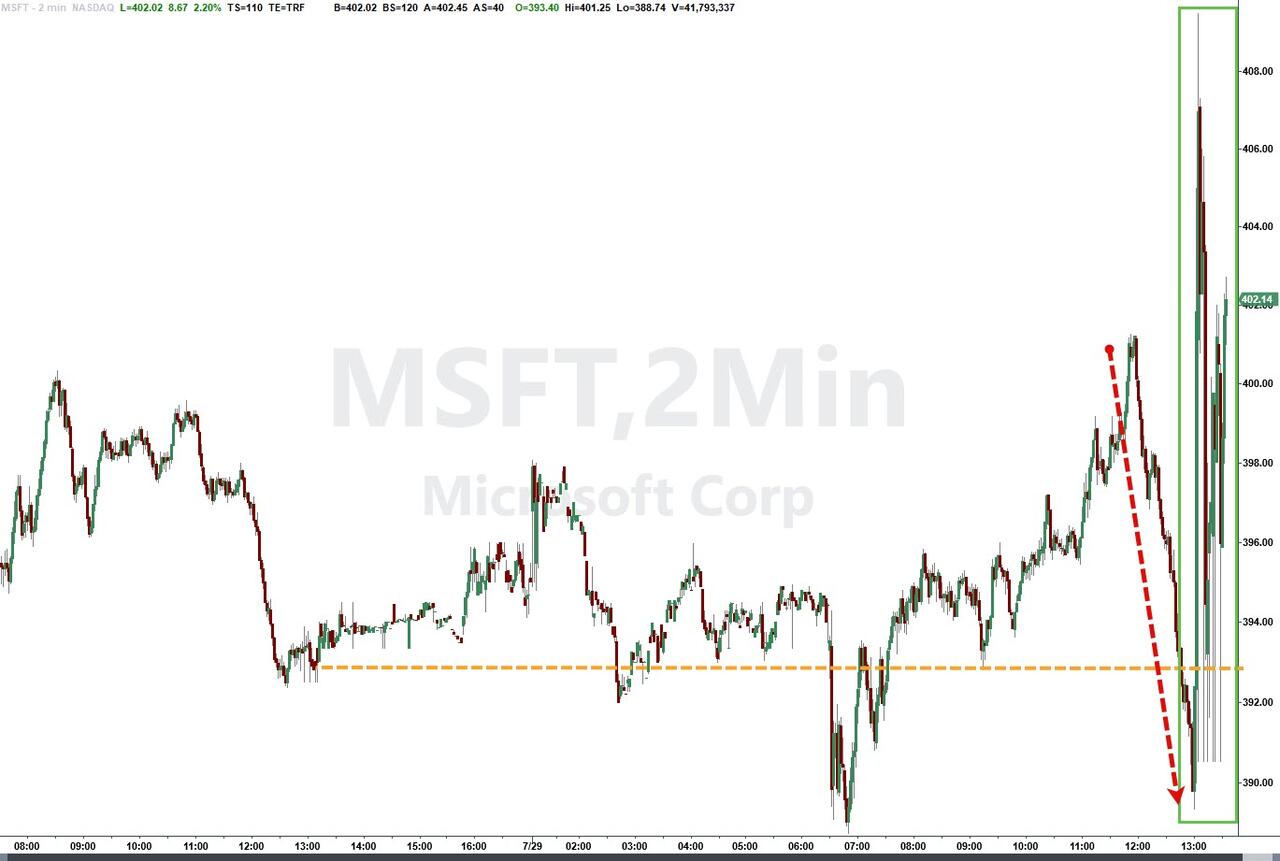
Following an afternoon of pain (thanks to Warsh), MSFT shares are bouncing modestly after hours - up around 3%...
Tonight closes the books on a fiscal year in which Microsoft guided capital expenditures and finance leases to roughly $190 billion - up 61% from the prior year - including, per CFO Amy Hood's April guidance, a $25 billion hit from higher component prices as the global memory crunch feeds straight into the cost of building AI infrastructure.
The forward-looking problem is worse: BNP Paribas analysts are already penciling in $262 billion of capex for fiscal 2027. Cloud gross margin, guided to roughly 64% for the quarter, has been grinding lower as data-center depreciation piles up, meaning the spending is now visibly eating into the earnings it was supposed to eventually justify.
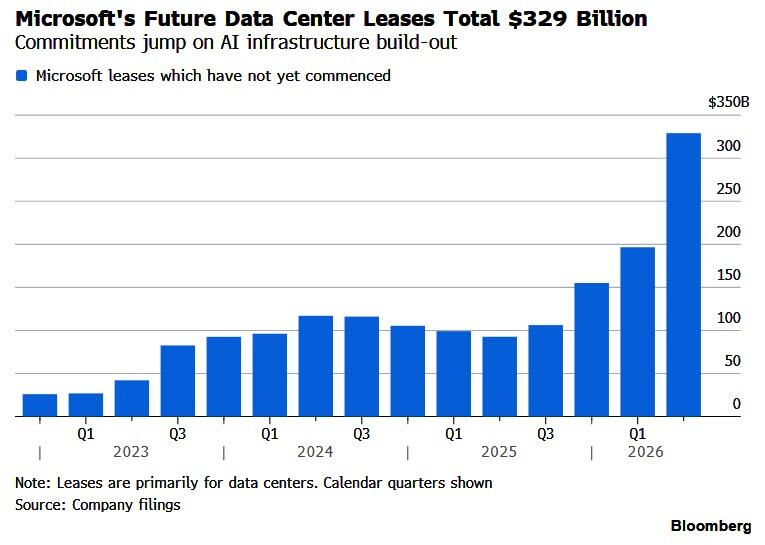
Along those lines, Bloomberg's Brody Ford reports that Microsoft added more than $130 billion in new data center leases in the past quarter, signaling an accelerating pace of spending on artificial intelligence infrastructure.
The company’s total commitments for leases that have not yet commenced were $329.1 billion as of the quarter ended June 30, Microsoft said Wednesday in a regulatory filing. That’s up from $196.6 billion in the prior period.
“That’s really a signal of the continued demand strength that we see,” Jonathan Neilson, Microsoft investor relations chief, said in an interview.
“These leases are going to be there to serve demand for many many years.”
The future costs, which come on top of active leases, won’t appear on Microsoft’s balance sheet until it begins making payments on them. The company said they are “primarily” for data centers and some are “subject to certain contractual conditions being met.”
This represents Microsoft’s largest quarterly jump in data center leasing by far.
The software giant continues to be held back by a lack of data center capacity after taking a pause on its leasing activity through much of 2025.
However, as we detailed earlier, simply put, until MSFT demonstrates some more tangible progress in AI (Copilot progress, proprietary LLM, proprietary chip, etc. as OpenAI potentially steals institutional share), it will likely remain on the battleground.
Microsoft will give its sales outlook for the current quarter, its fiscal Q1, as well as details on actual FY2026 CapEx on the conference call with analysts tonight.
Related Markets
All MarketsMarket data may be delayed. Not financial advice.
Powered by Gab AI
The Story At A Glance
Reading this article now — analysis appears below
💡 AI analysis provides alternative perspectives on current events