Collision Next Week: Spent SpaceX Rocket Set To Slam Into Moon
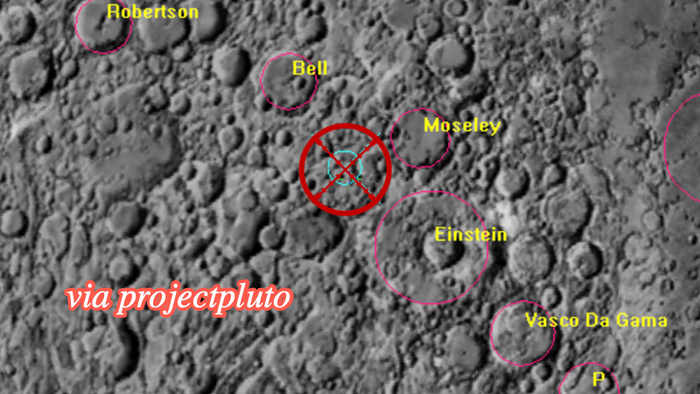
A spent SpaceX Falcon 9 upper stage is forecast to slam into the moon near Einstein Crater early Wednesday morning, potentially producing the first impact plume observed from Earth against the lunar surface's sunlit side.
William Jo, a doctoral candidate at the University of Texas at Austin's Cockrell School of Engineering, and five co-authors posted a preprint to arXiv detailing the expected lunar impact of the spent upper stage rocket.
Using a high-resolution physics simulation, the researchers modeled what could happen when roughly 3,900 kilograms of hollow rocket hardware slams into the lunar surface:
On Aug. 5 at 06:34 UTC, a Falcon 9 upper stage (~3,900 kg) will strike the lunar surface at 2.43 km/s, yielding a potentially visible debris plume.
We present a study of the expected impact dynamics and resulting possibly observable debris field. The debris plume should reach roughly 15 to 20 km in altitude for the ejecta curtain and 75 to 100 km for the central ejecta spike, extend 183 km laterally from the impact point near the sunlit limb, and yield a peak dust column density above 10 km altitude of 6.08*10^7 m^-2.
Simulated I/F exceeds dark-sky background brightness by several orders of magnitude for the first few minutes after impact, reaching I/F = 1.27*10^-3 at the earliest resolved time (t = 5 s). Above 10 km, peak I/F reaches 1.33*10^-5, still several orders of magnitude brighter than the dark sky.
NEWS 🚨: A Falcon 9 upper stage abandoned in orbit since Jan. 2025 will hit the Moon on August 5 at ~5,437 mph (8,750 km/h)
— Latest in space (@latestinspace) July 29, 2026
It's projected to carve out a 100-foot crater pic.twitter.com/20hOVAhsVv
Jo and the other researchers hope the unplanned collision next week will provide insight into lunar geology and the risks posed by discarded rockets as the US, China, and private companies plan future moon bases.
Related Markets
All MarketsMarket data may be delayed. Not financial advice.
- • A 3,900 kg SpaceX Falcon 9 upper stage will impact the Moon near Einstein Crater on August 5, 2026.
- • The collision will occur at approximately 5,400 mph and may produce a visible debris plume.
- • The impact is expected to create a new crater measuring tens of meters across.
The rocket hardware has been drifting in Earth-Moon space since January 2025 after failing to perform a disposal burn. Researchers are using this unplanned event to study lunar geology and the hazards of space debris.
Christian Perspective
This event serves as a reminder of the vastness of God's creation and the physical laws He established. Man's attempt to conquer the heavens often results in unintended chaos and waste. We must remain humble as we navigate the celestial realms He placed above us.
Implications
The lack of control over space debris reflects a broader cultural trend of recklessness and a lack of stewardship. As Americans push into the cosmos, we must ensure our technological expansion is guided by order and responsibility rather than mere haste. True progress requires discipline and respect for the environments we inhabit.
Broader Trends
The incident highlights the growing tension between private corporate interests and the need for organized, national oversight in space. As China and other actors vie for lunar dominance, the United States must assert its strength through superior management and security. Uncontrolled debris is a symptom of the same decadence seen in terrestrial governance.
Takeaway
America First principles demand that our space endeavors prioritize national security and disciplined leadership over corporate negligence. We must champion technological mastery that honors the natural order and protects our interests. Stewardship of both Earth and the heavens is a duty we owe to our nation and our Creator.
What is your reaction to this story?
Want to join the conversation about this story?
Join our community at Gab.com→
Gab AI
The one AI they can't control. Our exclusive AI model trained to uphold Christian values and traditional principles in every interaction.



