Groundhog Day

By Benjamin Picton, senior market strategist at Rabobank
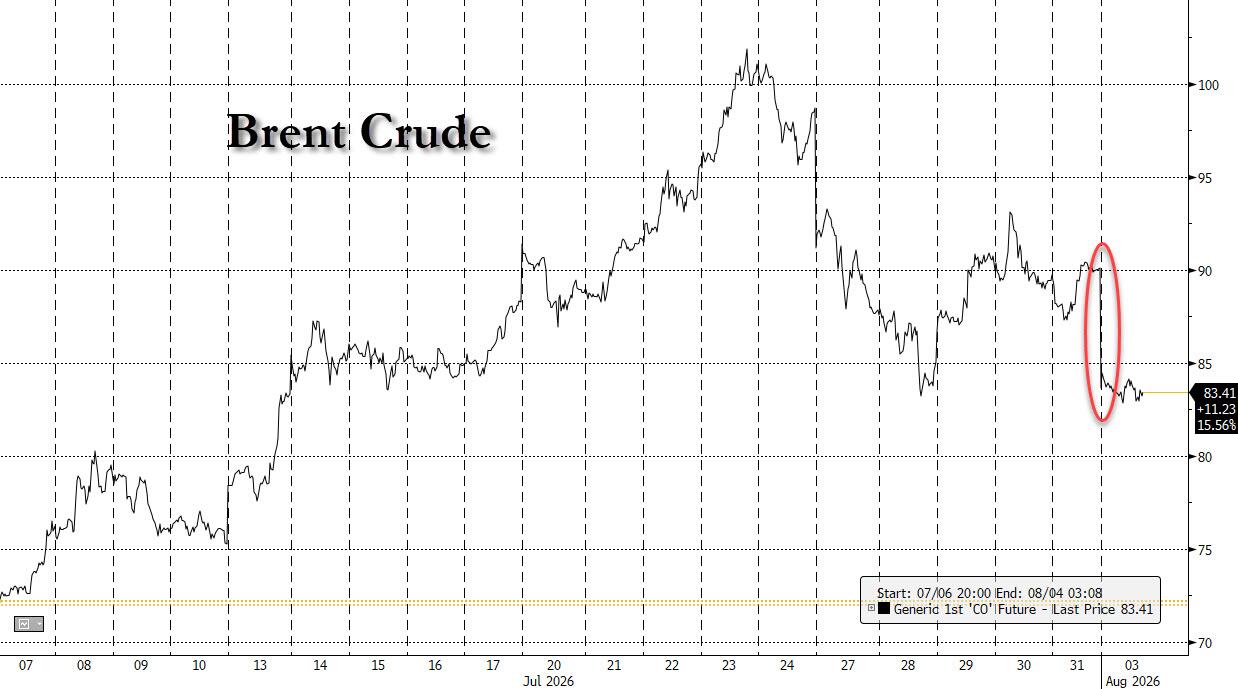
It’s Monday morning again and it feels like Groundhog Day as I sit down to write that the US President has (again) halted strikes on Iran and teased that a diplomatic breakthrough is close. Brent crude prices have dutifully fallen in early trade, risk currencies are rallying and equity markets are poised to extend the gains posted late last week.
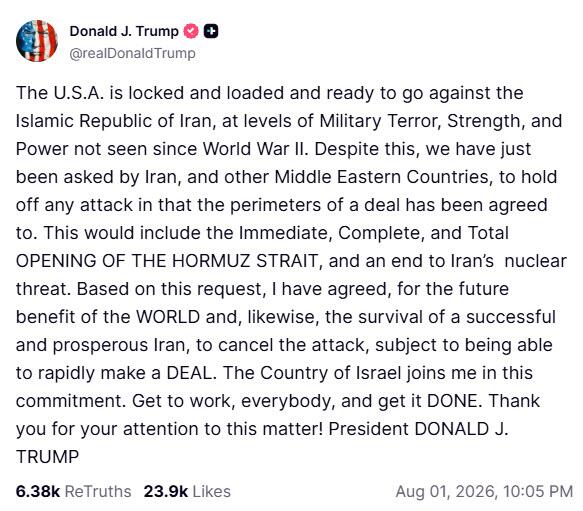
In his trademark bloviating style, President Trump posted to Truth Social that the USA was “locked and loaded” to unleash “levels of Military Terror, Strength, and Power not seen since World War II”, but that “for the future benefit of the WORLD” he had responded to a request from Iran and other Middle Eastern countries to hold off as the outline of a deal had been agreed. Trump went on to claim that the deal would include the “Immediate, Complete, and Total OPENING OF THE HORMUZ STRAIT”, as well as an end to the Iranian nuclear threat.
Obviously we’ve heard this one before. Iran’s Fars news agency reports that “informed sources” deny that any agreement has been reached on the status of the Strait of Hormuz, and that policy regarding the critical shipping route remains unchanged.
Meanwhile, Iran’s IRNA news agency reported that negotiations between Iran and Oman over the administration of the strait are in the final stages. Foreign ministry spokesman Esmail Baghaei said that talks have centerd around agreeing a new route for shipping, and that the talks are unrelated to the question of whether Hormuz is open or closed. He said that issue is a separate discussion. However, markets will take the positive signal that agreeing a new shipping route implies future shipping. What it does not tell us is where the ships will head to and under what conditions.
Of course, the other aspect of the Hormuz Groundhog Day is that later in the week strikes typically resume, oil prices rally, equities sell, and bond yields rise. While there is every chance of that happening this week for now the impression seems to be of ‘strikes for strikes’. This would require somebody to break the current pause that seems to suit the purposes of both sides for the moment. Encouragingly, Iranian sources continue to stress “proportionality” in responding to US aggression, which seems to imply an unwillingness to escalate, but there also continues to be a sense that the civilian government in Tehran is not on the same page as the IRGC – who broke the most recent pause in hostilities by attacking US targets in Jordan.
Less than five days left until Trump announces the next massive Iran strikes at 4:01pm on Friday
— zerohedge (@zerohedge) August 3, 2026
The relentless logic of arithmetic continues to be the critical factor in Middle East developments. Markets have so far taken large draws in global inventories in their stride with price rises mostly insufficient to cause severe demand destruction. At the same time, higher prices have induced a supply response by lifting US oil rig counts by almost 11% since the war broke out, increasing refinery capacity utilization, and prompting OPEC+ to announce another 188,000 lift in production quota from September onwards.
The physical realities of war in the Eastern Europe and the Middle East have rendered the latter a mostly theoretical increase for the time being, but could contribute to a structural reshuffling of the energy deck on the other side of the current crisis. Product markets continue to provide the clearest hints of the seriousness of the current supply squeeze, with Singapore gasoil spot prices still sitting more than two standard deviations above the long-run spread to Brent.
China continues to play the role of balancing entry in global energy trade while also pedalling faster than most to reduce its dependence on imported energy. The manufacturing investment boom in solar panels, batteries and electric vehicles is helping to offset the slow-motion trainwreck that is the Chinese real estate market, while also building supply chain resilience and doing planet Earth a solid with regards to climate change.
While geopolitics and a protectionist tilt away from Chinese goods in an effort to safeguard domestic supply chains is underway, some are still happy to take the subsidy from China and import those cheap goods to boost domestic living standards. Australia is one such country, where new household battery installations in the first half of 2026 was roughly equal to total household battery installed capacity in the United States, a country with more than twelve times the population. BloombergNEF reports that Australia now ranks third globally in terms of installed battery capacity, behind only the USA and China. This sounds good in the short term, but critics will note that this perhaps invites new risks for Australia’s domestic energy infrastructure – not to mention the trade and security relationship with the United States.
Electric vehicle sales has similarly surged since energy flows through Hormuz were interrupted, with battery and hybrid vehicle sales reaching almost 50% of total sales in Q2 and interrupting Australia’s long-running love affair with diesel pickup trucks. The surge in EV sales has accrued mostly to new market entrant brands from China and to (largely Chinese-made) Tesla. Year-on-year sales growth in June was 131% for BYD, 89% for Tesla, 327% for Geely, 569% for Jaecoo, 1660% for Zeekr and 316% for Leapmotor. Four of the top ten, and seven of the top twenty best-selling brands are now Chinese.
The success of those new entrant Chinese brands highlights the challenges faced by legacy manufacturers in the US, Japan, South Korea and, especially, Europe – where marques such as Fiat and Citroen have already exited the market, while Peugeot is reportedly considering a similar move. In an era where supply chain sovereignty and industrial capacity matters for national security, how can legacy manufacturers compete with the Chinese industrial juggernaut without meaningful restrictions on Chinese trade or massive export subsidies of their own?
Related Markets
All MarketsMarket data may be delayed. Not financial advice.
💡 AI analysis provides alternative perspectives on current events