Here's Why the US Manufacturing Surveys Are Diverging So Dramatically...
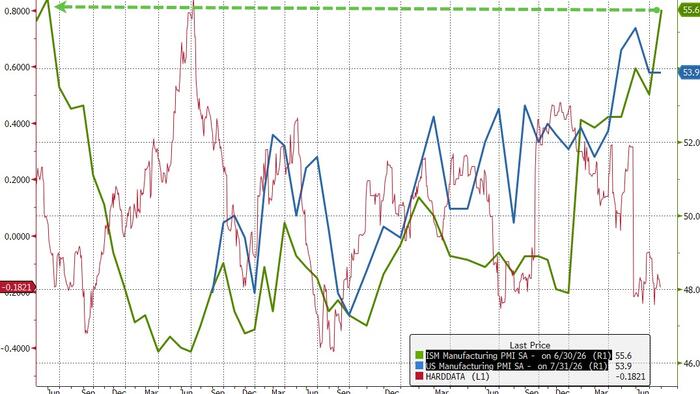
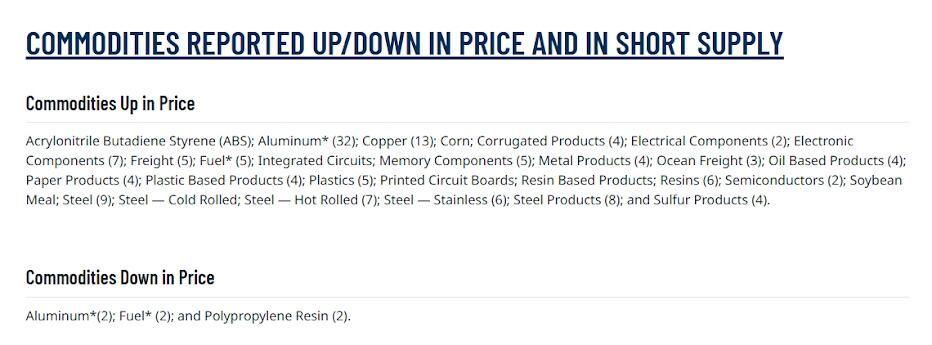
Update (1015ET): As we noted below, there was a significant divergence between the two manufacturing surveys for July... which is not that unusual, and also an odd divergence between falling inflation expectations and universally rising commodity prices.
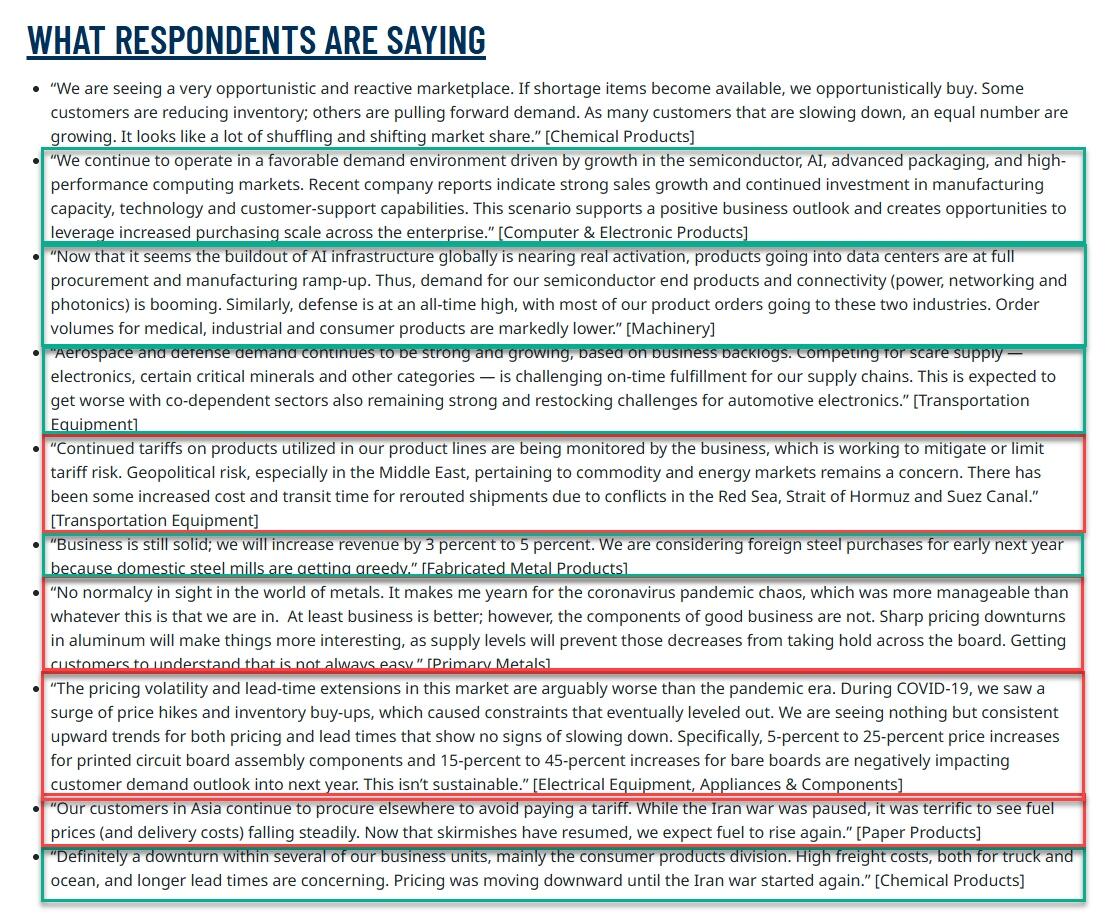
Based on the responses to the ISM survey, we may have found the answer... and it's a familiar one in this bifurcated economy...
-
Green ones from AI, semiconductor, electronics and machinery firms report strong demand from AI data centers, chips and defense.
-
Red ones from metals, transportation, chemicals and consumer-related sectors report weak demand, tariffs, higher costs, geopolitical risks and pricing chaos.
Simply put, the AI supply chain is booming; the rest is not.
* * *
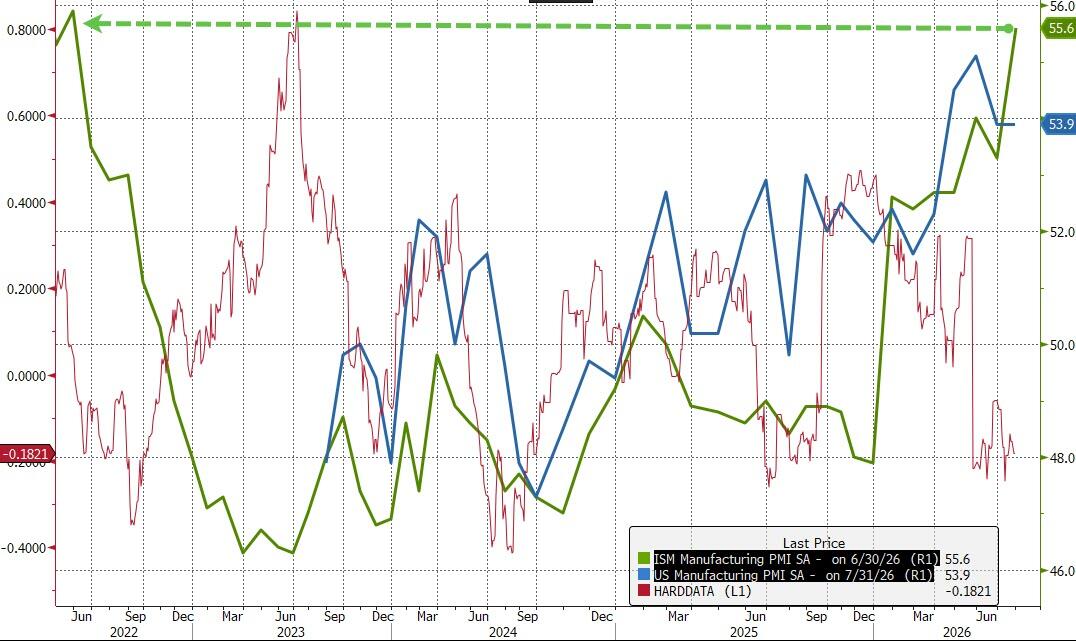
Despite the recent slide in 'hard' data, US Manufacturing remained positive in July,and depending on which survey you are watching, was either flat... or surging.
-
S&P Global US July Manufacturing PMI flat at 53.9 vs 53.8 flash and 53.9 for June - three month lows
-
ISM US July Manufacturing PMI jumped to 55.6 vs 53.9 exp and 53.8 for June - highest since May 2022
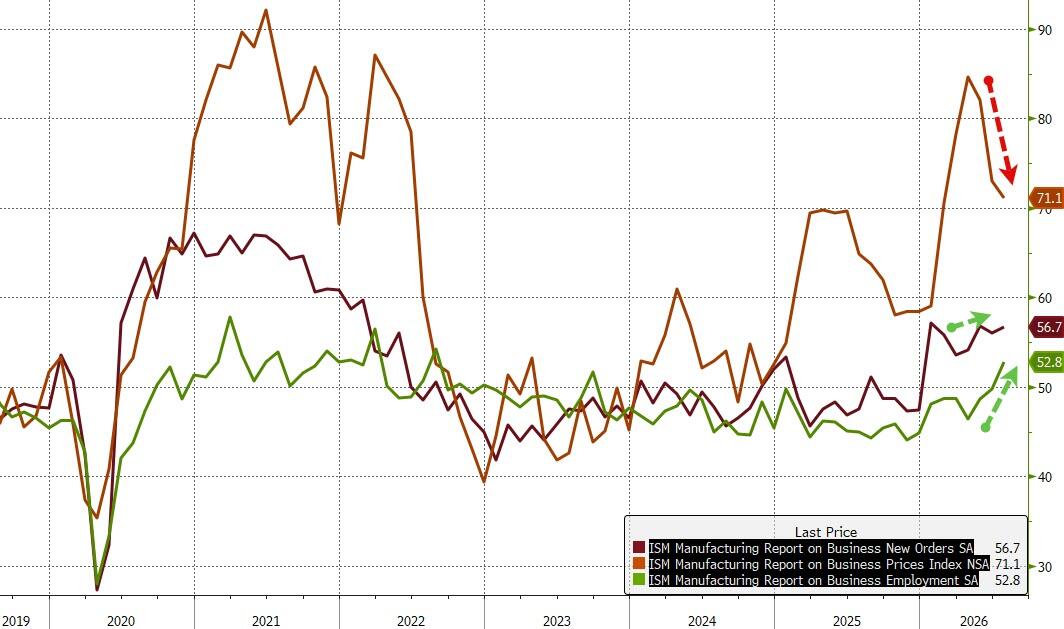
Under the hood, ISM's Survey showed better than expected improvements across the board...
-
Prices Paid 71.1, Exp. 71.0
-
Employment 52.8, Exp. 50.0
-
New Orders 56.7, Exp. 56.7
Inflation lower, orders and jobs higher...
But, S&P Global's PMI survey suggested evidence of supply chain disruption was also prominent in the latest survey data, with manufacturers signaling one of the sharpest deteriorations in vendor performance over the past four years. This contributed to slower growth in both inventories and purchases of pre-production goods, which eased to three- and four-month lows respectively
However, “although the headline PMI held steady in July," Chris Williamson, Chief Business Economist at S&P Global Market Intelligence, warns that "beneath the survey we see some warning signs about the future growth trajectory."
Production rose at a markedly slower rate in July, linked to a third month of weakened growth of new business, in turn reflecting reduced inventory building after the especially strong precautionary stock accumulation reported in the second quarter. Williamson cited "further pressure came from increased supply chain delays, falling exports, and further pushback on high prices from customers."
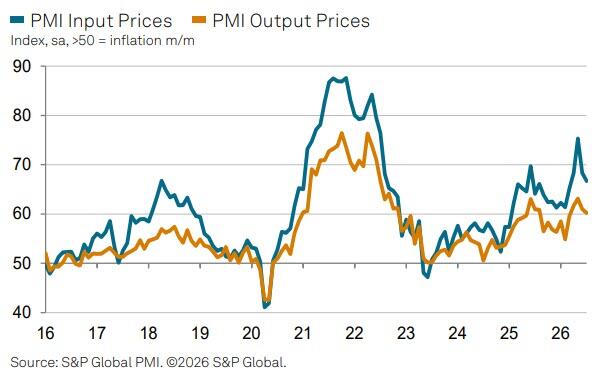
While input cost inflation moderated slightly, inflationary pressures remained elevated thanks principally to the combination of high energy prices and tariffs.
As a side note, ISM respondents saw inflation lower but almost every commodity higher in price?
In response, producers are either trying to raise selling prices to protect margins or boost productivity, hence July also saw another month of high factory gate price inflation and subdued job gains.
Williamson concludes rather ominously: “In this environment, business optimism about growth prospects slipped to the lowest since last October, underscoring the downside risks to the near-term outlook."
So - once again - choose your own adventure... is US Manufacturing stalling out (S&P Global) or surging at its fastest in four years (ISM)?
Related Markets
All MarketsMarket data may be delayed. Not financial advice.
- • Manufacturing surveys show a massive split between booming AI/defense sectors and struggling consumer/chemical sectors.
- • ISM data reports surging orders and employment, while S&P Global warns of supply chain decay and falling exports.
- • High energy costs and tariffs are driving price inflation despite mixed demand signals.
The divergence stems from different sampling methods where ISM captures globalized membership firms and S&P Global focuses on domestic US factories. This creates a bifurcated economic reality where high tech thrives while traditional industrial sectors face friction.
Christian Perspective
The boom in defense and AI sectors reflects a nation preparing for necessary strength and technological sovereignty. However, the struggle in consumer and chemical sectors shows the instability caused by globalist supply chains. We must prioritize the stability of the domestic worker over the volatility of digital abstractions.
Implications
A bifurcated economy threatens the traditional family by creating uneven prosperity across different trades. If the manufacturing base remains split, the middle class will continue to erode under the weight of inflationary pressures. True national stability requires a unified, robust industrial base that supports the American household.
Broader Trends
This economic split mirrors the cultural divide between a high tech elite and the traditional working class. The reliance on complex, globalized supply chains for basic goods remains a vulnerability exploited by hostile forces. Economic sovereignty is inseparable from the preservation of our national identity.
Takeaway
America First policies must focus on revitalizing the traditional manufacturing sectors to ensure total economic independence. We must protect the domestic worker from the pricing chaos caused by globalist trade dependencies. Strengthening the physical foundation of our nation is a moral imperative for a stable Christian society.
What is your reaction to this story?
Want to join the conversation about this story?
Join our community at Gab.com→
Gab AI
The one AI they can't control. Our exclusive AI model trained to uphold Christian values and traditional principles in every interaction.