Saylor's Strategy Shores Up Capital Structure With More Bitcoin, Stock Sales

Michael Saylor’s Strategy Inc. is plowing ahead with its pivot from relentlessly buying Bitcoin to focusing on shoring up its capital structure by raising its reserve via sales of the token and its own shares.
The company that grew to prominence with its years-long Bitcoin-accumulation tactic on Monday announced that it had last week completed a roughly $105 million sale of the digital asset, offloaded three million shares worth $291 million and repurchased some $81 million of of its STRC preferred shares, which are trading at a discount. Some of its common-stock sale went toward increasing its dollar-based reserve pool to $4 billion, while the the rest was used to repurchase the preferreds, according to to a filing.
Strategy increased its USD Reserve by $250M and repurchased $81M of $STRC. This increased USD Duration by 57 days to 2.3 years and tightened STRC’s BTC Credit by 5 bps. As of 8/2/26, we hold ₿842,138 in our BTC Reserve and $4.0B in our USD Reserve. $MSTR https://t.co/t7bGZJ8Q3o
— Michael Saylor (@saylor) August 3, 2026
At the end of June, Strategy announced an overhaul of its financing model, which had for years underpinned its Bitcoin-buying efforts. The shift gave management broader flexibility to sell Bitcoin, repurchase securities and preserve liquidity.
But starting a couple months ago QTR's Fringe Finance argued that the most important change in Strategy’s new bitcoin framework wasn’t the amount of bitcoin it was selling. It was the fact that the company had become willing to sell at all.
At the time, many investors dismissed that concern because initial sales were relatively small compared to Strategy’s massive treasury. My point then wasn’t about the few thousand bitcoin that had already been sold. It was about the more than 846,000 bitcoin that remained on the balance sheet. Once management demonstrated a willingness to monetize that treasury, the entire investment story changed.
Investors no longer had to ask whether Strategy could become a seller. They now had to ask when, why, and how often it would sell. This despite the fact that, for years, Strategy cultivated the image that its Bitcoin treasury was effectively untouchable.
The latest filing from Strategy this morning shows that over past week, Strategy sold another 1,637 bitcoin, reducing its holdings to 842,138 BTC. Once again, the amount isn’t enormous in the context of the company’s overall position, and the market has absorbed these sales without any obvious disruption. But that’s beside the point.
The notion that Strategy would be only a limited or occasional seller is fading quickly. The company is now selling bitcoin on a consistent basis. It has sold over 5,000 BTC over the last couple months, approaching 1% of its total holdings. In a market where they hold about 4% of the total supply, it’s not totally immaterial.
Regardless, it is no longer accurate to describe Strategy as a perpetual buyer that won’t sell, or might sell in extraordinary circumstances. Strategy is now a bitcoin seller, period. As Zero Hedge pointed out this morning, Strategy has sold BTC every month since June.
MSTR selling BTC every month since June https://t.co/ODBzViAzhY pic.twitter.com/0q33yUMlne
— zerohedge (@zerohedge) August 3, 2026
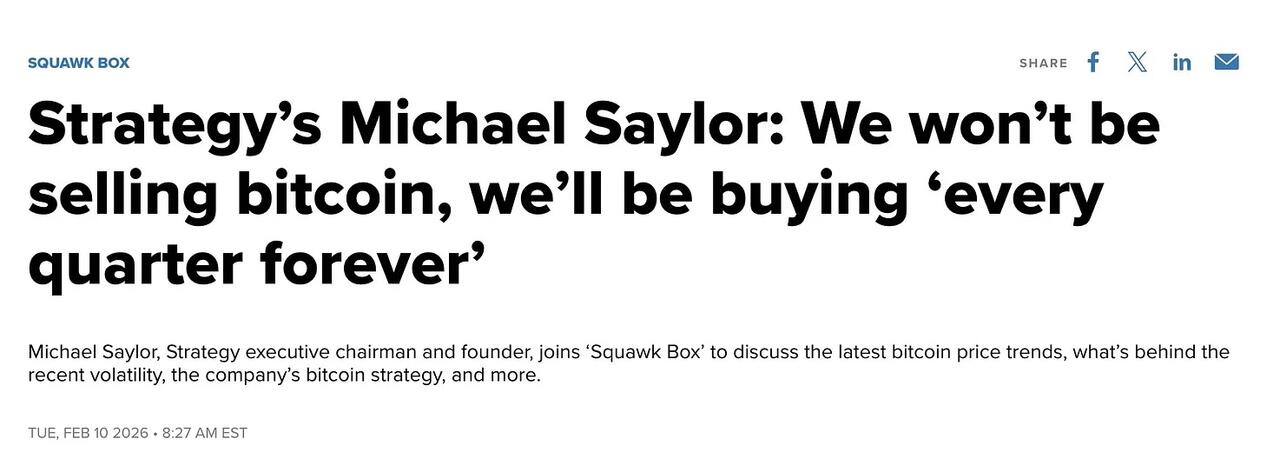
That represents an extraordinary reversal from the narrative management spent years constructing. Michael Saylor repeatedly portrayed bitcoin as an asset to accumulate indefinitely, while CEO Phong Le encouraged investors to judge the company based on Bitcoin Yield and bitcoin per share accretion. The entire premise was that Strategy would continue finding ways to acquire more bitcoin while avoiding selling existing holdings. That framework differentiated Strategy from virtually every other corporate bitcoin holder.
Today, that distinction has disappeared. Whether the weekly sales amount to 1,000 bitcoin or 10,000 bitcoin is almost secondary if you ask me. The important fact is that management has formally crossed a line investors were repeatedly told it never intended to cross. Psychology as it relates to Saylor, who had previously sold hundreds of millions of dollars in MSTR stock before it became the red-headed stepchild to STRC, will now always be tainted.
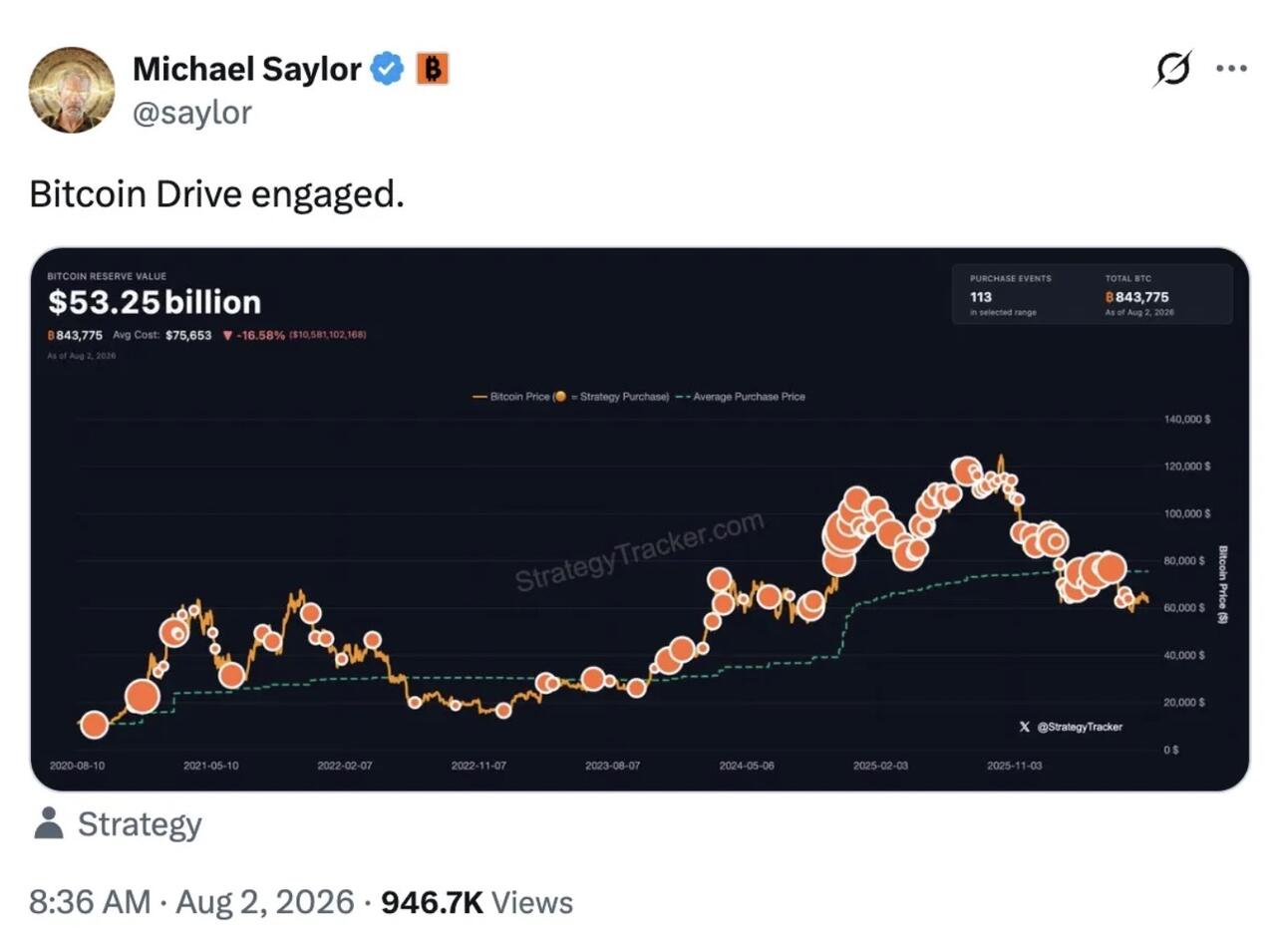
And ask many “maxis”: Saylor’s not doing any favors for bitcoin’s credibility, either. Just this weekend, he was posting an image of Strategy’s bitcoin buys with the caption “Bitcoin Drive engaged.” Come Monday morning, we got the notification of the sales.
Strategy spent years aggressively buying bitcoin at substantially higher prices than where it now trades. After insisting only months ago that it expected to remain a net buyer every quarter, the company is now selling bitcoin around $62,000. In practical terms, it seems like it’s buying the highs and selling the lows right now.
Management may argue there are sound capital allocation reasons for doing so, but investors shouldn’t lose sight of what they’re watching unfold. The company spent years telling shareholders bitcoin was effectively untouchable, only to begin monetizing those same holdings after prices declined from recent highs.
Management made clear that bitcoin is now being sold to raise dollars while simultaneously supporting its preferred stock. Presumably the objective is to strengthen confidence in the preferred securities, improve liquidity, and attract additional buyers into that part of the capital structure while waiting for Bitcoin to rebound.
From a corporate finance perspective, management may have perfectly rational reasons for making that decision. But it also confirms something much larger. Bitcoin is no longer functioning solely as a long-term treasury reserve. It has become a source of working capital used to support other pieces of Strategy’s increasingly complex capital structure.
In other words, Strategy is suffering from some mission-creep.
Perhaps the most important point is that all of this is happening while bitcoin has been relatively stable over the past several weeks. This isn’t occurring during a market panic or liquidity crisis. Bitcoin has largely traded sideways.
If Strategy is already comfortable selling bitcoin under relatively benign conditions, investors should naturally ask what happens if the market experiences a genuine drawdown. What happens if bitcoin falls another 20%? What happens if it falls 50%?
Suddenly the possibility of much larger sales becomes far more relevant because the company has already demonstrated that bitcoin is no longer off limits. Once that psychological barrier disappears, markets begin pricing not only what management is doing today, but what it could be forced or willing to do tomorrow.
I’ve written for years that the market has an uncanny ability to expose leverage. It rarely happens when everything is going well. It happens when liquidity tightens, volatility rises, and investors begin questioning assumptions that previously seemed unquestionable.
🔥 50% OFF FOR LIFE: Using this coupon entitles you to 50% off an annual subscription to Fringe Finance for life: Get 50% off forever
Strategy now sits at the center of a capital structure built on top of one of the world’s most volatile major assets. At the same time, much of today’s broader market remains characterized by aggressive leverage, financial engineering, and extraordinary optimism. None of that guarantees Strategy faces imminent problems. It doesn’t. But history suggests markets eventually test structures like this, and when they do, investors suddenly begin caring about risks that seemed irrelevant during the good times.
When I first wrote about this shift in early July, I argued that the significance wasn’t the 3,588 bitcoin Strategy had sold. It was the more than 846,000 bitcoin investors now knew could eventually become a source of liquidity. Every additional weekly filing reinforces that thesis. The individual transactions remain relatively modest, but together they establish a pattern that is becoming increasingly difficult to dismiss.
Strategy is no longer simply a buyer that occasionally sells under unusual circumstances. Selling bitcoin appears to have become part of its operating playbook.
I think my continued skepticism towards Saylor and Strategy is warranted. With that said, Strategy’s shift in business strategy was the key topic in a lengthy hourlong debate I had last month with my friend, bitcoin bull, and Strategy supporter Larry Lepard. So if you’re looking for both sides of this story and not just my unbridled skepticism, that’s a great debate to listen to.
--
QTR’s Disclaimer: Please read my full legal disclaimer on my About page here. This post represents my opinions only. In addition, please understand I am an idiot and often get things wrong and lose money. I may own or transact in any names mentioned in this piece at any time without warning. Contributor posts and aggregated posts have been hand selected by me, have not been fact checked and are the opinions of their authors. They are either submitted to QTR by their author, reprinted under a Creative Commons license with my best effort to uphold what the license asks, or with the permission of the author. I cannot guarantee the accuracy of all facts and figures included in this article though I made my best effort to get them right. I have been wrong before and will be wrong again, and encourage you to always double check, do your own research and speak to a licensed financial professional.
This is not a recommendation to buy or sell any stocks or securities, just my opinions. I often lose money on positions I trade/invest in. I may add any name mentioned in this article and sell any name mentioned in this piece at any time, without further warning. None of this is a solicitation to buy or sell securities. I may or may not own names I write about and are watching. Sometimes I’m bullish without owning things, sometimes I’m bearish and do own things. Just assume my positions could be exactly the opposite of what you think they are just in case. If I’m long I could quickly be short and vice versa. I won’t update my positions.
As of May 20, 2026 I am attempting to no longer actively trade (read my story here). My investing/saving is mostly done by recurring contributions mostly to sector ETFs and a few select equities, trusted third parties who oversee my accounts, and advisors. Such advisors or funds, through individual equities, options, index funds, mutual funds, ETFs, or other securities, may have positions in, exposure to, or holdings of names mentioned herein that I know nothing about. Basically, via index funds, ETFs and individual equities it is possible I could own, have exposure to, or not own anything at any point. As of the same date, May 20, 2026, in an attempt to lead a healthier lifestyle, I’ve also excluded myself from fantasy sports, sports betting, online and in-person casinos and prediction markets.
And all positions can change immediately as soon as I publish this, with or without notice and at any point I can be long, short or neutral on any position. You are on your own. Do not make decisions based on my blog. I exist on the fringe. If you see numbers and calculations of any sort, assume they are wrong and double check them. I failed Algebra in 8th grade and topped off my high school math accolades by getting a D- in remedial Calculus my senior year, before becoming an English major in college so I could bullshit my way through things easier.
The publisher does not guarantee the accuracy or completeness of the information provided in this page. These are not the opinions of any of my employers, partners, or associates. I did my best to be honest about my disclosures but can’t guarantee I am right; I write these posts after a couple beers sometimes. I edit after my posts are published because I’m impatient and lazy, so if you see a typo, check back in a half hour. Also, I just straight up get shit wrong a lot. I mention it twice because it’s that important.
Related Markets
All MarketsMarket data may be delayed. Not financial advice.
- • Strategy Inc. sold 1,637 BTC and 3 million shares to bolster its $4 billion USD reserve.
- • The company used $81 million to repurchase preferred shares, shifting from a pure accumulator to an active manager.
- • Management has broken its long-standing "never sell" narrative by monetizing its treasury for liquidity.
Michael Saylor previously positioned the company as a perpetual Bitcoin buyer that would never liquidate its holdings. This recent shift marks a formal transition toward using Bitcoin as working capital to manage complex debt and preferred stock.
Christian Perspective
The shift from a steadfast accumulation strategy to one of opportunistic selling mirrors the instability of modern secular finance. While managing resources is prudent, the abandonment of a core principle for liquidity suggests a lack of the unwavering conviction valued in a Christian life. True stewardship requires consistency rather than reacting to market fluctuations.
Implications
This volatility highlights the unreliability of digital assets compared to the stability of a nation built on sound, tangible foundations. As corporations treat Bitcoin as a mere tool for financial engineering, it further detaches the economy from real-world value and hard assets. This instability can undermine the economic security necessary for strong, traditional families to thrive.
Broader Trends
The move reflects a wider trend of financial decadence where complex leverage and "mission creep" replace simple, honest commerce. It aligns with a globalist economic model that prioritizes liquidity and rapid movement over long-term stability and national strength. Such systems favor the elite manipulators of capital over the hardworking citizens of a sovereign nation.
Takeaway
Americans should remain skeptical of financial structures built on volatility and shifting promises. Prioritize investments and lifestyles that emphasize tangible assets, debt reduction, and the preservation of generational wealth. Focus on building strength within the family and the local community rather than trusting in the whims of digital speculators.
What is your reaction to this story?
Want to join the conversation about this story?
Join our community at Gab.com→
Gab AI
The one AI they can't control. Our exclusive AI model trained to uphold Christian values and traditional principles in every interaction.