Anti-Trump GOP Governors Plot To Undermine President's Immigration Crackdown With Work-Visa Scheme
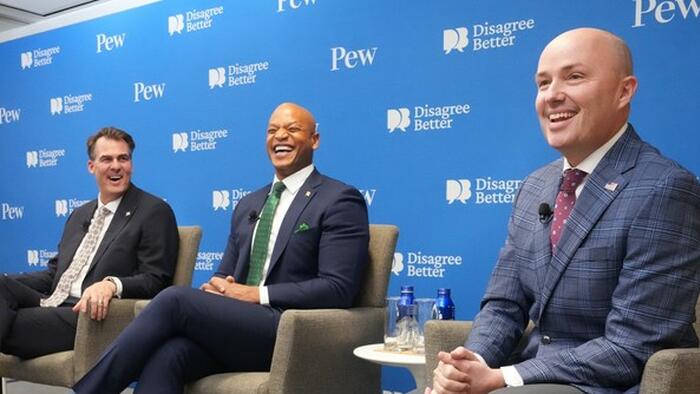
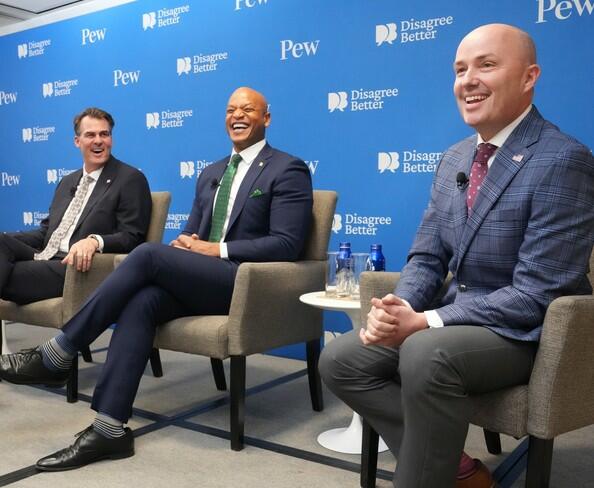
Two Republican governors with a long history of clashing with Donald Trump are working with Democrats on a plan to hand migrant workers state-issued work permits instead of deportation notices, a direct challenge to the president's immigration crackdown that the four laid out on camera. Utah Gov. Spencer Cox and Oklahoma Gov. Kevin Stitt joined Democratic Govs. Wes Moore of Maryland and Matt Meyer of Delaware for a joint interview with Bloomberg, describing a shared position that has far more in common with the Democratic Party and the labor lobby than with the Trump administration's approach to the border.
The vehicle for that position is the National Governors Association's Task Force on Immigration Policy, which Stitt built after noticing a pattern among his colleagues. "The reason I set this task force up is because I realized by talking to my colleagues that they're having the same issues," Stitt told Bloomberg reporter Christina Ruffini. "Let's actually have the governors issue workforce permits."
That last line is the whole ballgame. The task force wants Congress to hand governors the discretion to issue migrant work permits at the state level, a proposal that treats illegal immigration less as a legal violation and more as a labor supply problem for agriculture, construction and hospitality. It resembles former President George W. Bush's immigration reform approach, which sent the message to illegal immigrants, "If you're doing a job an American won't do, you're welcome here, for a period of time, to do that job."
Cox framed the alliance as a breakthrough four decades in the making. "For 40 years, we've been trying to do immigration reform and nobody's ever been able to get it done," he said. "But what's different this time is that we have a secure border." He credited that border security to the current administration while working, in the same breath, to carve states out from under its enforcement arm. "We all care - Republicans and Democrats - about a secure border," Cox said, a sentiment that gets considerably murkier once the conversation turns to what happens to people already inside it.
Cox described a February meeting among the governors as almost startling in its unity. "We were together in February and having a conversation about immigration, and we were all shocked at the level of bipartisanship, cooperation, and agreement," he said. "We were really stunned that everybody had kind of the same opinions on what needed to be done." Bipartisan agreement among governors on loosening enforcement is not the reassurance Cox seems to think it is.
Ruffini asked the group for a show of hands on whether ICE and the Department of Homeland Security have been effective. Neither Cox nor Stitt raised one. Cox pointed to enforcement actions in Minnesota as a specific concern, citing "the violence and the deaths that we've seen" and calling the incidents "deeply problematic." Stitt was even more blunt about his overall assessment. "We're not using common sense right now," he said.
Stitt's example centered on a green card holder from Vietnam who has lived in Oklahoma City for 25 years. "We had a person from Vietnam that's been in Oklahoma City for 25 years, legally in the United States, with a green card, working at Hobby Lobby," he said. The man had self-deported after a marijuana arrest then returned to the country legally. "They've been a great citizen chasing the American dream, but they've been picked up for deportation now," Stitt said. Gov. Moore added an economic gloss to the argument, saying a deportation agenda focused on criminals ought to travel alongside pro-growth policy rather than replace it.
Neither Republican governor has a great relationship with Trump, and both have clashed with him politically in recent years, which explains their break with him on immigration enforcement.
The Trump administration clearly isn't on board. Trump won a second term in 2024 in part by promising to close a border that sat wide open for four years under Biden. Immigration has generally been the strongest issue for him, outperforming his approval numbers on the economy and foreign policy.
DHS Secretary Markwayne Mullin set the tone from inside the administration at the same NGA gathering, sitting beside Stitt and offering his own verdict on the odds of any of this actually happening. "Is immigration reform possible? No," Mullin told the assembled governors. "Do you really need immigration reform? Yes, you do, but can we work with the system we have? Yes."
Related Markets
All MarketsMarket data may be delayed. Not financial advice.
💡 AI analysis provides alternative perspectives on current events