The Diamond Crash Accelerates
The short version
- " Technological progress in growing diamonds in labs has been amazing.
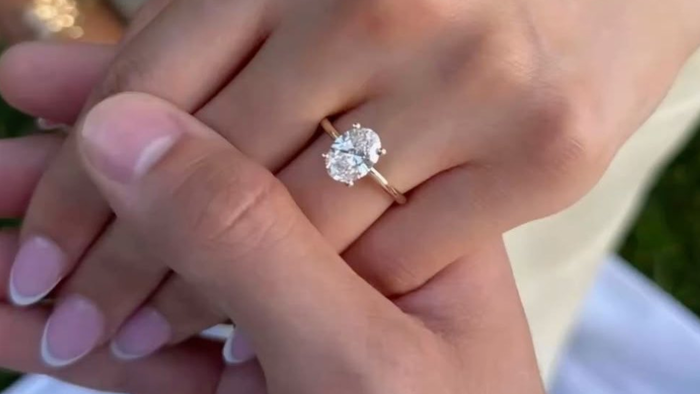
- It's no surprise most engagement rings are now using lab diamonds ," X user Crémieux said.
- Technological progress in growing diamonds in labs has been amazing.
- The natural-diamond market is shrinking in both size and value and circling the drain following the commoditization of its product by modern technology.
- The same thing happened to pearls 100 years ago, but it will be much worse for diamonds: they will become a signal of bad taste rather than wealth…
The story
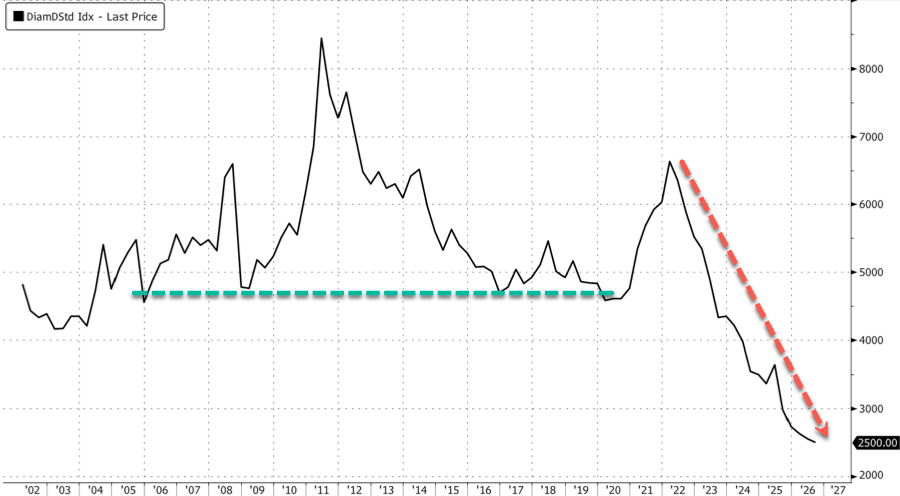
The Diamond Standard Index, tracked on Bloomberg under the ticker DIAMINDX, tumbled to new record lows during the first half of August as a surge in affordable lab-grown stones eroded the scarcity premium underpinning natural diamond prices.
"Technological progress in growing diamonds in labs has been amazing. It's no surprise most engagement rings are now using lab diamonds," X user Crémieux said.
Technological progress in growing diamonds in labs has been amazing.
— Crémieux (@cremieuxrecueil) August 8, 2026
It's no surprise most engagement rings are now using lab diamonds. https://t.co/MZ4zWVlQNq pic.twitter.com/fH1lFYD3Ih
X user Saul Sadka warned that the diamond downturn will likely persist for years as lab-grown stones flood the market:
Expect the collapse in diamond prices to accelerate substantially over the next few years. The natural-diamond market is shrinking in both size and value and circling the drain following the commoditization of its product by modern technology. The same thing happened to pearls 100 years ago, but it will be much worse for diamonds: they will become a signal of bad taste rather than wealth, just as pearls went from high society to a matronly cliché within 50 years.
I have been telling friends in the diamond industry to find a new line of work for ten years. It was clearly only a matter of time before lab-grown diamonds became a mass-market commodity, sold at some small premium over production costs, which would themselves continue to plummet.
Since they are identical to natural diamonds, and buyers actually have multiple reasons to choose them instead, including no "blood diamonds" and supposedly greater environmental friendliness, most buyers will not care.
Attempts to differentiate the products using $20,000 machines will not help: they are indistinguishable in real life.
There was always going to be some multiple that people would be willing to pay for "natural" over "lab," but it did not really matter whether that multiple was 2× or 10×. Once lab-grown diamonds can be made for next to nothing, even ten times next to nothing is still very little. People will pay more, perhaps much more, for an identical product because of its backstory, but not infinitely more.
The reason natural-diamond prices have held up reasonably well over the past four years, "only" falling by around 50% in real terms, has more to do with supply cutbacks. Production has been reduced by about 20% over that period, from 120 million to 98 million carats, in a desperate attempt to support prices as the natural and lab-grown markets diverge. If production returned to its previous level, prices would fall even faster.
But it is going to get much, much worse. A trip to Miami will explain why: people who look like gangsters walk around wearing enormous tennis bracelets that would have cost a million dollars 20 years ago but can now be purchased for the price of a used Rolex.
Diamonds are going to become a sign of tackiness, as, frankly, they always should have been, rather than class or exclusivity. And then the game will be up for everyone in the diamond industry.
Expect the collapse in diamond prices to accelerate substantially over the next few years. The natural-diamond market is shrinking in both size and value and circling the drain following the commoditisation of its product by modern technology. The same thing happened to pearls… https://t.co/XdHRsgSp6h pic.twitter.com/c0zHoUqi2L
— Saul Sadka (@Saul_Sadka) August 9, 2026
Sadka continued in a series of follow-up tweets:
One of the biggest problems for hopes of a residual natural-diamond industry is that diamonds ARE, in fact, FOREVER. At some point, the market will shrink to the point where the secondhand supply, fed by the estates of Boomers as they fall off this mortal coil, will provide sufficient supply to make any mining or polishing uneconomic.
One of the biggest problems for hopes of a residual natural diamond industry is that diamonds ARE, in fact, FOREVER. At some point, the market will shrink to the point where second-hand supply, fed by the estates of Boomers as they fall off this mortal coil, will provide… pic.twitter.com/VkOhukpH5I
— Saul Sadka (@Saul_Sadka) August 10, 2026
This would have been true 30 years ago, and it would have been a big blow to the Israeli economy, but it's not true anymore. The industry once accounted for up to 3% of Israeli GDP, but it's now under 0.2%. Sorry, Turkey.
This would have been true 30 years ago, it would have been a big blow to the Israeli economy, but it's not true anymore. They once were up to 3% of Israeli GDP, but its not under 0.2%.
— Saul Sadka (@Saul_Sadka) August 10, 2026
Sorry Turkey. pic.twitter.com/pORcoY4GcK
There might be some limited residual market at the high end, but my guess is that there will be enough supply from Boomers as they "check out" to glut that demand without any need for miners or cutters, etc.
There might be some limited residual market at the high end, but my guess is that there will be enough supply from the boomers as they "check out" to glut that demand without any need for miners or cutters etc.
— Saul Sadka (@Saul_Sadka) August 10, 2026
To sum up: natural diamonds face a structural, rather than cyclical, collapse. If you're in the market for an engagement ring and hoping it will serve as some store of value, you might be out of luck because lab-grown stones are destroying the scarcity premium, while a potential wave of secondhand supply from aging Baby Boomers could pressure the market even further.
Related Markets
All MarketsMarket data may be delayed. Not financial advice.
Powered by Gab AI
The Story At A Glance
Reading this article now — analysis appears below
💡 AI analysis provides alternative perspectives on current events