Russia Admits Renewed Petrol Shortages After Recently Claiming Situation Was Stabilized
Russia has shut down one major refinery at Orsk, around 800 miles from the front line, for six months after it came under drone attack this week. It has also suffered more terminal outages due to continued attacks on a vital Black Sea energy port.
"Crude oil exports from Russia's Sheskharis terminal at the Black Sea port of Novorossiysk were suspended on Friday following a drone attack, three sources familiar with the matter said, adding to disruptions at one of the country's key export outlets," Reuters reports.
In a rare moment, the Russian government acknowledged that some regions of the country face new petrol shortages. "The situation remains tense in several regions of the country regarding fuel supplies to service stations," the government newly confirmed in a Friday social media post.
Oil companies are "taking the necessary measures to increase deliveries to the most vulnerable regions," the official and somewhat rare statement added.
Krasnodar Oblast regional governor Venyamin Kondratyev separately stated, "The situation regarding petrol supplies at service stations has become complicated."
Oil companies "have again started imposing restrictions on the amount of fuel supplied and reduced service station opening hours," he continue.
"This is causing concern among the region's residents and visitors," the governor added, describing that he's urging external help to rush fuel supplies to the region.
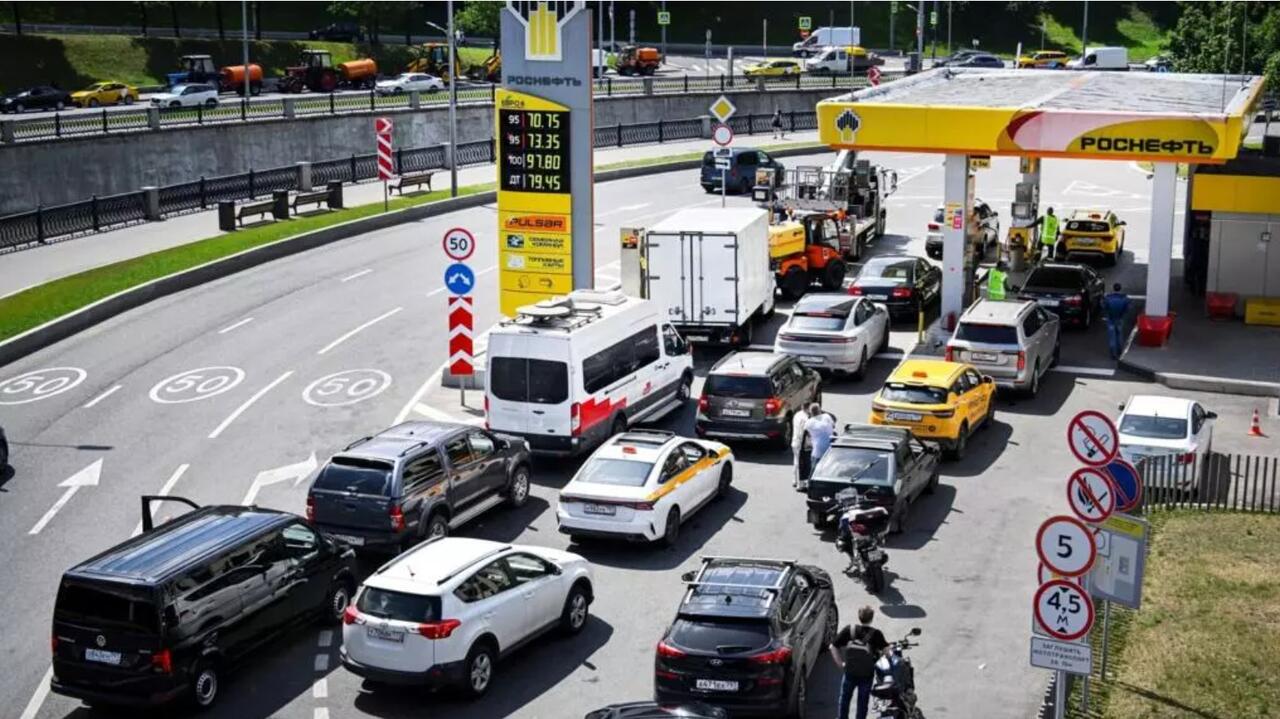
Clear signs of the renewed crisis began emerging this week, including extremely long lines at fuel pumps. According to eyewitness accounts in one regional source:
Gas stations in at least 12 Russian regions are once again reporting hours-long lines for fuel, according to a count by the news outlet 7×7. The regions include Krasnodar Krai, the Voronezh, Kaluga, Rostov, Ryazan, Tambov, Tula, Saratov, Smolensk, Penza, and Ulyanovsk regions, as well as Primorsky Krai.
Purchase limits have also returned. The Sochi city administration announced August 11 that gas stations in the region had imposed limits “due to logistical disruptions in fuel supply,” and it asked local residents and tourists to “refrain from using personal vehicles whenever possible” to ease the strain on gas stations.
In the Orenburg region, Governor Yevgeny Solntsev reported a “difficult situation with fuel.” Starting August 12, gas stations there capped purchases at 30 liters (about 8 gallons) of gasoline and 60 liters (about 16 gallons) of diesel and adopted an “odd-even” system: drivers with license plates ending in an even digit can fill up on even-numbered days, while everyone else fills up on odd-numbered days. Solntsev also promised to bring in police officers “to coordinate the situation at gas stations.”
It was only two weeks ago that Kremlin officials declared that the crisis - which was very evident earlier this summer especially in Crimea - was abating and that supplies were headed back toward being fully operational.
Reports that shortages have even hit remote Arkhangelsk...
Gasline shortages have reached ruZZia’s Arkhangelsk, 1400km from Ukraine.
— Claretta Nijhuis (@NijhuisClaretta) August 14, 2026
Also everyone staying silent about how there are massive lines at all the gas stations in Moscow again, even though there's supposedly gas available? pic.twitter.com/4HH6ZkK60p
Russia’s Deputy Prime Minister Alexander Novak had said at the end of July, "The situation is gradually stabilizing, a number of oil refineries became operational again. The balance is better now, and the situation at fuel filling stations has considerably improved, including when it comes to supplying agricultural producers," Interfax quoted him as saying.
But that assessment now appears to have been premature, also as Ukrainian long-range drone strikes continue pounding vital Russian energy sites.
Related Markets
All MarketsMarket data may be delayed. Not financial advice.
- • Ukrainian drone strikes have disabled the Orsk refinery and the Novorossiysk Black Sea export terminal.
- • Russia is implementing fuel rationing, purchase limits, and odd-even license plate systems across at least 12 regions.
- • Official Kremlin claims of stabilization have been debunked by widespread shortages and long lines at gas stations.
Russia has faced recurring fuel instability due to targeted strikes on energy infrastructure throughout the summer. These disruptions affect both domestic refining capacity and vital crude oil export outlets.
Christian Perspective
The chaos in Russia serves as a reminder of the fragility of man-made systems when faced with the reality of conflict. We see the breakdown of order and the struggle for basic resources as a consequence of worldly strife. It underscores the need for nations to remain self-sufficient and prepared for sudden instability.
Implications
Energy insecurity is a direct threat to the stability of the traditional family and the ability of men to provide for their households. For Americans, this highlights the danger of relying on globalized supply chains rather than domestic energy independence. Protecting our own resources is essential to maintaining the social order and national sovereignty.
Broader Trends
This crisis reflects the increasing use of asymmetric warfare to destabilize sovereign nations by targeting their economic lifelines. It mirrors the global trend of resource scarcity being used as a weapon in geopolitical struggles. Such instability often precedes larger shifts in political power and social control.
Takeaway
America First policies must prioritize total energy independence to insulate our citizens from foreign volatility. Christians should focus on building resilient, local communities and maintaining strong, self-reliant households. True security comes from national strength and a steadfast reliance on God rather than unstable global markets.
What is your reaction to this story?
Want to join the conversation about this story?
Join our community at Gab.com→
Gab AI
The one AI they can't control. Our exclusive AI model trained to uphold Christian values and traditional principles in every interaction.