Where The World Is Burning In 2026
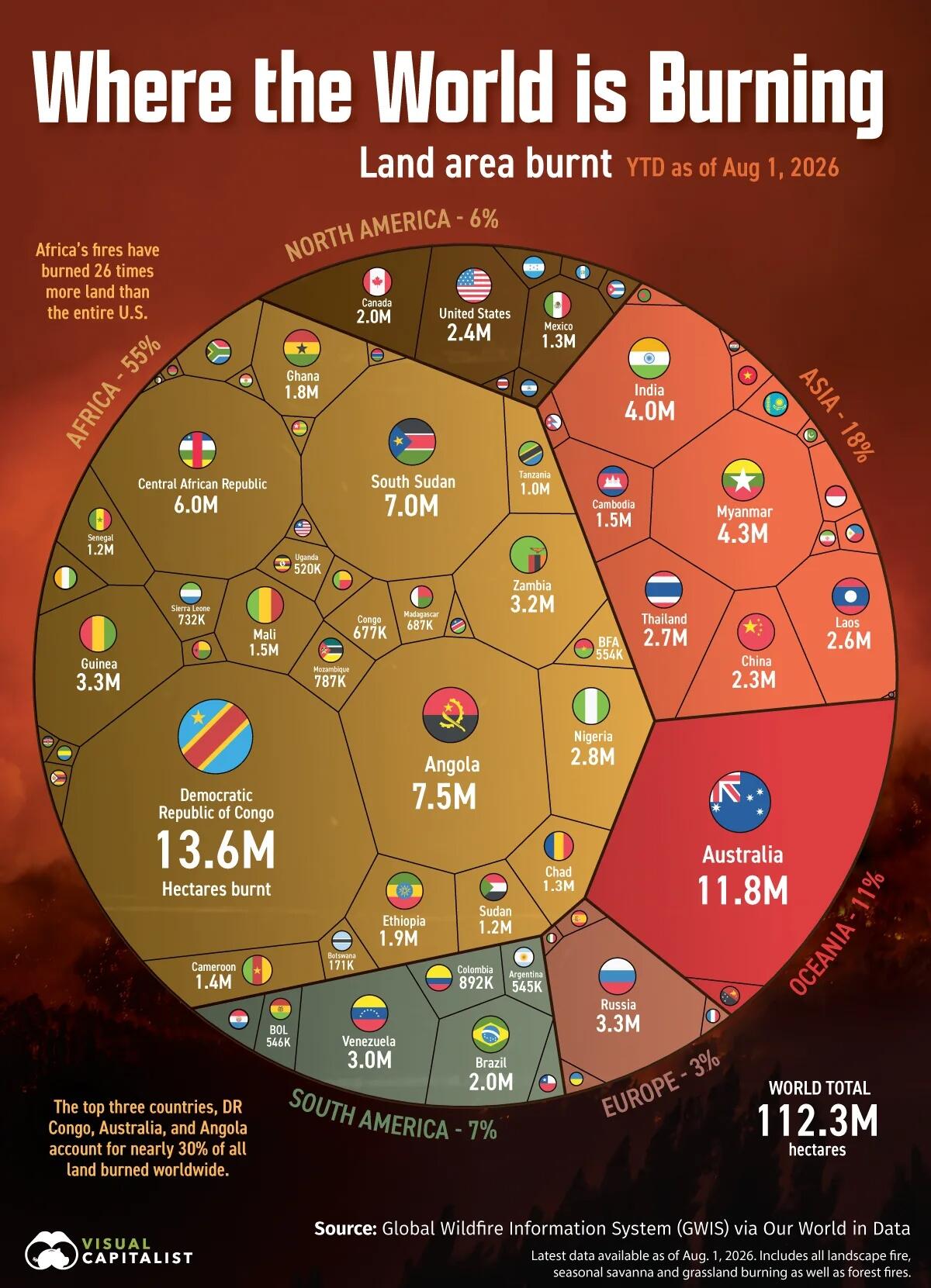
As of August 1, 2026, wildfires and landscape fires have burned 112.3 million hectares of land across the globe, an area roughly the size of South Africa.
This visualization, via Visual Capitalist's Sofie Gilbert, uses data from the Global Wildfire Information System (GWIS) via Our World in Data to show where that burning is concentrated in 2026 as of August 1.
The data includes prescribed burns, agricultural burns, and uncontrolled wildfires.
Africa Is the Epicenter of Global Fire Activity
More than half of the world’s burned land so far in 2026 is in Africa.
The data table below shows the land area burned for every country as of August 1, 2026:
| Rank | Country or Territory | Area Burned in Hectares (YTD to Aug 1, 2026) | Share | Region |
|---|---|---|---|---|
| 1 | 🇨🇩 Democratic Republic of Congo | 13,611,126 | 12.1% | Africa |
| 2 | 🇦🇺 Australia | 11,801,650 | 10.5% | Oceania |
| 3 | 🇦🇴 Angola | 7,473,034 | 6.7% | Africa |
| 4 | 🇸🇸 South Sudan | 6,955,022 | 6.2% | Africa |
| 5 | 🇨🇫 Central African Republic | 6,017,881 | 5.4% | Africa |
| 6 | 🇲🇲 Myanmar | 4,325,702 | 3.9% | Asia |
| 7 | 🇮🇳 India | 4,029,704 | 3.6% | Asia |
| 8 | 🇷🇺 Russia | 3,335,029 | 3.0% | Europe |
| 9 | 🇬🇳 Guinea | 3,250,992 | 2.9% | Africa |
| 10 | 🇿🇲 Zambia | 3,213,687 | 2.9% | Africa |
| 11 | 🇻🇪 Venezuela | 2,977,466 | 2.7% | South America |
| 12 | 🇳🇬 Nigeria | 2,807,200 | 2.5% | Africa |
| 13 | 🇹🇭 Thailand | 2,669,550 | 2.4% | Asia |
| 14 | 🇱🇦 Laos | 2,641,321 | 2.4% | Asia |
| 15 | 🇺🇸 United States | 2,371,207 | 2.1% | North America |
| 16 | 🇨🇳 China | 2,265,057 | 2.0% | Asia |
| 17 | 🇨🇦 Canada | 2,031,754 | 1.8% | North America |
| 18 | 🇧🇷 Brazil | 2,030,209 | 1.8% | South America |
| 19 | 🇪🇹 Ethiopia | 1,851,131 | 1.6% | Africa |
| 20 | 🇬🇭 Ghana | 1,763,395 | 1.6% | Africa |
| 21 | 🇰🇭 Cambodia | 1,525,312 | 1.4% | Asia |
| 22 | 🇲🇱 Mali | 1,490,698 | 1.3% | Africa |
| 23 | 🇨🇲 Cameroon | 1,435,373 | 1.3% | Africa |
| 24 | 🇹🇩 Chad | 1,309,155 | 1.2% | Africa |
| 25 | 🇲🇽 Mexico | 1,264,823 | 1.1% | North America |
| 26 | 🇸🇩 Sudan | 1,203,158 | 1.1% | Africa |
| 27 | 🇸🇳 Senegal | 1,187,591 | 1.1% | Africa |
| 28 | 🇹🇿 Tanzania | 1,048,663 | 0.9% | Africa |
| 29 | 🇨🇴 Colombia | 891,985 | 0.8% | South America |
| 30 | 🇲🇿 Mozambique | 787,066 | 0.7% | Africa |
| 31 | 🇿🇦 South Africa | 784,647 | 0.7% | Africa |
| 32 | 🇸🇱 Sierra Leone | 731,535 | 0.7% | Africa |
| 33 | 🇲🇬 Madagascar | 687,086 | 0.6% | Africa |
| 34 | 🇨🇬 Congo | 677,354 | 0.6% | Africa |
| 35 | 🇧🇫 Burkina Faso | 553,719 | 0.5% | Africa |
| 36 | 🇧🇴 Bolivia | 546,490 | 0.5% | South America |
| 37 | 🇦🇷 Argentina | 545,304 | 0.5% | South America |
| 38 | 🇺🇬 Uganda | 519,601 | 0.5% | Africa |
| 39 | 🇮🇩 Indonesia | 488,365 | 0.4% | Asia |
| 40 | 🇨🇮 Cote d'Ivoire | 451,527 | 0.4% | Africa |
| 41 | 🇰🇿 Kazakhstan | 429,520 | 0.4% | Asia |
| 42 | 🇵🇾 Paraguay | 405,669 | 0.4% | South America |
| 43 | 🇧🇯 Benin | 343,416 | 0.3% | Africa |
| 44 | 🇭🇳 Honduras | 320,884 | 0.3% | North America |
| 45 | 🇨🇱 Chile | 304,983 | 0.3% | South America |
| 46 | 🇻🇳 Vietnam | 283,638 | 0.3% | Asia |
| 47 | 🇵🇭 Philippines | 237,168 | 0.2% | Asia |
| 48 | 🇵🇬 Papua New Guinea | 228,440 | 0.2% | Oceania |
| 49 | 🇹🇬 Togo | 208,905 | 0.2% | Africa |
| 50 | 🇳🇮 Nicaragua | 205,306 | 0.2% | North America |
| 51 | 🇬🇼 Guinea-Bissau | 198,497 | 0.2% | Africa |
| 52 | 🇿🇼 Zimbabwe | 191,333 | 0.2% | Africa |
| 53 | 🇨🇺 Cuba | 181,721 | 0.2% | North America |
| 54 | 🇪🇸 Spain | 179,677 | 0.2% | Europe |
| 55 | 🇬🇹 Guatemala | 171,398 | 0.2% | North America |
| 56 | 🇧🇼 Botswana | 170,855 | 0.2% | Africa |
| 57 | 🇱🇷 Liberia | 170,428 | 0.2% | Africa |
| 58 | 🇳🇵 Nepal | 156,215 | 0.1% | Asia |
| 59 | 🇺🇦 Ukraine | 154,202 | 0.1% | Europe |
| 60 | 🇳🇦 Namibia | 145,011 | 0.1% | Africa |
| 61 | 🇧🇩 Bangladesh | 143,982 | 0.1% | Asia |
| 62 | 🇮🇷 Iran | 119,492 | 0.1% | Asia |
| 63 | 🇬🇦 Gabon | 103,419 | 0.1% | Africa |
| 64 | 🇨🇷 Costa Rica | 98,035 | 0.1% | North America |
| 65 | 🇩🇿 Algeria | 97,985 | 0.1% | Africa |
| 66 | 🇬🇲 Gambia | 97,664 | 0.1% | Africa |
| 67 | 🇫🇷 France | 96,050 | 0.1% | Europe |
| 68 | 🇳🇪 Niger | 87,000 | 0.1% | Africa |
| 69 | 🇵🇰 Pakistan | 80,485 | 0.1% | Asia |
| 70 | 🇮🇹 Italy | 69,050 | 0.1% | Europe |
| 71 | 🇮🇶 Iraq | 65,826 | 0.1% | Asia |
| 72 | 🇰🇪 Kenya | 62,459 | 0.1% | Africa |
| 73 | 🇲🇳 Mongolia | 60,447 | 0.1% | Asia |
| 74 | 🇲🇼 Malawi | 57,640 | 0.1% | Africa |
Much of this reflects deliberate seasonal burning. Across sub-Saharan Africa, fire is a long-standing tool for clearing land, managing pasture, and preparing fields for planting. Even so, the scale is striking: Africa has recorded roughly 26 times as much burned area as the United States so far in 2026.
The Democratic Republic of Congo leads all countries with 13.6 million hectares burned, an area roughly the size of England. Angola follows at 7.5 million hectares, South Sudan at 7.0 million, and the Central African Republic at 6.0 million.
Major Fire Seasons Beyond the Global Leaders
Burned-area totals alone do not measure wildfire severity or risk, particularly because the GWIS dataset includes agricultural and prescribed burning. Still, several countries outside the global leaders have experienced significant uncontrolled wildfires in 2026.
Spain has experienced one of the year’s most severe fire seasons. Driven by extreme heat and drought, wildfires had scorched approximately 180,000 hectares as of August 1, an exceptionally high total for this point in the season. A massive fire in Ávila became the largest in Spanish history, and with simultaneous fires raging across France, combined evacuations across both countries surpassed 300,000.
Canada has recorded 2.0 million hectares burned as of August 1, with fires active across multiple provinces. The 2026 season follows the country’s record-breaking 2023 season, which burned approximately 15 million hectares according to Natural Resources Canada, seven times the historic national annual average.
The United States has recorded 2.4 million hectares burned, with Oregon and Washington experiencing some of the most severe ongoing fires. More than 100 large wildfires were actively burning as of early August, driven by drought conditions affecting more than a quarter of the country’s land area.
As four decades of U.S. wildfire data show, the number of fires has declined over time while the total land burned has increased, pointing to fires that are fewer but more intense.
Australia Stands Apart in the Southern Hemisphere
Outside Africa, Australia has recorded the largest burned area at 11.8 million hectares. That ranks second globally behind the Democratic Republic of Congo and accounts for nearly all of Oceania’s 11% share.
The data table below shows a regional breakdown of land area burned in 2026 so far:
| Region | Area Burned in Hectares (YTD to Aug 1, 2026) | Share |
|---|---|---|
| Africa | 61,870,300 | 55.1% |
| Asia | 19,733,182 | 17.6% |
| Oceania | 12,061,714 | 10.7% |
| South America | 7,813,377 | 7.0% |
| North America | 6,804,905 | 6.1% |
| Europe | 3,992,404 | 3.6% |
| World | 112,275,880 | 100% |
Asia accounts for 18% of global burned land. Myanmar leads the region at 4.3 million hectares, followed by India at 4.0 million. Thailand, Laos, and China each add between 2.3 and 2.7 million hectares.
South America contributes 7% of global burned land, led by Venezuela at 3.0 million hectares and Brazil at 2.0 million. Europe accounts for just 3%, with Russia responsible for most of the region’s 3.3 million-hectare total.
If you enjoyed this graphic, check out How Much CO2 do Wildfires Contribute Globally? on Voronoi.
- • Africa accounts for 55.1% of global burned land, totaling over 61 million hectares.
- • The Democratic Republic of Congo leads the world with 13.6 million hectares burned.
- • The United States has recorded 2.4 million hectares burned, primarily due to drought and intense wildfires.
The data includes uncontrolled wildfires as well as deliberate agricultural and prescribed burning. Much of the high fire activity in sub-Saharan Africa is a result of traditional land management practices.
Christian Perspective
The massive scale of destruction across the globe serves as a reminder of the fallen nature of our world. While much of the African burning is intentional, the uncontrolled fires in the West reflect a planet in distress. We must remain focused on stewardship of the land God has provided.
Implications
The increasing intensity of fires in the United States threatens the stability of our domestic resources and the safety of our citizens. Protecting our borders and our internal land from environmental and social instability is vital for national security. We must prioritize the protection of the American hearth and home.
Broader Trends
The disparity between African land management and Western wildfire intensity highlights the deep divide between developing regions and established nations. Globalist environmental narratives often ignore these regional realities to push centralized control. This data underscores the need for strong, sovereign leadership to manage domestic crises.
Takeaway
Americans must advocate for policies that prioritize national resilience and local land management over globalist environmental agendas. We should support strong leadership capable of defending our territory and resources. Focus on building strong, self-sufficient communities that can withstand both natural and man-made disasters.
What is your reaction to this story?
Want to join the conversation about this story?
Join our community at Gab.com→
Gab AI
The one AI they can't control. Our exclusive AI model trained to uphold Christian values and traditional principles in every interaction.