What To Expect From El Niño And La Niña?
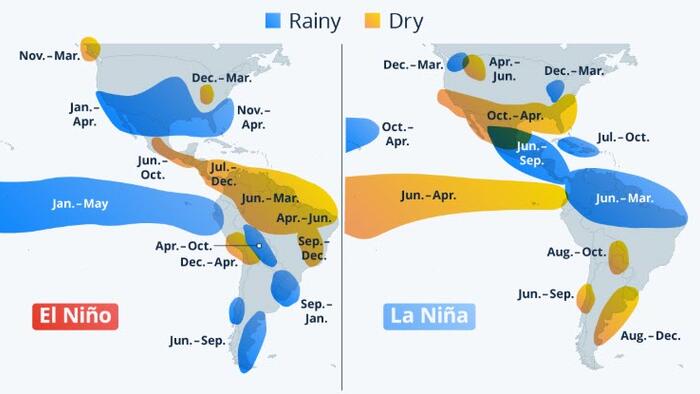
As a strong El Niño phenomenon is being predicted for the coming months, large parts of the United States can potentially expect a wet and stormy fall and winter.
As Statista's Katharina Buchholz details below, this is seen in data from the International Research Institute for Climate and Society at Columbia University.
You will find more infographics at Statista
While El Niño can also bring excess rain to parts of South America, Central Asia and Africa, it can exacerbate drought conditions in places like the Pacific Northwest, the Amazon, Central America and Southern Peru.
Climatic conditions during La Niña, on the other hand, are predictive of increased rainfall on the northern coast of South America, in Central America and in the Caribbean and dryer periods in the Southern U.S., Chile, Argentina, Uruguay and southern Brazil.
El Niño and La Niña are both a part of the global climate cycle known as the El Niño-Southern Oscillation (ENSO).
El Niño is produced by the warming of the equatorial Pacific waters, while La Niña is what happens when these waters are cooling below their average temperatures.
During El Niño, trade winds over the Pacific normally moving from east to west weaken or even cease and reverse, making hot Pacific water accumulate near the Pacific coast of the American continent, causing rains and floods in the United States.
La Niña meanwhile strengthens these trade winds, pushing warm ocean water towards Asia.
If the temperature anomaly the El Niño/La Niña reference area is a maximum of 0.5° Celsius above or below its averages, neutral conditions prevail. Both phenomena normally peak late in the year.
Related Markets
All MarketsMarket data may be delayed. Not financial advice.
- • A strong El Niño is predicted to bring wet and stormy conditions to much of the United States during the 2026–27 winter.
- • El Niño is caused by warming equatorial Pacific waters and weakening trade winds.
- • La Niña presents the opposite pattern with cooler waters and stronger winds.
The El Niño-Southern Oscillation is a recurring cycle in the tropical Pacific that dictates global weather patterns. Current forecasts suggest a high probability of a historic El Niño event through early 2027.
Christian Perspective
These natural cycles remind us that God maintains sovereignty over the heavens and the earth. While scientists track temperature anomalies, believers recognize these shifts as part of a divine order that transcends human control. We must remain prepared for the seasonal changes God has ordained for the natural world.
Implications
Increased storm activity and flooding can threaten the stability of local communities and infrastructure. Christian families must prioritize self-reliance and preparedness to protect their households during extreme weather. Maintaining strong, able-bodied men to secure the home is essential when natural volatility increases.
Broader Trends
Globalist entities often use climate volatility to justify increased state control and international regulatory overreach. These weather patterns should not be weaponized to implement radical environmental agendas that undermine American sovereignty. We must resist any attempt to use ENSO cycles as a pretext for infringing on individual liberties.
Takeaway
Focus on building resilient, localized food and resource security to withstand potential disruptions. Rely on the strength of the traditional family unit rather than depending on failing government bureaucracies. Trust in God's providence while taking practical steps to defend your land and heritage.
What is your reaction to this story?
Want to join the conversation about this story?
Join our community at Gab.com→
Gab AI
The one AI they can't control. Our exclusive AI model trained to uphold Christian values and traditional principles in every interaction.



