"July Was A Bad Month": Jane Street Lost $15 Billion In First Down Month In A Decade
Back in February, just around the time gold and silver had peaked at prices that seemed impossible just a year earlier...
... we warned readers that with Jane Street emerging as the biggest holder of SLV with almost 21 million shares, it was time to get the hell out of the precious metal as this HFT shop, best known for spawning SBF, the 10am slam of bitcoin, and constant, unforgiving market momentum (ignition), would now reverse its accumulation of silver - which its involvement had made a momentum stock - and would send its price plunging.
We have been huge silver bulls since 2009, but be very careful here: lots of financial engineering going on.
— zerohedge (@zerohedge) February 25, 2026
Jane Street not only added a record 20.6MM shares of SLV in Q4, it is now also the biggest holder of SLV pic.twitter.com/XNEiLz2ltZ
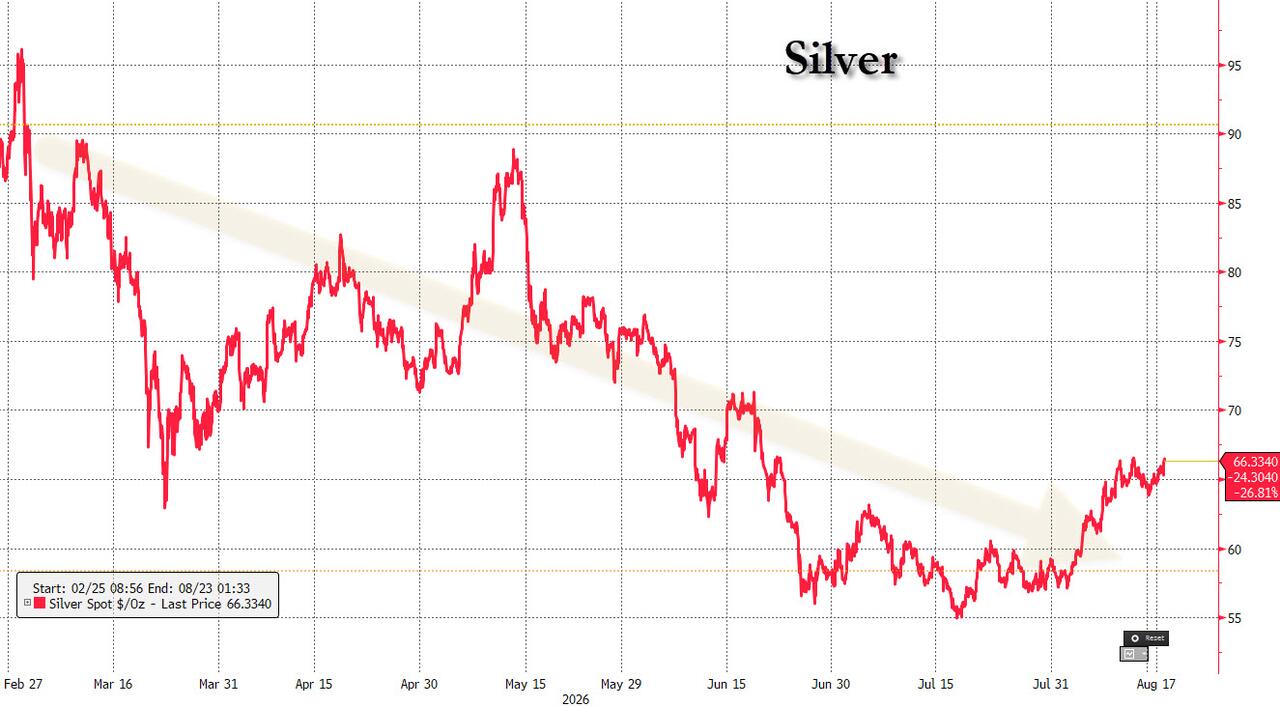
This is what happened to the price of silver since...
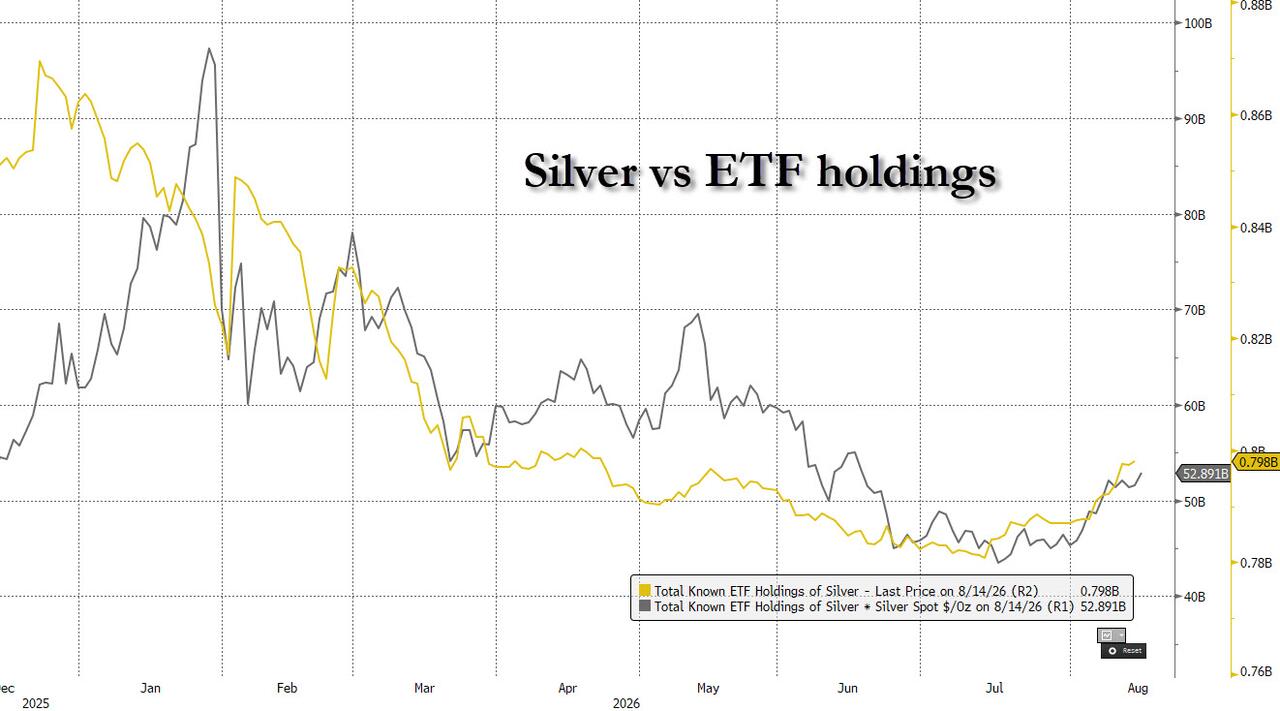
... driven in no small part by continued selling across the ETF space, where Jane has been the biggest seller, taking its total holdings from 20.7 million to just 6.7 million shares.
In short, like any marquee HFT company, Jane rides - and creates - the momentum elevator on the way up... and then rides it, and creates it, on the way down.
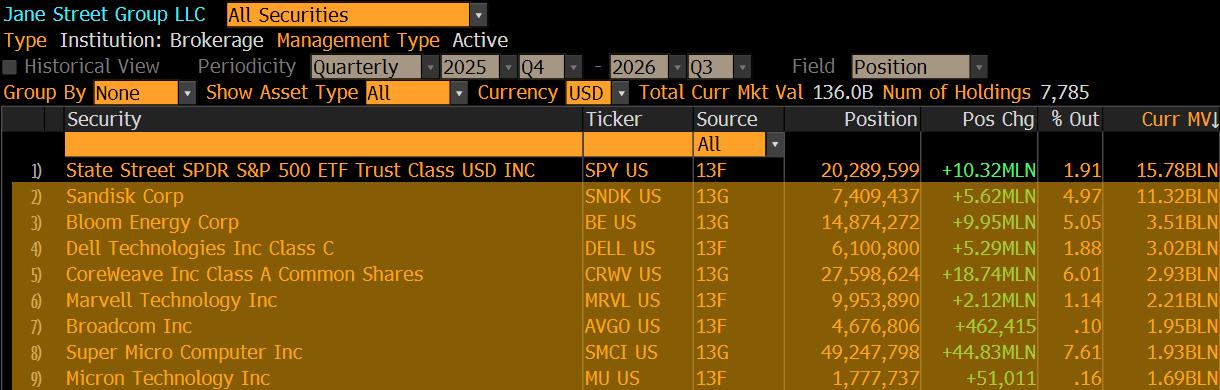
Which is why on Friday afternoon when the latest 13F filings dropped (our full breakdown is coming), the first company we looked at, even before Berkshire, was Jane Street and were not at all surprised to find that its latest holdings where the who-is-who of the Q2 momentum explosion, including such names as Sandisk, Bloom Energy, Dell, Micron, SMCI, CoreWeave, Broadcom and virtually any and every other retail momentum darling...
... all of which peaked on June 27, when as we pointed out previously, we saw Total Return Swap funding rates explode to record high levels, an indication that leverage had gone well beyond the peak and was now in Archegos territory (as we also warned)...
You will never guess on what day S&P funding costs hit an all time high and rolled over hard (sorry Total Return Swap bros) https://t.co/6vt6Ei82QR pic.twitter.com/9reNto9rsi
— zerohedge (@zerohedge) July 24, 2026
... a warning which had Situational Awareness listened to, it could avoid the most embarrassing firesale liquidation this decade.
Our observation came just moments before the FT and Bloomberg blasted flashing red headlines that Jane Street had suffered massive losses as a result of its momentum-chasing ways in July.
Because while everyone now knows that Situational (Un)awareness lost $35 billion between the start of July and the end of the month, thus sealing its fate, Jane Street - whose positions were effectively a carbon copy of what Leopold Aschenbrenner held on his book at the time of the handover to Citadel - was slammed with a historic $15 billion loss in July, its first monthly slump in about a decade, as the handful of AI-focused names that both its and Situational Awareness plunged into the end of the month as the momentum trade suffered a historic meltdown.
Jane Street, in addition to investing in the stocks held by Leopold, also invests in Situational Awareness directly, suffered a rare and severe downturn amid volatile stock markets, Bloomberg and the FT reported. The company’s investment in the hedge fund, as well as wrong-way bets in Asian equity markets, drove part of the losses, said the person, who asked not to be identified citing private details.
"July was a bad month,” said Jane Street partner Turner Batty in an internal note.
To be sure, Jane has generated more than $40 billion of net trading revenue so far this year, more than it did in all of 2025 when it set a Wall Street record. Still, sch violent moves are a major red flag and an indication that either leverage is far too high or risk weightings are off the charts.
Batty said in the internal note that the desks have reduced exposures in strategies that contributed to volatility.
“Despite the large year-to-date increase in trading capital, the recency of these losses has caused us to locally be more selective about risk,” Batty said. “We’ve closed a significant portion of our risk in the specific areas we lost on in July, and have also reduced risk-taking in other strategies.”
It's not clear if that means that company was no longer igniting momentum in the same chip/memory momentum names that exploded, then collapsed all in the span of a month.
The HFT black box, pardon "market maker" described the impact of the debacle at Situational Awareness while seeking to refinance billions of dollars of debt, according to the Financial Times, which earlier reported the loss.
The market maker described the impact of the debacle at Situational Awareness while seeking to refinance billions of dollars of debt, according to the Financial Times, which earlier reported the loss.
Jane Street was rattled by Situational Awareness and market turmoil as it was preparing to issue $14.6 billion of bonds this week to overhaul its debt load. It’s a stumble for the market maker that invested early in some of AI’s biggest players, including Anthropic PBC and CoreWeave Inc., adding to profits from its business frontrunning handling thousands of trades within milliseconds.
That said, don't cry for Jane Street and its scretive boss Robert Granier, who have been setting record after record in recent years, including $39.6 billion of trading revenue for 2025, surpassed Wall Street trading giants including Goldman and JPMorgan.
“Our positions currently seem appropriate for our present risk tolerance,” he said. “Market volumes have been strong, and we’ve continued to make improvements to our short time horizon strategies, that trading seems more profitable than ever.”
Translation: unlike silver which has seen Jane continue dumping, we expect that when it comes to momentum chip and memory stocks, Jane will double down and then use the same HFT momentum ignition gimmicks to create a new wave of retail excitement it will ride once again on the way up, while collecting an arm and a leg from the mile-wide bid ask spreads in names like Sandisk, something we pointed out last week.
Top 10 stocks traded YTD average 16.4% of total market notional volume.
— zerohedge (@zerohedge) August 10, 2026
And no stocks is more profitable for dealers and HFTs than SNDK with a 12.4bps spread. No wonder they try to create constant momentum pic.twitter.com/8NPck9kqMC
As for Jane Street’s latest debt deal, the firm's deplorable July performance did not hold anyone back: investors including PIMCO, Capital Group and Fidelity bought in, which was issued across three bonds. The refinancing allowed the market maker to fund technology infrastructure and expand its trading strategies, Bloomberg previously reported.
The new fixed-rate deal, led by JPMorgan, is part of Jane Street’s plan to repay its floating-rate loans and revamp its $11 billion capital stack.
Related Markets
All MarketsMarket data may be delayed. Not financial advice.
💡 AI analysis provides alternative perspectives on current events