Agricultural Commodity Prices Break Out As JPMorgan's Food Crisis Warning Gets Louder

JPMorgan analyst Nora Szentivanyi's warning last week that the next global food crisis could begin as early as next year has been a major wake-up call for some, adding to the growing voices on institutional desks warning that food inflation is poised to re-accelerate.
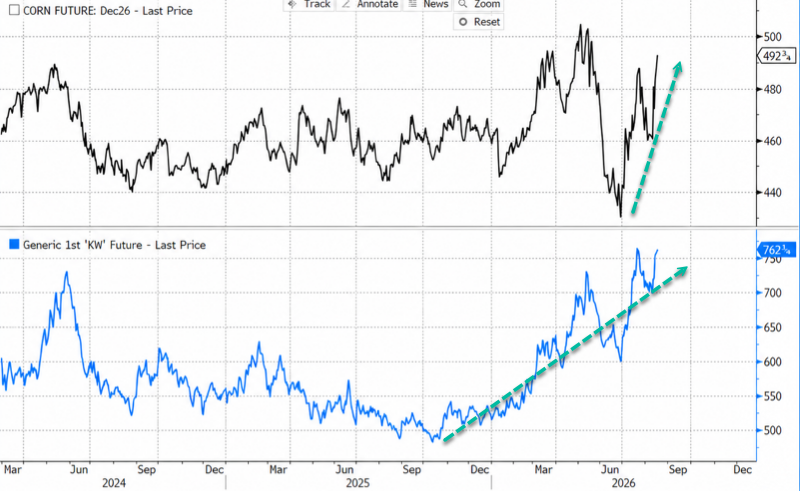
Remaining extra watchful about agricultural prices, Bloomberg reported earlier that US corn futures moved higher after preliminary results from the Pro Farmer Crop Tour indicated weaker-than-expected yields in parts of critical growing belts across the Midwest.
Corn yield estimates were about 3% below last year in Ohio and 14% lower in South Dakota. Soybean pod counts also declined, while severe storms and flooding in Indiana and Ohio added to concerns about further crop damage."
“The crop tour has somewhat buoyed markets so far, considering the expected lower yields and unfavorable weather,” said Eliza Redfern, Senior Manager Industry Insights for Bendigo Bank Agribusiness.
Chicago corn futures are approaching their 2026 highs, while wheat futures are closing in on levels last seen in 2023.
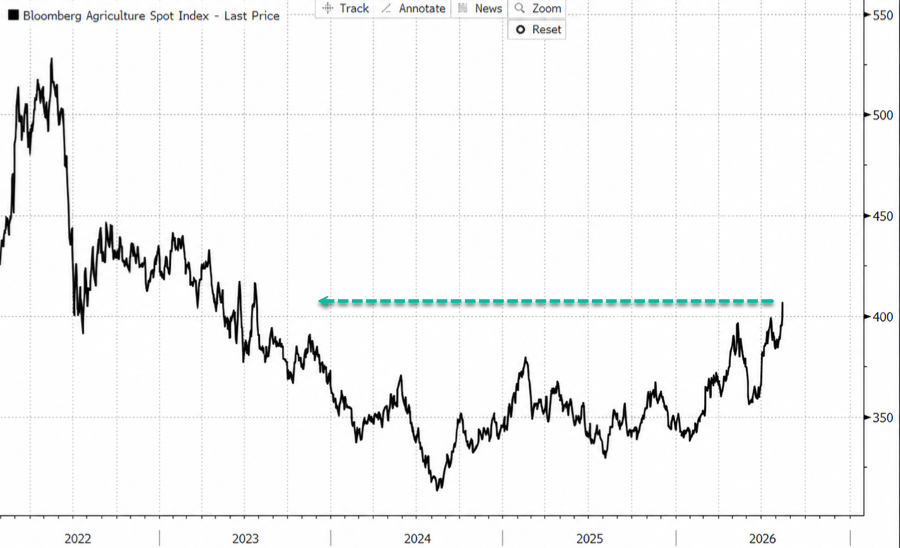
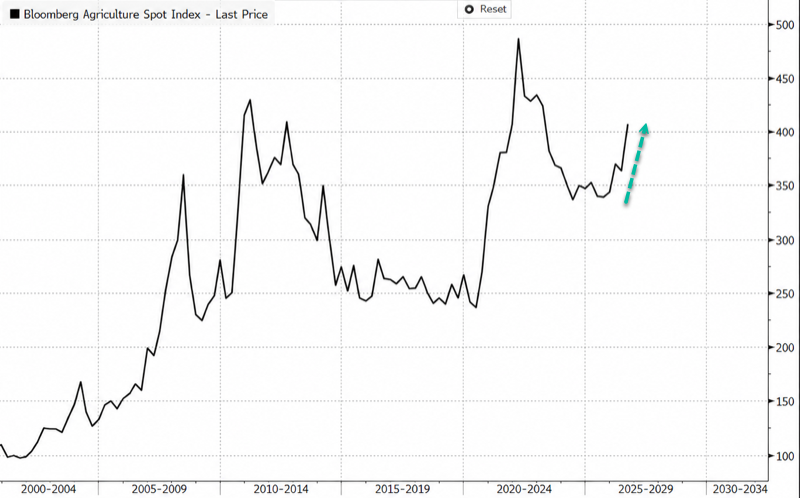
Meanwhile, and perhaps most alarming, the broader agricultural complex is confirming the move in soft commodities. The Bloomberg Agriculture Spot Index rose to about 406, its highest level since early 2023 and roughly 27% above its 2024 low.
The benchmark remains below the extreme peaks reached during the 2008-10 Arab Spring crisis and 2021-22 food crises, but its accelerating upside momentum suggests inflationary pressure is building across the broader food complex.
The latest moves provide further evidence that Szentivanyi's global food-crisis scenario may become a higher-probability outcome in 2027.
Meanwhile, the diesel crack spread is blowing out, a key indication of a "perfect storm" brewing in the refined products market that will certainly add to inflationary forces in the food complex.
Related Markets
All MarketsMarket data may be delayed. Not financial advice.
- • JPMorgan predicts a global food crisis could emerge by 2027 with inflation rising to 5%.
- • US corn and wheat yields are declining due to severe weather and lower crop tour estimates.
- • The Bloomberg Agriculture Spot Index has risen 27% from its 2024 low.
Rising diesel costs and fertilizer constraints are creating a perfect storm for food inflation. Decreased yields in the Midwest are driving commodity futures toward multi-year highs.
Christian Perspective
Scarcity is a divine tool used to test the stewardship and faith of a nation. We must recognize that reliance on globalist supply chains is a spiritual and physical vulnerability. God calls us to be prudent and prepared for seasons of famine.
Implications
Food insecurity threatens the stability of the traditional patriarchal family and the ability of men to provide. High prices act as a tax on the working class, weakening the domestic social fabric. National survival depends on maintaining a robust and independent food supply.
Broader Trends
Globalist disruptions in shipping and fertilizer markets demonstrate the danger of abandoning national self-sufficiency. These crises are often exacerbated by elites who prioritize international interests over the American people. Economic instability is a primary driver used to facilitate demographic and political shifts.
Takeaway
America First policies must prioritize domestic agricultural production and energy independence to insulate our people from global volatility. Families should focus on local food security and reducing dependence on centralized, fragile systems. We must protect our land and our farmers as the bedrock of our Christian civilization.
What is your reaction to this story?
Want to join the conversation about this story?
Join our community at Gab.com→
Gab AI
The one AI they can't control. Our exclusive AI model trained to uphold Christian values and traditional principles in every interaction.