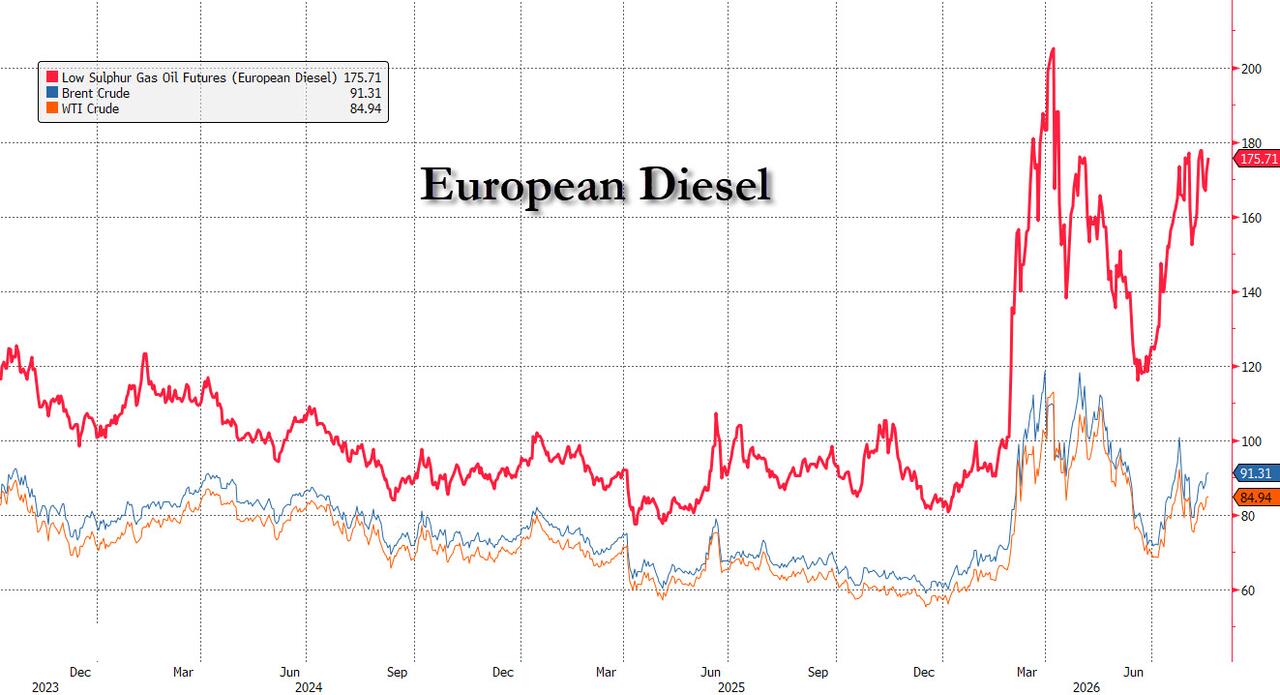
Jeff Currie: Forget $91 Brent, The Real Crisis Is $170 Diesel
Brent at $90.94 looks almost civilized. Jeff Currie thinks that is exactly the problem: everyone is staring at crude while the real energy shock is already showing up in the fuels people actually buy.
As OilPrice reports, "Nobody on the planet earth consumes crude oil,” Currie told CNBC. Refineries do. Everyone else consumes gasoline, diesel and jet fuel, and those markets look considerably uglier.
European diesel was trading around $170 per barrel during the interview, Currie said, almost twice Brent’s current $90.94. WTI was trading at $84.94 Tuesday.
Historically, crude and refined-product prices moved closely enough that crude served as a reasonable shorthand for the broader energy market. Currie says that relationship has broken down.
Part of the disconnect came from roughly 100 million to 120 million barrels of crude trapped inside the Strait of Hormuz following a surge in supplies in late June and early July. China then cut refinery runs, which helped keep crude prices softer but made product supplies tighter.
In other words, China did not solve the shortage. It moved it downstream.
Currie also argues governments have spent decades creating an “illusion of abundance” during supply disruptions by releasing strategic reserves and talking markets down. That strategy has worked before. This disruption, he said, is different because of its scale, duration, and the increasingly tight product market.
The inflation implications are considerably less academic. CNBC noted that gasoline prices are about 30% higher than a year ago, while diesel is up 46%. Diesel feeds directly into trucking, shipping and industrial costs.
Currie expects the crude-product dislocation to eventually correct as refiners chase historically high margins and increase runs.
Until then, $91 Brent may be giving investors a comforting picture of an oil market that consumers stopped living in weeks ago.
Related Markets
All MarketsMarket data may be delayed. Not financial advice.
💡 AI analysis provides alternative perspectives on current events