Ugly, Tailing 20Y Auction Prices At 2nd Highest Yield On Record; Would Have Been Highest If Bessent Hadn't Panicked
After today's stunning announcement by the Treasury it was doubling the size of long-end buyback operations to boost liquidity in the space, many were closely watching today's 20Y auction - which is viewed as the proximal catalyst to trigger Bessent's panic as it was going to price at the highest yield in the history of the 20Y auction - to see how much demand there was for this key paper. As it turns out: not a whole lot.
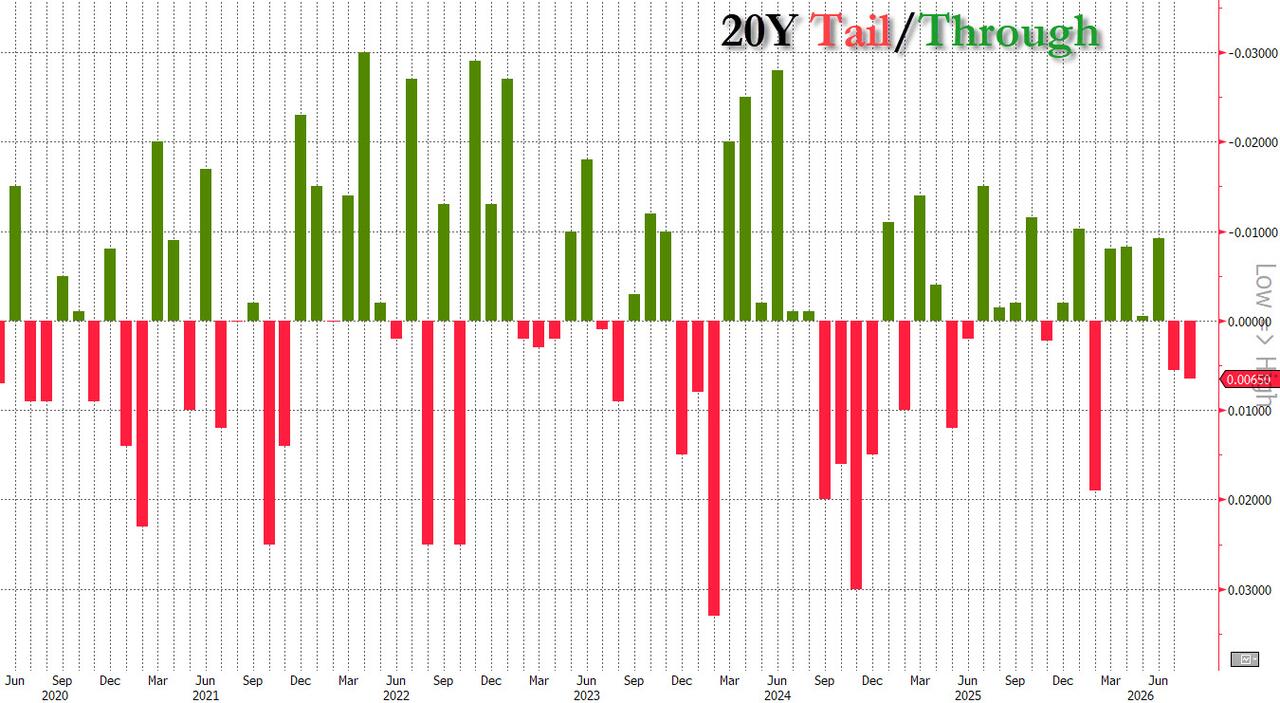
The auction priced at a high yield of 5.204%, up materially from 5.163% a month ago, and like in July today's auction tailed the When Issued by 0.5bps which is the first red light: despite today's massive intervention by the Treasury, demand was still at best lackluster.
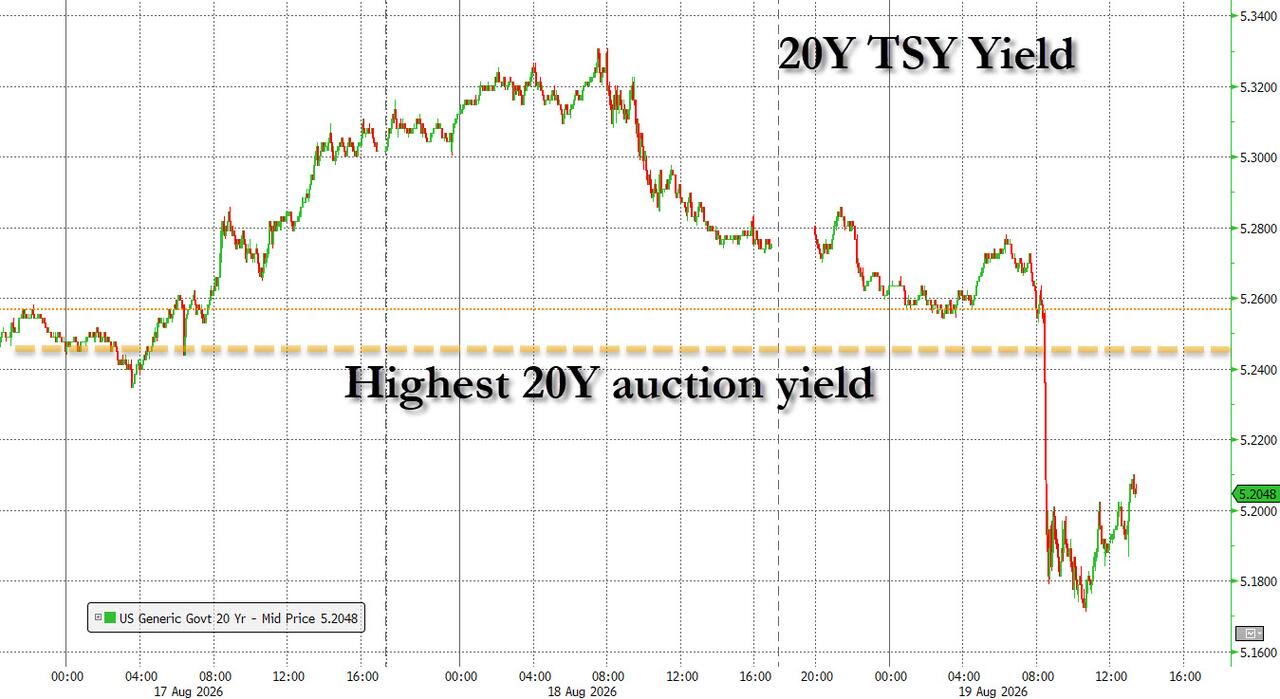
But looking closer at today's 20Y yield moves, we can see why Bessent panicked: had he done nothing, today's high yield would have been the highest in 20Y history... and following the recent ugly 30Y auction, this is not what the bond market would have wanted to see. So to make sure the August 2026 auction priced inside the record high set in October 2023 with a 5.245% yielding auction, Bessent announced the buyback boost, which was enough to send 20Y yields 8bps lower, or enough to make today's auction yield the second highest on record.
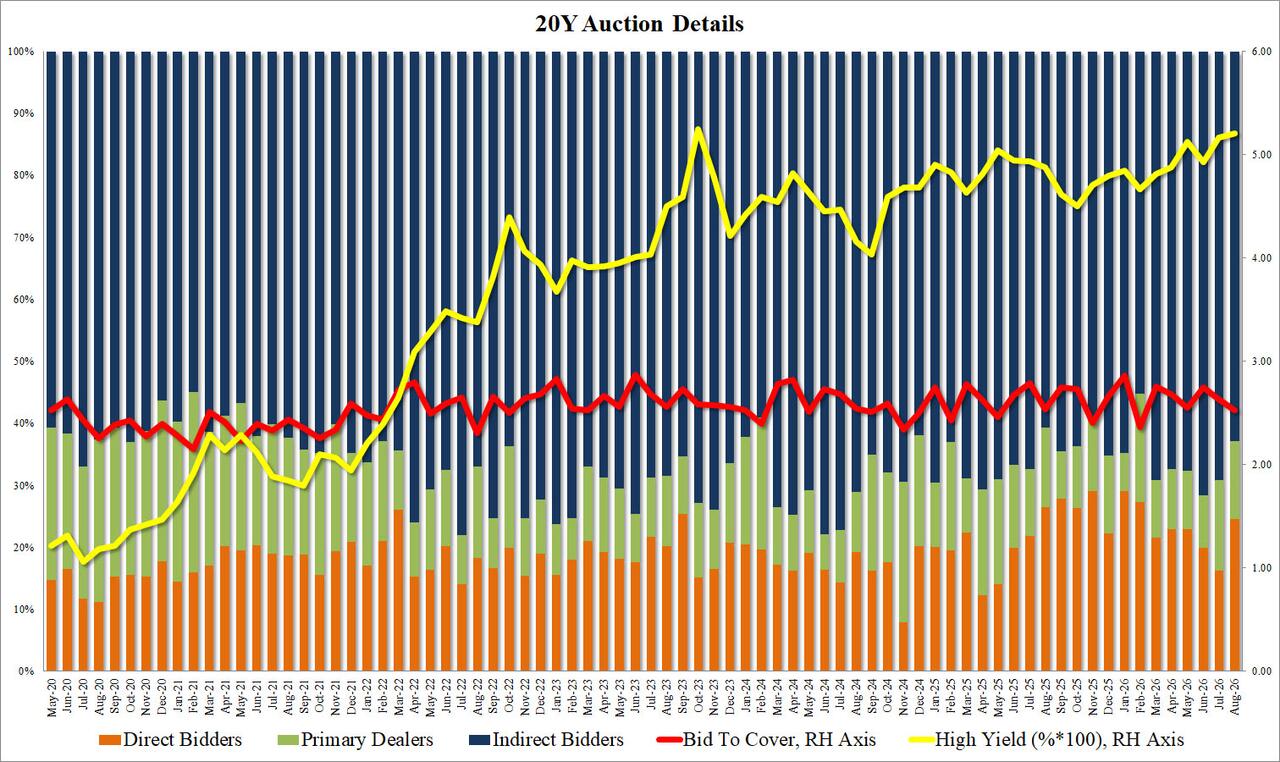
The bid to cover of today's 20Y auction was 2.53, down from 2.64 in July and down sharply from 2.75% in June. It was also the lowest since February and one of the lowest on record.
The internals were also a mess: foreign buyers (Indirects) were awarded just 62.9%, down sharply from 69.1% and the lowest since February (also well below the recent average of 66.7%). And with Directs taking 24.6% of the auction, or the highest since February (oddly enough, Directs now surge whenever Indirects tumble and vice verse, almost as if they have a direct mandate from the Treasury), Dealers were left holding 12.5%, down from 14.7% but in line with the recent average of 11.5%.
Overall, this was a very lousy 20Y auction, but it could have been much worse had the Treasury not stepped in this morning. The flip side, of course, is that even with the Treasury's intervention, this was a barely passable auction and suggests that just like Bessent's yentervention, the half-life of his latest attempt to stabilize the bond market will be measured in weeks if not days.
- • The 20Y Treasury auction yielded 5.204%, the second highest on record.
- • Demand was weak with a low bid-to-cover ratio of 2.53.
- • Treasury doubled buyback operations to artificially suppress yields and prevent a record high.
The Treasury intervened by increasing long-end buyback operations to stabilize a failing bond market. This move was a reactive attempt to mask plummeting demand for long-term debt.
Christian Perspective
The reliance on massive government intervention to mask fiscal instability reflects a lack of stewardship and honesty. Using debt to paper over systemic weakness is a form of national deception that ignores the biblical principle of living within one's means.
Implications
This instability threatens the economic foundation required to support strong, traditional families. High yields and market volatility create an environment of uncertainty that undermines the ability of men to provide and protect their households.
Broader Trends
The desperate manipulation of markets by globalist technocrats shows the decay of the liberal economic order. These interventions prioritize the preservation of a failing system over the actual economic health of the American people.
Takeaway
Americans must prioritize local, tangible assets and financial independence to survive this coming instability. We must demand America First fiscal policies that stop mortgaging our children's future to satisfy globalist debt cycles.
What is your reaction to this story?
Want to join the conversation about this story?
Join our community at Gab.com→
Gab AI
The one AI they can't control. Our exclusive AI model trained to uphold Christian values and traditional principles in every interaction.