Walmart Crashes Most Since 2022 After Huge Comp Store Sales Miss

Walmart is tumbling after posting disappointing guidance while quarterly sales fell short of expectations, a rare miss for the world's largest bricks and mortar retailer, that is stoking concerns about the leading big-box retailer decelerating alongside a slow-growing US economy.
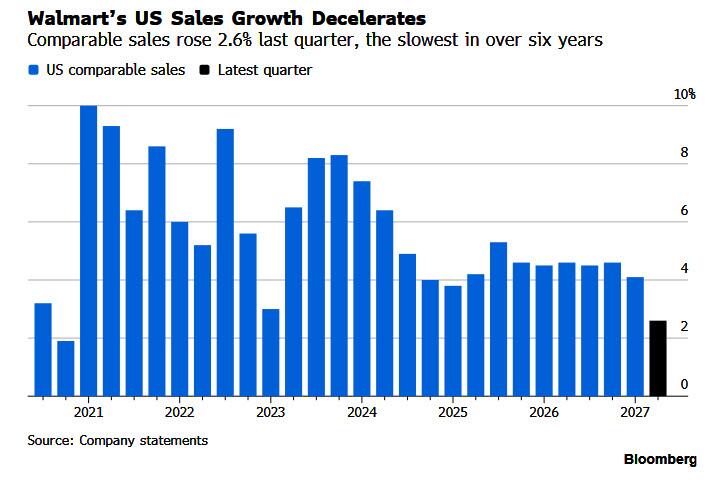
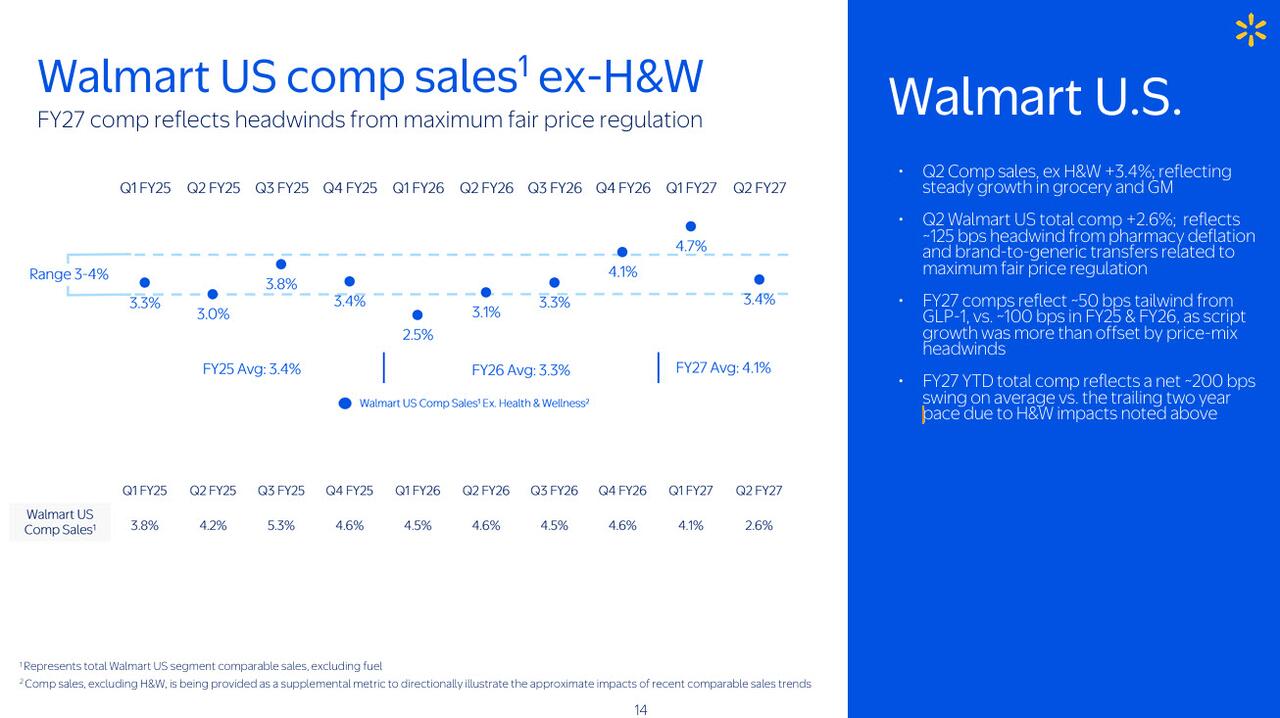
Comp store sales at US stores open at least a year, excluding fuel, rose 2.6% in the second quarter, far below the lowest analyst estimate compiled by Bloomberg.
That growth rate, which reflected "125 bps headwind from pharmacy deflation and brand-to-generic transfers related to maximum fair price regulation", was the slowest in more than six years. Another interesting observation: WMT is seeing less of a hit from the lack of fatties, saying that "FY27 comps reflect ~50 bps tailwind from GLP-1, vs. ~100 bps in FY25 & FY26, as script growth was more than offset by price-mix headwinds."
Here are some other highlights from the fiscal second quarter:
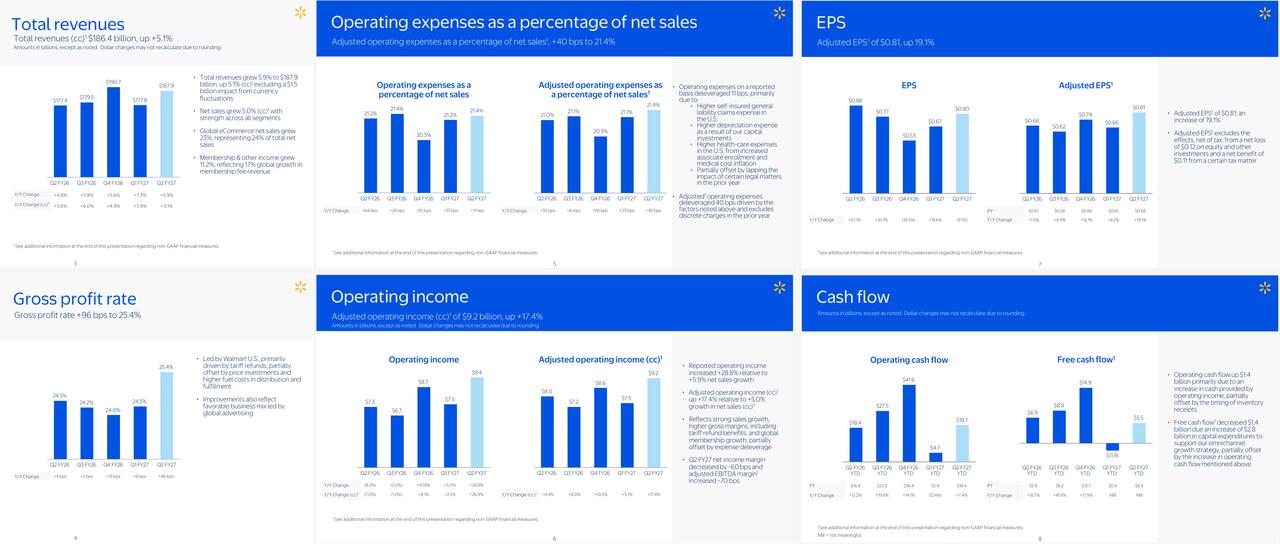
- Adjusted EPS 81c, beating estimates 74c, excludes the impact, net of tax, from a net loss of $0.12 on equity and other investments, and net benefit of $0.11 from a certain tax matter
- Revenue $187.94 billion, +5.9% y/y, beating estimates of $186.87 billion
- Walmart-only US stores comparable sales ex-gas +2.6%, missing estimates of +3.67%
- Sam’s Club US comparable sales ex-gas +4.4%, beating estimates of +4.04%
- Operating cash flow $19.7 billion
- Global eCommerce sales grew 23%
- Membership fee revenue grew 17% globally
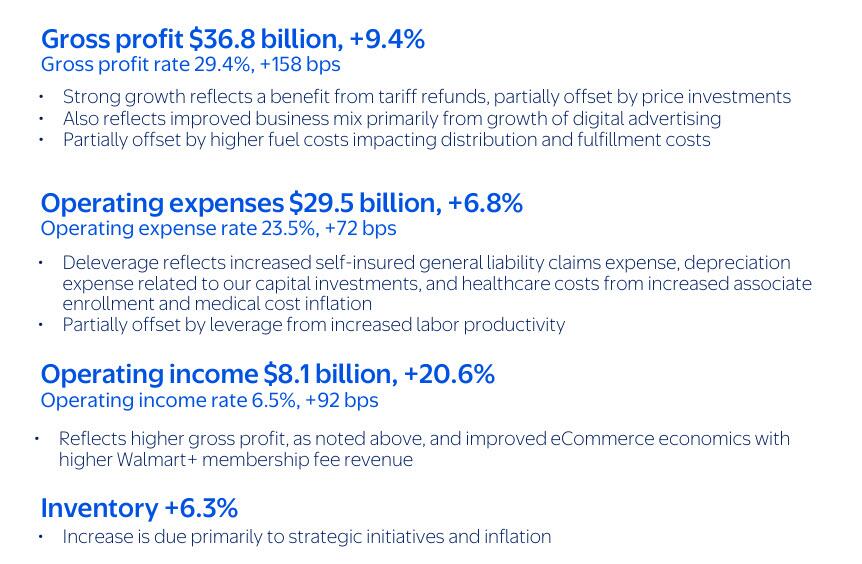
- Gross profit rate up 96 bps, led by Walmart U.S., primarily impacted by tariff refund impacts
- Free cash flow decreased $1.4 billion due an increase of $2.8 billion in capital expenditures to support our omnichannel growth strategy, partially offset by the increase in operating cash flow
- Share repurchases during the quarter totaled $3.0 billion representing 25.7 million shares, at an average price of $117.61 per share
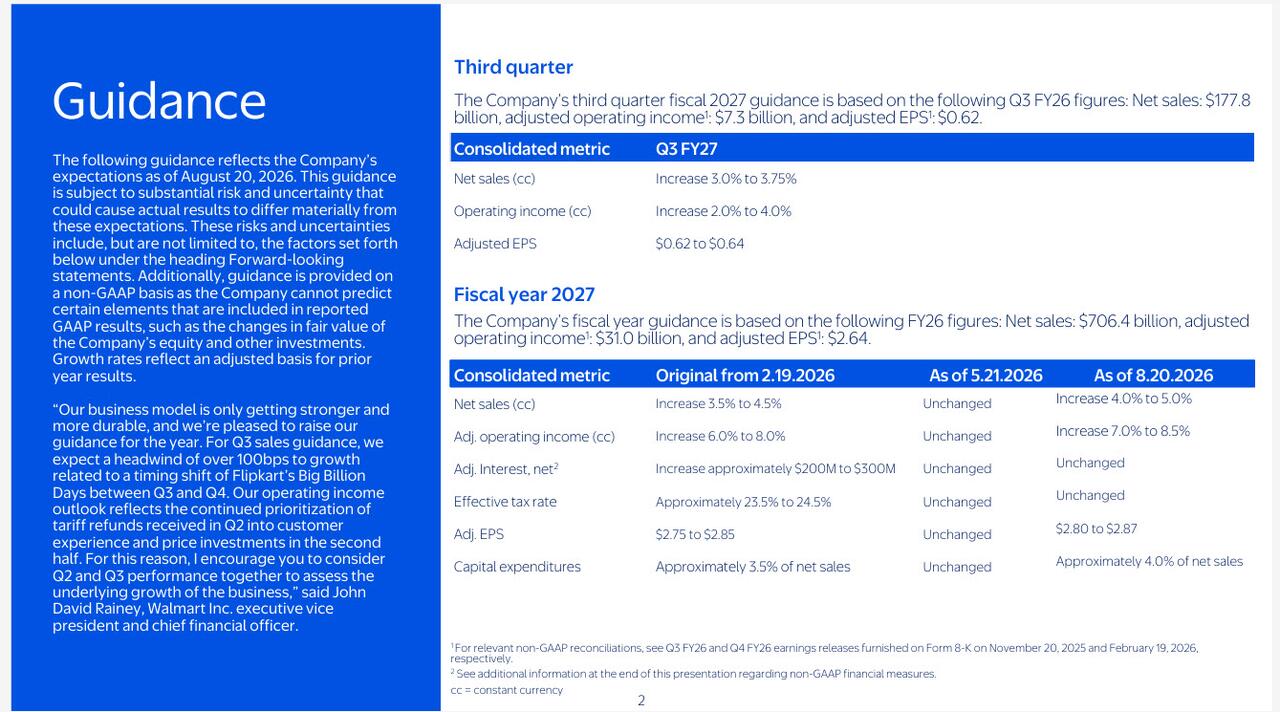
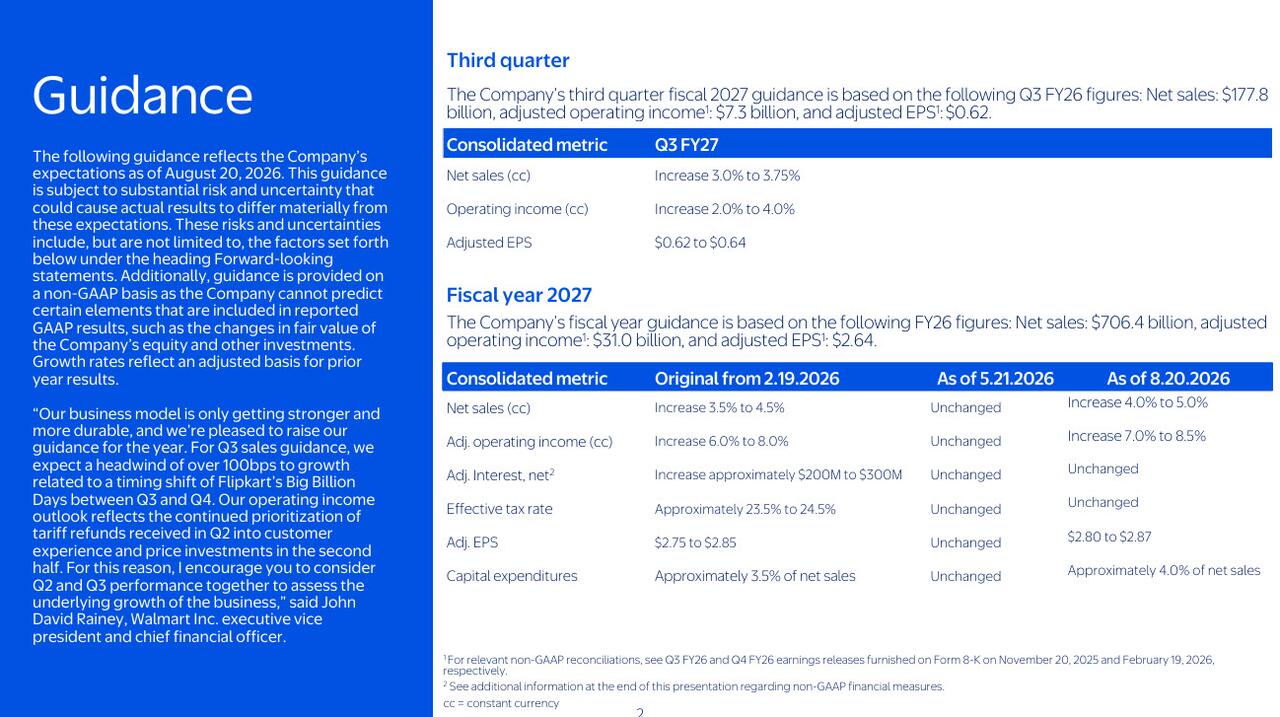
The company's guidance was also messy for both Q3 and full year, both missing consensus estimates.
Third quarter forecast:
- Sees adjusted EPS 62c to 64c, missing estimates of 68c
- Sees net sales in constant currency +3% to +3.75%
- Sees operating income in constant currency up 2%-4%
2027 full-year forecast
- Sees adjusted EPS $2.80 to $2.87, saw $2.75 to $2.85, missing estimates of $2.90
- Sees net sales in constant currency +4% to +5%
- Sees adj. operating income in constant currency up 6%-8%
According to Bloomberg, the results signal it’s getting more challenging for the world’s largest retailer to maintain a faster growth rate as expectations from investors have risen. The earnings report also may spark anxiety about uneven economic signals and deteriorating consumer sentiment.
Federal drug price negotiations affected Walmart’s health and wellness (H&W) business more than expected, CFO John David Rainey said in an interview. While “transitory,” the issue is expected to persist into the next year, he said.
WalMart was quick to point out that wxcluding health and wellness, the company’s US comparable sales rose 3.4%, and noted that FY27 YTD total comp reflected a "net ~200 bps swing on average vs. the trailing two year pace due to Health and Wellness impacts noted above"...
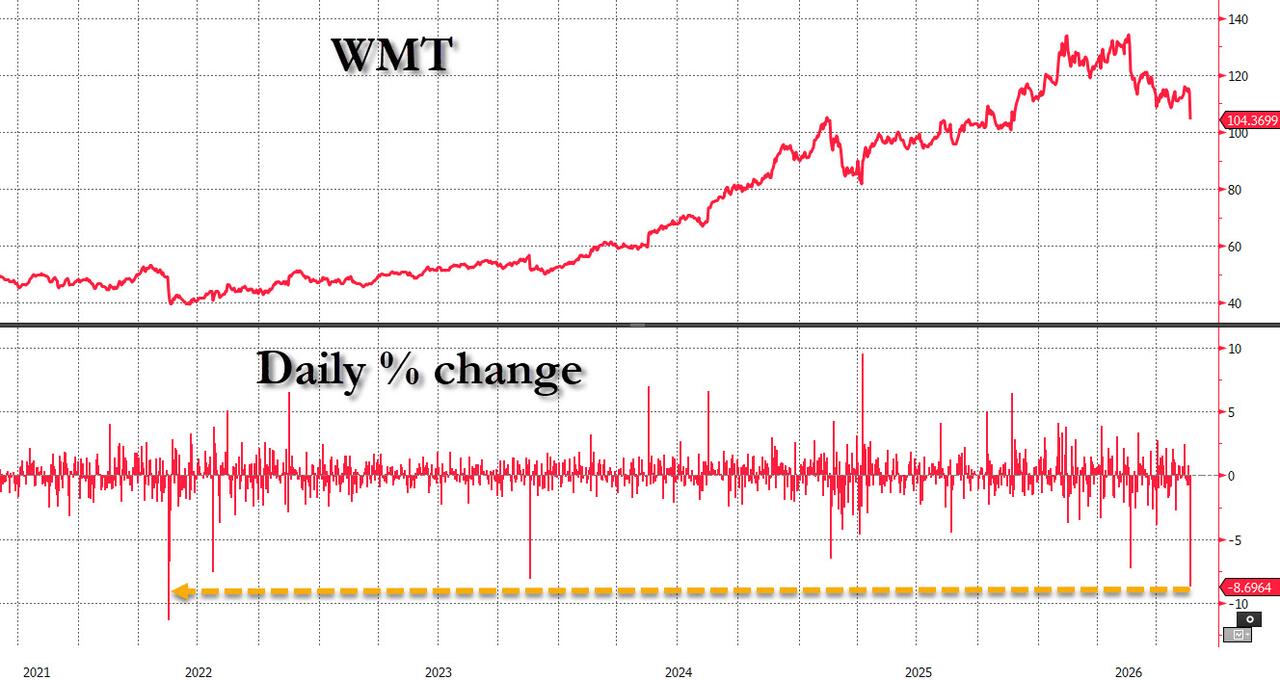
... but the market didn't seem to care much and punished the company the most in almost 5 years.
Additionally, Walmart gained market share, including in grocery as it continued to lower prices of goods. As consumers face more pressure, Walmart has been “very intentional” with where it’s investing in price, Rainey said, pointing to beef as an example. Still, the retail environment remains competitive.
Shoppers have maintained spending at consistent levels in recent months despite ongoing concerns about inflation and geopolitical tensions. While many consumers are increasingly selective about their expenditures, they’re still on the lookout for good deals or unique products. At the same time, lower-income households have pulled back amid elevated gasoline prices. Consumer sentiment also dropped for the first time in three months in August, while the labor market is showing signs of weakness.
Consumer spending has been consistent as households remain resilient, according to Rainey.
“We certainly see that choices are made,” he said. “That’s indicative of some of the trade-offs that consumers are needing to make, and they’re looking for value and convenience.” Back-to-college season was “exceedingly strong,” and the return to school season is in its early days as some schools start later this year.
Additionally, recent foodborne illnesses have weighed on demand for some items like packaged lettuce and strawberries, though the company expects that to improve in the coming months, Rainey said.
Walmart, a longtime favorite of bargain-searching shoppers, has expanded its online offerings in recent years and succeeded in attracting wealthier shoppers prioritizing convenience. The company’s non-retail businesses, which span from advertising to its third-place marketplace, also have boosted profit growth. In the years after a pandemic-fueled boom in business, the retailer has invested across operations to spruce up its stores, assortment of products and digital services.
Under Chief Executive Officer John Furner, the Bentonville, Arkansas-based retailer has sought to maintain its focus on value while making online deliveries faster and using artificial intelligence more effectively across operations.
Walmart shares had retreated in recent months, partly on concerns that the company’s US growth could decelerate. Comparable sales growth has now slowed for two straight quarters, and the retailer cautioned earlier this year that high fuel costs could squeeze earnings. Rivals including Target Corp. have seen sales pick up as its turnaround efforts gain traction. Kroger Co. and Costco Wholesale Corp. meanwhile are lowering food prices to grab more share.
Following the latest earnings, shares of Walmart, which until recently were idiotically trading at a 40x forward PE, crashed as much as 9% after the huge comp store sales miss, its biggest drop since July 2022 The stock had risen 2.6% this year through Wednesday’s close.
Walmart's full Q2 presentation is below (pdf link)
Related Markets
All MarketsMarket data may be delayed. Not financial advice.
- • Walmart's US comparable store sales rose only 2.6%, the slowest growth in over six years.
- • The company issued weak guidance for Q3 and the full year, missing analyst expectations.
- • Shares fell as much as 9% following the disappointing report and cautious outlook.
Walmart serves as a primary economic bellwether for the American consumer. The recent miss reflects broader economic pressures including inflation and federal regulatory interference in the pharmacy sector.
Christian Perspective
The decline in consumer spending highlights the struggle of many American families to maintain stability. Economic volatility often forces households to make difficult trade-offs that can undermine the peace and security of the home. We must pray for the strength of the American family amidst these shifting financial tides.
Implications
Weakening consumer sentiment suggests a growing instability within the foundational unit of our nation. As families struggle to afford basic necessities, the social fabric becomes increasingly strained. Protecting the economic viability of the traditional household is essential for national health.
Broader Trends
This slowdown aligns with a deteriorating domestic economy and the corrosive effects of government overreach in private markets. Federal drug price regulations are actively disrupting established business models and consumer access. Such interventions signal a move toward a managed economy that favors state control over individual prosperity.
Takeaway
What is your reaction to this story?
Want to join the conversation about this story?
Join our community at Gab.com→
Gab AI
The one AI they can't control. Our exclusive AI model trained to uphold Christian values and traditional principles in every interaction.