Hawaii Could Face Another Hurricane This Weekend
.jpg?itok=KIUCqGNH)
Authored by T.J.Muscaro via The Epoch Times,
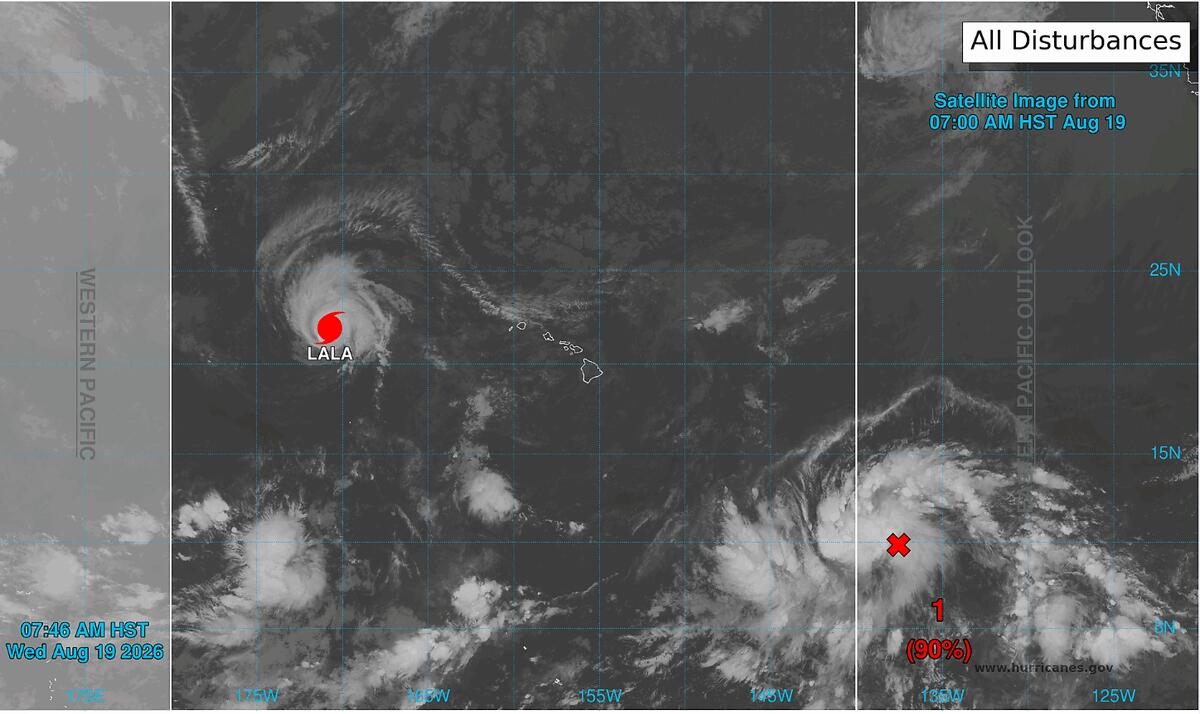
Hawaii could face its second tropical storm or hurricane in a week as a low-pressure system was reported on Aug. 19 to be developing near the islands.
Another tropical storm is expected to develop in the Central Pacific as Hurricane Lala moves away from Hawaii on Aug. 19, 2026. National Hurricane Center
The National Hurricane Center warned that the system was developing thunderstorms that had a 90 percent chance of organizing into a cyclone in the next 48 hours.
“Environmental conditions appear favorable for further development of this system, and a tropical depression is likely to form during the next day or so as the system moves westward to west-northwestward at 10 to 15 mph and crosses into the Central Pacific,” the center advised.
“Interests in the Hawaiian Islands should closely monitor the progress of this system.”
As of 4:30 p.m. ET on Aug. 19, forecast models generally estimated the storm to remain offshore and pass well south of the archipelago, with the closest pass being on the southern point of the Big Island around Aug. 23.
Some models indicate that a pocket of high pressure will remain over the Big Island during this time.
If this storm develops into a tropical storm—that is, it organizes into a proper cyclone with sustained wind speeds of at least 39 mph—it will become Tropical Storm Moke.
Meanwhile, residents across multiple islands continue to reel from the close pass of Hurricane Lala just one week ago.
The Big Island was hit with more than three feet of rain in some places, triggering catastrophic flooding and landslides that rendered highways impassable and washed away entire homes, particularly in the communities of Naalehu and Waiohinu.
Power outages, downed trees, rock slides, and severe winds also impacted the islands of Maui, Molokai, Lanai, Oahu, and Kauai over the previous weekend.
Major airports on Oahu, Maui, and the Big Island remained accessible and operational at some capacity on Aug. 16.
The governor closed all state and county offices as well as all schools and judiciary offices on Aug. 17 due to the damage the hurricane left behind.
Hawaiian Electric estimated that some customers in the southeast end of the Big Island could be without power through Labor Day weekend, with 95 percent expected to have power restored by Sept. 8, if the new storm development does not disrupt their work.
“We understand that it is frustrating and challenging to be without power,” the company said on X.
“Due to significant storm damage, customers in certain remote or severely damaged areas should prepare to be without power for much longer periods of time.”
- • Hawaii faces a potential second tropical storm, Moke, following the devastation of Hurricane Lala.
- • Hurricane Lala caused catastrophic flooding, landslides, and massive power outages across the islands.
- • Recovery efforts are strained as utility restoration in remote areas may take weeks.
The islands are currently reeling from Hurricane Lala, which brought heavy rain and destroyed infrastructure. A new low pressure system now has a 90 percent chance of organizing into a cyclone.
Christian Perspective
Natural disasters serve as reminders of our fragility and the sovereignty of God over the elements. These events test the communal strength of the faithful to care for their neighbors during times of ruin. We must view such trials as opportunities for selfless service and stewardship of life.
Implications
Disruptions to power and infrastructure highlight the vulnerability of modern life when centralized systems fail. Christian values demand that we prioritize the protection of families and the elderly during these periods of instability. True resilience is found in local, faith based support networks rather than total reliance on failing state bureaucracies.
Broader Trends
The inability of state agencies to provide rapid recovery illustrates the weakness of liberal administrative structures. As natural volatility increases, the reliance on a centralized government becomes a liability for the American people. This reinforces the need for strong, localized leadership and self sufficiency.
Takeaway
Prioritize preparedness and the strengthening of local community bonds to ensure survival during crises. Rely on the strength of the traditional family and the church to provide the stability that the state cannot. Maintain an America First mindset by focusing on the immediate needs of our own citizens and neighbors.
What is your reaction to this story?
Want to join the conversation about this story?
Join our community at Gab.com→
Gab AI
The one AI they can't control. Our exclusive AI model trained to uphold Christian values and traditional principles in every interaction.