Diesel Crack Spread Madness Deepens As Jefferies Finds No Easy Exit From Russia's Refining Crisis
Refined-product markets have emerged as the epicenter of the global energy crisis, with commodity desks across Wall Street, including Goldman, Citi, Bank of America and Jefferies, warning that disruptions in the Strait of Hormuz and Ukraine's ongoing long-range drone attacks on Russian energy infrastructure are converging into a perfect storm for global fuel supplies.
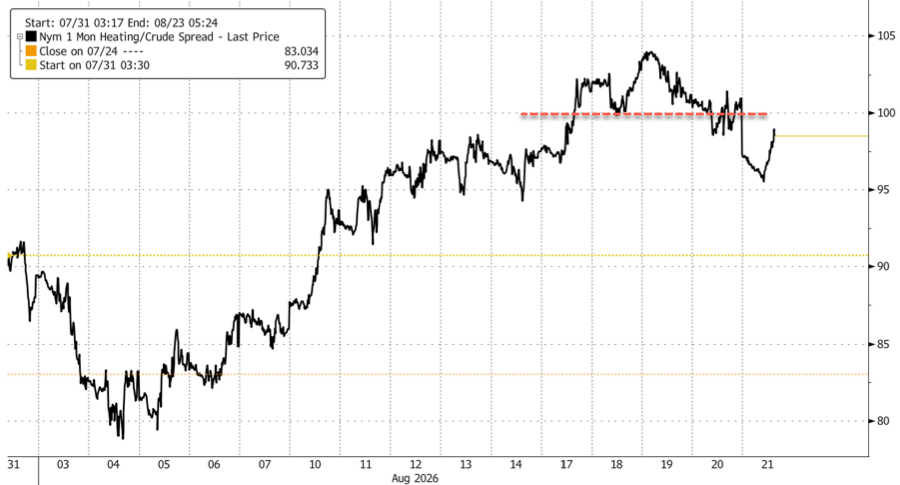
As we close out this week, Monday marked a historic milestone, with Bloomberg's front-month US diesel crack spread (HOCL1 Index) topping $100 per barrel for the first time as the diesel shortage intensified and the spread landed on everyone's radar.
Four days before the HOCL1 Index breached the $100 mark, we cited notable Wall Street commodity desks that warned about the "perfect storm" brewing in refining markets:
Then, early Monday morning, we reported:
By late evening, our X post on the HOCL1 Index had gone absolutely viral because a reading above $100 is not only unprecedented, but also suggests, as we noted, that the "industrial economy either grinds to a halt or consumers are about to be hit with the biggest energy pass-through in history."
Diesel crack hits record $102. This is absolutely unprecedented.
— zerohedge (@zerohedge) August 17, 2026
Industrial economy either grinds to a halt or consumers about to be hit with the biggest energy pass through in history pic.twitter.com/OtAdgrCvb3
Then, by Wednesday, Jeff Currie, the former Goldman Sachs commodities chief and now co-chair of Abaxx Markets, went on CNBC to explain, as we've warned, that the real crisis is not in crude, but in diesel markets.
"Nobody on the planet earth consumes crude oil," Currie told CNBC. "Refineries do. Everyone else consumes gasoline, diesel and jet fuel, and those markets look considerably uglier."
By Thursday, Currie explained that the convergence of tight physical markets, currency debasement and policy intervention represents the hallmark of a structural commodity bull cycle.
"Stop looking at crude. Nobody consumes it but refineries. The economy runs on gasoline and diesel, and that consumption-weighted basket costs $165 against $85 WTI," Currie wrote on X. Read the report.
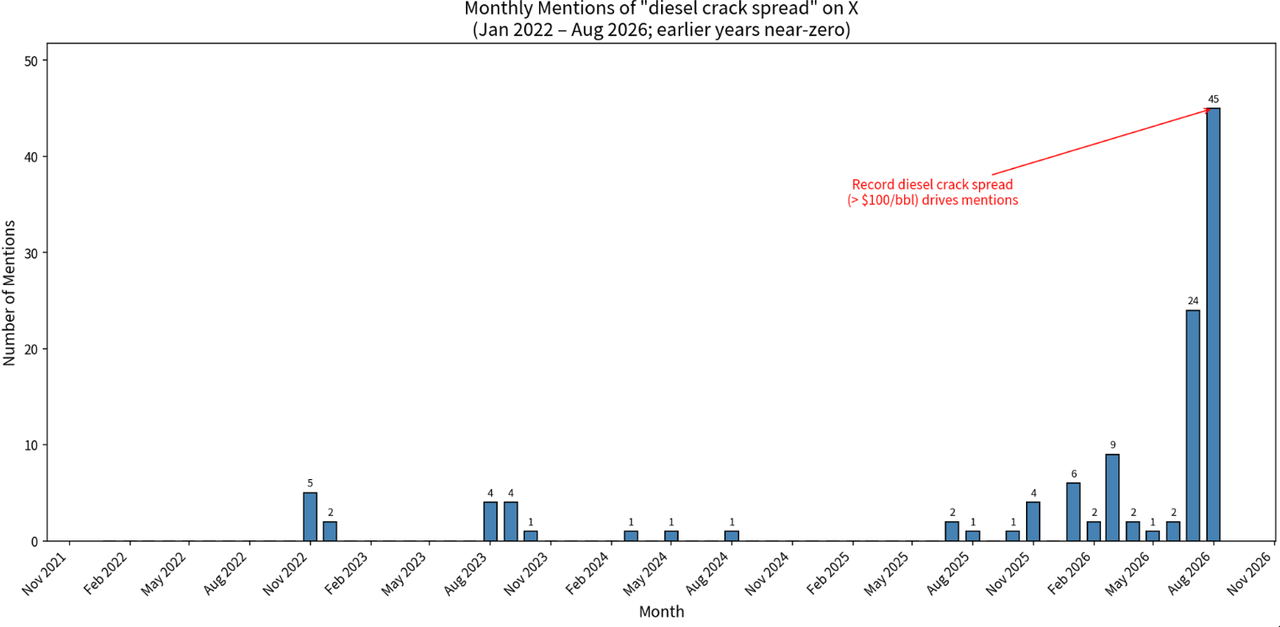
Certainly, all this attention on diesel crack spreads was enough to have many others on X discussing what the spread meant and its implications...
For more color on how Ukraine's expanding drone campaign is achieving what years of Western sanctions failed to deliver to Washington and European elites, Jefferies analyst Lloyd Byrne spoke with Ronald Smith, a specialist in Russian oil and gas, to discuss the ongoing and worsening crisis in Russia's refining and product markets.
"Repair downtime is often short, but consistent strikes have pressured throughput, leading to export product bans. Gasoline exports are unlikely to resume until '27. The diesel ban could be lifted in Oct, but volumes will likely stay low, continuing to support cracks. Asked about paths forward, answers were few," Byrne wrote in the note published Thursday.
Here are Byrne's highlights from the conversation with Smith, which provide readers with a better understanding of Ukraine's drone campaign against Russian energy assets as one of the factors, along with Hormuz disruptions, driving global refining markets into crisis:
Russian Refining Overview. Russia has nameplate refining capacity of ~6.7mmbpd (~6.5% of global capacity); however, throughput has historically been lower, at ~5.0-5.5mmbpd. In Aug '26, throughput collapsed to ~4mmbpd amid ongoing Ukrainian drone strikes. In '25, Russia produced ~0.95mmbpd of gasoline and ~1.7 mmbpd of diesel, but due to the Ukrainian attacks, Aug '26 gasoline is down to ~0.65mmbpd and diesel to ~1mmbpd.
Ukraine Drone Campaign. In Jan '24, Ukraine began launching sporadic strikes on Russian refineries, but attacks climbed from Aug to Sept-25 with ~3 refineries hit per week. Attacks dipped in 1Q26 (~1 pw), before intensifying to ~4 pw in May-Jul 26 and up to ~5 pw in Aug '26, leading to a fuel crisis & export restrictions. Strikes have focused mainly on refineries near Ukraine (e.g., Syzran, Saratov, and Ryazan), but the attack on Omsk (2,675km) demonstrated both the expanding reach of Ukrainian drones and the vulnerability of Russia's most sophisticated refinery. While some larger/select refineries have been consistently targeted (e.g., Ryazan & Ufa), other scale plants have been hit a only a few times, with little recognizable pattern.
Refinery Outages. The duration of downtime depends on the complexity of the unit hit and the availability of replacement materials, with no average downtime per strike. That said, ~50% of outages are <2w and ~75% are <1m, but there have been a handful of 3-6m outages (e.g., Moscow). Mr Smith highlights that Soviet refinery units were designed to be dispersed to defend against strikes, and that Russia has developed domestic engineering capabilities. Still, sanctions and technology restrictions play a role, but China has been somewhat supportive, per Mr Smith. To compensate for the damaged refineries, functional refineries are running at higher utilizations and are encouraged by officials to delay maintenance, which may lead to more unplanned outages if continued. Deputy PM Novak recently stated that several refineries will return to service in the near future.
Russian Product & Crude Exports. In '25, Russia was a net exporter of ~150mbpd of gasoline, ~850mbpd of diesel, and ~30mbpd of jet fuel, but through '26 these have plunged amid persistent refinery outages. In April '26, Russia banned gasoline exports and, in July '26, diesel exports. In aggregate, Mr Smith estimates that Ukrainian drone strikes have removed ~1.1mmbpd of refined products from global mkts, mostly diesel (~750mbpd). Mr Smith asserts that gasoline exports are unlikely to resume until '27, but the diesel export ban could be lifted post-harvest season (Oct), but with exports staying low. This depends on the pace of Ukraine's drone campaign, the speed of Russia's repairs, and Russian defensive effectiveness. With no global product exporter able to fully offset the lost exports, Russian outages will continue to put upward pressure on crack spreads.
Because of the lower refining capacity available, crude exports surged to ~8.9mmbpd in July '26, but remain below OPEC+ quotas. Mr Smith suggests that Russia could be at physical crude export limits, and export capacity could be compromised by drone strikes.
Professional subscribers can read much more about crack spreads and the energy crisis on our new Marketdesk.ai portal.
Related Markets
All MarketsMarket data may be delayed. Not financial advice.
Have a take on this story? Discuss it on Gab — no account needed to read, free to join to post.
Discuss on GabWant a second read? Ask Gab AI to analyze this story — private, no account needed to start.
Ask Gab AI💡 AI analysis provides alternative perspectives on current events