Rial Hits Record Low As Bessent Readies "Economic D-Day" Assault To Isolate Iran
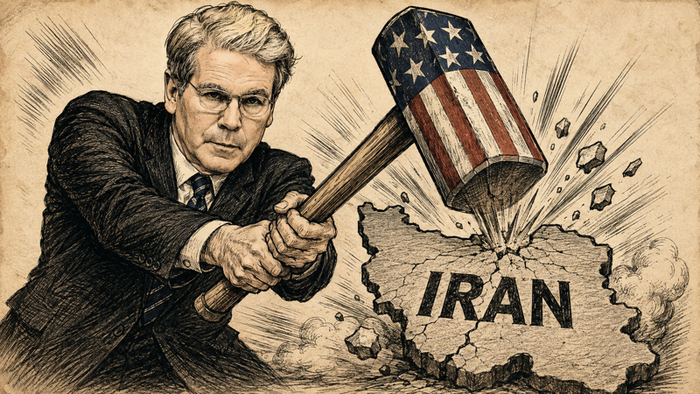
In the coming hours, the Trump administration is expected to unveil a sweeping campaign to economically isolate Iran and its trading partners, with China likely the primary target. The escalation is designed to force Tehran back to the negotiating table, as its only leverage - the Strait of Hormuz - appears to be quickly eroding. Commercial ships are now transiting the newly opened, US military-supervised shipping corridor off Oman, raising the possibility that Iran has partially lost control of the critical waterway.
Treasury Secretary Scott Bessent told CNBC that he would hold a press conference on Monday to "talk about exactly what we're going to do" regarding an economic war against Tehran.
"Economic pressure means that we are going to all of our allies, and this is going to be the greatest coordinated economic isolation in the history of the world, and we are going to them and saying, 'You are either with us or against us,'" Bessent said.
Late Sunday, Bessent wrote on X: "We are now entering the endgame. At dawn begins an economic D-Day, the single greatest financial offensive ever marshaled against an adversary."
"President Trump has dismantled Iran's military capabilities, destroyed nearly 100 percent of its military factories, and buried its nuclear program," Bessent continued.
He noted, "The Islamic Republic has subsisted by dressing extortion as security guarantees. It has drawn strength from a calculus that regards Iranian retaliation as certain and American enforcement as negotiable. Under President Trump, that era is over. And those who fear the danger of defying Tehran ought not to discount the cost of testing Washington."
President Trump has dismantled Iran’s military capabilities, destroyed nearly 100 percent of its military factories, and buried its nuclear program.
— Treasury Secretary Scott Bessent (@SecScottBessent) August 23, 2026
We are now entering the endgame. At dawn begins an economic D-Day — the single greatest financial offensive ever marshaled against…
In markets, Iran's currency tumbled to a record low. The rial dropped to about 2.02 million per US dollar on the open market (bonbast.com), compared with the central bank's official rate of roughly 1.5 million.
Even before the US and Israel operation to neuter Iran's offensive capabilities on Feb. 28, the rial had been under pressure, coupled with persistent double-digit inflation and economic turmoil. Economic conditions have worsened since the US Navy's blockade of the Strait of Hormuz disrupted trade and government revenue.
The economic shock is increasingly visible across household prices. Rice has jumped 60% in just a few months, while beef prices have soared by 150%. The International Monetary Fund forecasts a 5% contraction in Iran's economy.
On Friday, Iranian President Masoud Pezeshkian warned of mounting economic pressure on Tehran, while cautioning against "humiliatingly" backing down "before the enemy."
"The war must come to an end at some point," Pezeshkian emphasized in a speech quoted by state media. "It is better that we demonstrate our strength and dignity today and tell the world that we have won and that we are ending the war."
Tehran's leverage over the critical waterway eroded last week as new data over the weekend showed that commercial transits through the US military-supervised Oman shipping corridor surged 400%. Trump has declared the Strait of Hormuz "an American territory."
Related Markets
All MarketsMarket data may be delayed. Not financial advice.
Have a take on this story? Discuss it on Gab — no account needed to read, free to join to post.
Discuss on GabWant a second read? Ask Gab AI to analyze this story — private, no account needed to start.
Ask Gab AI- • The Rial has collapsed to a record low of 2.02 million per US dollar.
- • Treasury Secretary Bessent is launching an unprecedented economic isolation campaign against Iran and China.
- • US military supervision of the Oman shipping corridor has stripped Iran of its leverage in the Strait of Hormuz.
The Trump administration has already dismantled much of Iran's military infrastructure and nuclear capabilities. This economic offensive aims to finalize the neutralization of the Islamic Republic through total financial isolation.
Christian Perspective
The aggressive dismantling of a regime built on extortion and anti-Western hostility aligns with the necessity of defending righteous order. Using economic strength to subdue an adversary that threatens global stability is a legitimate exercise of national sovereignty. This approach reflects a refusal to negotiate with forces that oppose the natural and divine order of nations.
Implications
This decisive action secures American interests and protects the global economy from Middle Eastern instability. By asserting control over critical waterways, the US reinforces its role as a dominant protector of commerce. This strength prevents the spread of chaos that often follows the rise of radical, anti-Christian regimes.
Broader Trends
This move represents the practical application of America First principles by prioritizing national security over globalist appeasement. It signals a shift away from the failed era of endless diplomacy and toward a policy of overwhelming strength. The targeting of China alongside Iran demonstrates a commitment to protecting the American economic core from hostile foreign influence.
Takeaway
Americans should support the use of total economic leverage to ensure the nation remains unburdened by foreign threats. Strength and clarity are the only ways to maintain a stable world order. We must continue to demand leadership that uses every tool available to protect our borders and our way of life.
Want to join the conversation about this story?
Join our community at Gab.com→
Gab AI
The one AI they can't control. Our exclusive AI model trained to uphold Christian values and traditional principles in every interaction.






