Jet-Fuel Price Shock Hits Airlines As Raymond James Cuts Estimate Across Coverage, Warns Of JetBlue Bankruptcy Risk
As we've told readers, and as former Goldman commodities guru Jeff Currie explained last week, the energy crisis is not necessarily in Brent or WTI supplies, but in refined-product markets, given the diesel crack spread's jump above $100 a barrel last week. Early Monday, the spread was trading around $94.
The secondary effects of a global refined-products crisis are beginning to hit airline earnings, according to Raymond James analyst Savanthi Syth, who wrote in a note Monday morning that she is cutting estimates across her airline coverage universe as jet-fuel prices surge.
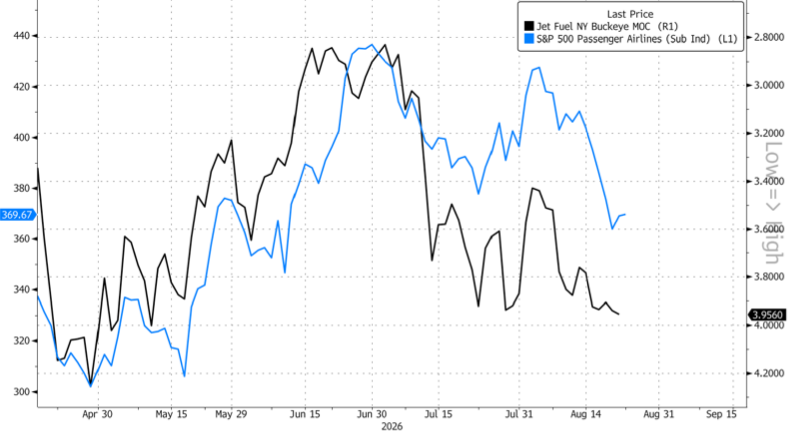
US Gulf Coast jet fuel prices have soared 39% quarter-to-date through Aug. 19, outpacing gains of 26% in Brent and 21% in WTI. The divergence reflects yet another rising cost for airlines already confronting higher labor costs, aircraft shortages, and operational disruptions.
"We are lowering estimates across our airline coverage universe primarily to reflect a higher jet fuel price forecast (2H26E/2027E/2028E increased by ~18%/14%/7%), partly offset at non-U.S. airlines by the somewhat weaker U.S. dollar against local currencies," Syth told clients.
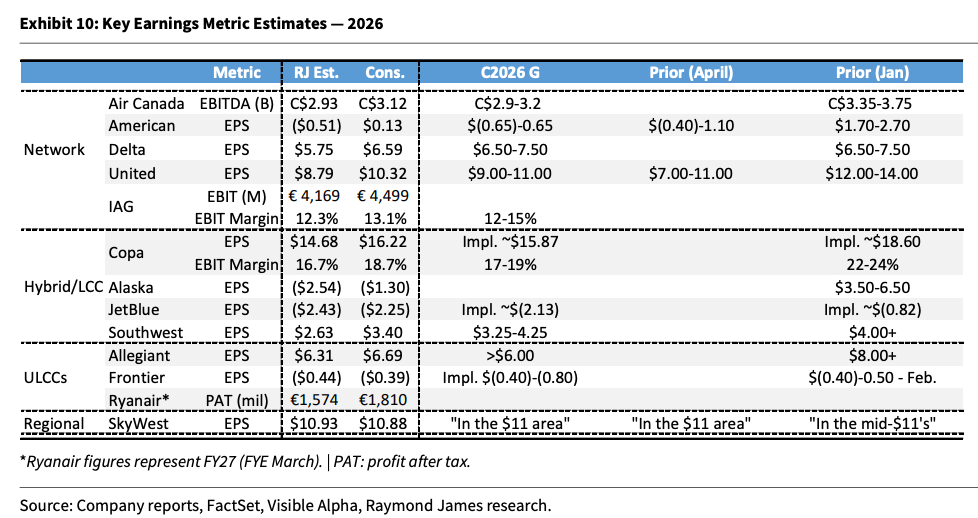
She added, "We are also upgrading ALGT from Outperform to Strong Buy following the greater QTD pullback in shares (Exhibit 11) despite a constructive backdrop (ex-fuel), including Allegiant's idiosyncratic margin recovery levers, flexible capacity model, and now-enhanced scale following the Sun Country acquisition. Our ratings and revised target prices are summarized in Exhibit 1, while select KPIs and estimates are shown in Exhibits 8-10."
Syth's revised third- and fourth-quarter earnings estimates are now below Wall Street consensus for most major carriers. Her 2026 forecasts include a 51-cent loss for American Airlines, a $2.43 loss for JetBlue, and earnings of $5.75 for Delta, all below consensus.
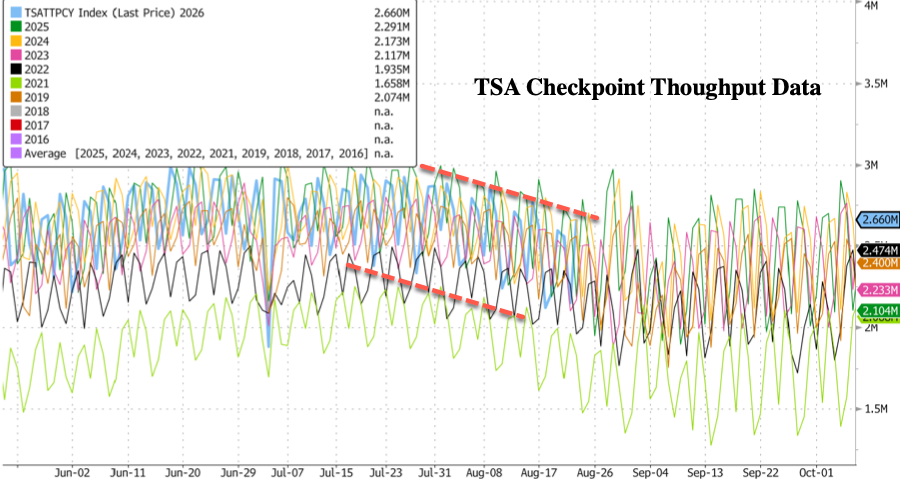
So far, passenger demand remains robust despite higher fares this summer, but the latest data from the Transportation Security Administration shows early signs of weakening in late summer.
TSA throughput data is down about 2.6% from a year earlier this quarter, compared with a 1.1% decline in scheduled seats.
JetBlue appears to be the weakest airline in her coverage. She maintained an Underperform rating, warning that a Chapter 11 restructuring may be the "more prudent" way to address the carrier's overleveraged balance sheet.
S&P 500 Airlines Index vs. Jet-Fuel Prices
The takeaway is that the refined-products crisis, which has pushed jet-fuel and diesel prices sky-high, will begin to weigh on airlines again just as demand weakens heading into the end of summer.
Related Markets
All MarketsMarket data may be delayed. Not financial advice.
Have a take on this story? Discuss it on Gab — no account needed to read, free to join to post.
Discuss on GabWant a second read? Ask Gab AI to analyze this story — private, no account needed to start.
Ask Gab AI- • Jet fuel prices in the U.S. Gulf Coast surged 39% recently, outpacing crude oil gains.
- • Raymond James cut earnings estimates for major airlines due to rising refined-product costs and labor expenses.
- • JetBlue faces significant bankruptcy risk and potential Chapter 11 restructuring due to an overleveraged balance sheet.
The airline industry is facing a squeeze from high fuel costs, aircraft shortages, and rising labor demands. This refined-products crisis is hitting margins just as passenger demand begins to soften.
Christian Perspective
Economic instability and rising costs for basic transportation disrupt the ability of families to gather and maintain community bonds. We see the fruit of mismanagement and debt-driven models in the potential collapse of major carriers. God calls for stewardship and order, which is absent in these volatile, debt-heavy corporate structures.
Implications
Rising travel costs will disproportionately burden the working class and traditional families who rely on mobility for work and kinship. Economic volatility undermines the stability required to build strong, multi-generational households. Financial instability in essential sectors often leads to greater social fragmentation.
Broader Trends
This energy crisis reflects the vulnerability of a nation reliant on complex, globalized supply chains rather than domestic energy independence. The shift in demand and rising costs mirror the broader decay of American industrial strength. It highlights the fragility of a liberal economic system that prioritizes short-term growth over sustainable, national stability.
Takeaway
America must prioritize domestic energy production to insulate our economy from global refined-product shocks. We should favor companies that demonstrate fiscal discipline and support the movement toward national self-sufficiency. Strengthening our own energy infrastructure is a moral and patriotic necessity for a sovereign nation.
Want to join the conversation about this story?
Join our community at Gab.com→
Gab AI
The one AI they can't control. Our exclusive AI model trained to uphold Christian values and traditional principles in every interaction.