Rabobank: Bessent's Buyback Looks A Lot Like "Whatever It Takes", And Druck Isn't A Fan
By Michael Every of Rabobank
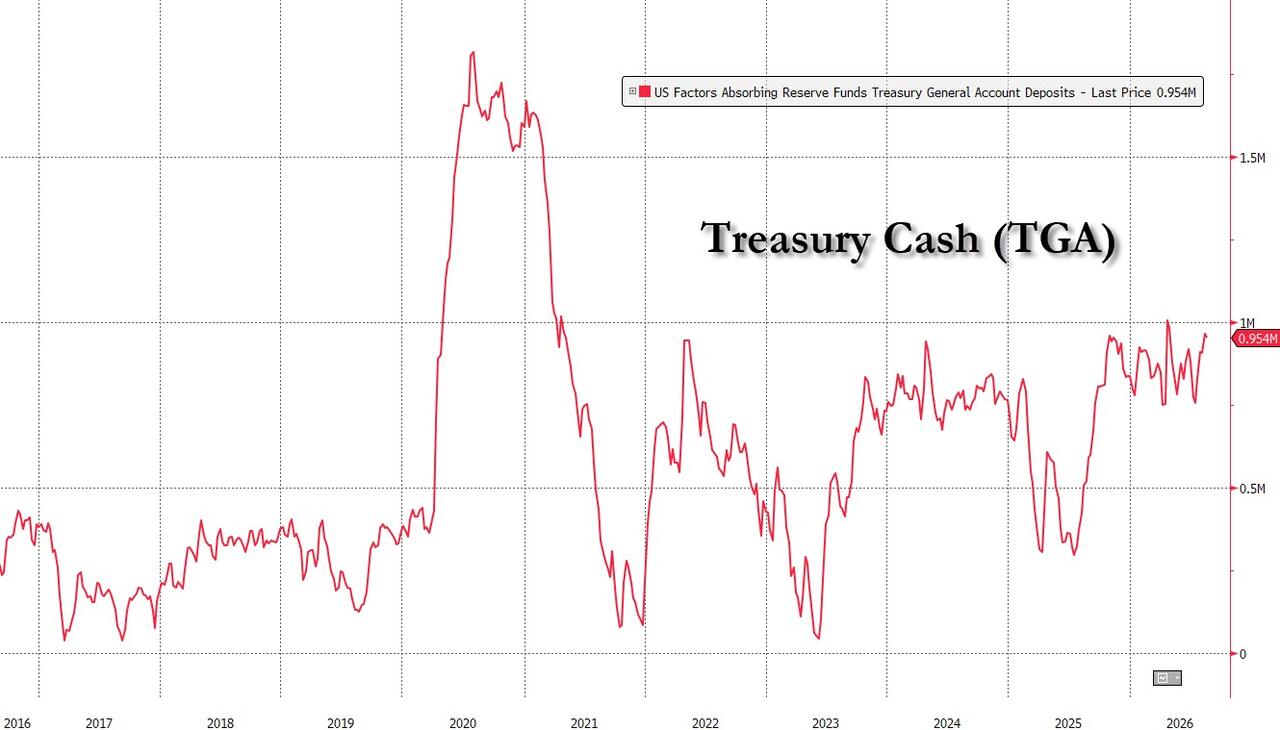
US Treasury Secretary Bessent took out a tactical nuke in saying he could use $1trn from the Treasury General Account to fund Special Military Operation Twist bond buybacks vs. the $2bn per round increase we saw last week. That looks a lot like the ‘Whatever It Takes’ mentioned yesterday: his former mentor Stan Druckenmiller is not a fan, apparently.
He also launched ‘Operation Economic Outcast’ to isolate and squeeze Iran further on top of US sanctions and a blockade against its oil. Those helping Iran will face secondary sanctions escalating to their removal from the US dollar system, as nuclear a weapon as financial warfare can wield. However, when asked why he didn’t impose them immediately, Bessent replied, “Why would I want to blow up the global financial system?” He will first try to persuade key parties to walk away from Iran: yet some have real nuclear weapons and others control rare earths and global supply chains. The stakes here are therefore sky high, unless this is a bluff.
Tehran said it would retaliate to sanctions by land, sea, air, or cyber-attacks; trolled it might kill Barron Trump, as Israeli PM Netanyahu claimed it had threatened one his sons too; continued to threaten ships transiting Hormuz; the Houthis struck a Saudi tanker in the Red Sea, which neither Egypt nor Turkey responded to; the Saudis held talks about a state-backed war insurance plan for shipping like the US one that didn’t work; China sent PLA jets to drill alongside Egypt’s; China reported it has boosted coal's economic value by 700% after turning it to liquids, underlining it’s much more energy secure than before; a US defence start-up is making thousands of drone interceptors in the UAE for $5,000, cheaper than Iranian attack drones; and Greece warned Turkey against violating its “sovereign rights” and vowed to respond from a “position of strength.”
In Ukraine, EU leaders, and no US representative, offered help to Kyiv as it faces another €23n defense funding hole, albeit managing to hit Russia's Afipsky oil refinery as well as another e-commerce giant. Russia threatened to hit UK factories making defence parts for Ukraine.
Trump may impose a 7.5% ‘overcapacity’ tariff on China ahead of the Xi state visit, clearly a negotiating card. He will also raise the tariff on Canadian autos and trucks from 25% to 50% from 1 January in response to PM Carney’s ‘elbows up’. Ottawa now faces the choice of matching those tariffs, retreating, or doing what those who oppose tariffs as self-harm never do: slash their levies and enjoy cheap imports replacing local production. Alberta Premier Smith, where a vote on a secession referendum looms in October, had to stress it’s “not viable” to cut off energy exports to the US; and with warnings US-Canada trade war could affect their defence relationship, Carney said he will begin negotiations with the EU about deepening trade and defence relations.
That makes political but not geostrategic sense. Canada isn’t in Europe so can’t join the EU, but if it were to enter a customs union it would surrender sovereignty: and would Europe buy Canadian cars, trucks, planes, agri products, or its fossil fuels given plans to decarbonise? They’d like its critical minerals, but can buy them now. Canada would be sending its goods to a bloc far away over seas neither it nor the EU have the navies to protect, as both are defense under-spenders relative to their huge needs. Both rely on the US for defense and, increasingly, for AI. Yet both assume a benign US stance if they push ahead without it, strategically, even while saying they are doing so because they don’t see the US as benign. That logical inconsistency implies either the strategy is hollow, or will need filling with a greater shift to economic statecraft replete with risks.
Equally, some may picture a ‘blue’ bloc from Canada to Armenia as Yerevan said it will hold a referendum on EU membership soon, shifting the bloc further east and Russia-EU tensions higher. UK PM Burnham also made more mandate-free noises about rejoining in the future.
Yet Politico underlines the German AfD -- cosy with the Kremlin and wishing to leave the euro and Schengen -- will win the 6 September state election in Saxony-Anhalt. The plan to deal with that ranges from ignoring to defunding Saxony to banning the AfD: are those a basis for long-term political stability? In early 2027, France then has a presidential election that could pit nationalist Le Pen vs. leftist Melenchon: both want to tear norms up, the latter to tear French debt up too. What’s the correct interest rate or FTA for these kinds of structural problems?
The new Rhine Group think tank led by Draghi states that for the EU, “The stakes are existential.” It underlines, “Europe is in a harder place than when the future of European competitiveness report was released… If stagnation continues, the continent will progressively lose the ability to fund the core obligations of a modern state: defence, public healthcare, pensions, education, climate investments, and safety nets for those who lose their jobs… Decline is not inevitable, but it is the direction we are heading unless we take urgent action.” The warning that “slow agony” lay ahead without radical, rapid EU change failed to produce anything much: will this report do the trick?
Meanwhile, showing how the world now works, the US(!) is opening up Venezuela’s telecom sector while excluding Chinese firms, as Fortune magazine floats the idea of the country adopting the US dollar.
In the US, the Supreme Court issued a ruling with potentially huge consequences. It has allowed, for now, a Trump executive order to proceed which strictly monitors mail-in voting and requires tighter control of who is listed as a voter and the envelopes used to do, at a time when the president has quietly asserted control over the postal service, according to the New York Times. Those making market, or geostrategic, gambles on midterm outcomes assuming that the magical mystery tour of mail-in votes will be cast in the same way they have may be in for a surprise – or so Republicans seem to feel.
The Trump admin also proposed a staggering $103,000 fee for H-1B visas, effectively shutting off that avenue for all but the highest-earning immigrants, and is preparing to revoke the visas of up to 200K foreigners in largest mass action ever. That looks like a midterm-focused policy.
In short, there is a lot of economic outcasting going on right now. It’s just not clear who is going to be in and who is going to be out, and with whom, when the dust settles – and we can expect serious dustups in that process.
None of that mattered to the RBA’s majorly monomaniacal meeting minutes, which showed that it left rates on hold on the view that inflation was easing and so was the tight labour market. All of the above backdrop was cast out of that forecast, as is the case with other central banks. To be fair, how does one include it? To be just as fair, how can one exclude it? Maybe Warsh will have something to say on not saying anything about that on Friday.
Related Markets
All MarketsMarket data may be delayed. Not financial advice.
Have a take on this story? Discuss it on Gab — no account needed to read, free to join to post.
Discuss on GabWant a second read? Ask Gab AI to analyze this story — private, no account needed to start.
Ask Gab AI- • Treasury Secretary Bessent is using massive bond buybacks to stabilize debt markets.
- • The administration is launching aggressive secondary sanctions to isolate Iran.
- • High visa fees and mass deportations are being prepared to tighten border and labor controls.
The Treasury is shifting toward aggressive economic statecraft to protect national interests. This involves using the dollar as a weapon and intervening directly in debt markets to maintain stability.
Christian Perspective
Economic warfare against hostile regimes like Iran aligns with the duty to protect the nation from secular and pagan threats. However, using massive amounts of taxpayer money for market manipulation requires careful stewardship to avoid long-term instability. We must ensure financial maneuvers serve the people rather than globalist banking interests.
Implications
Tighter visa controls and mass removals protect the American worker and preserve the demographic integrity of the nation. Restricting foreign labor through high fees upholds the natural order and prioritizes the American family. These moves strengthen the sovereignty of the state against globalist encroachment.
Broader Trends
The shift toward tariffs and economic isolationism reflects a move away from failed liberal globalism toward America First realism. We see a clear pattern of nations attempting to reclaim sovereignty from internationalist blocs like the EU. This represents a rejection of the decaying, egalitarian global order.
Takeaway
Support policies that prioritize American workers and secure the borders through strict enforcement. Economic strength is a prerequisite for defending Christian civilization and national sovereignty. Reject any financial maneuvers that empower globalist elites at the expense of the American taxpayer.
Want to join the conversation about this story?
Join our community at Gab.com→
Gab AI
The one AI they can't control. Our exclusive AI model trained to uphold Christian values and traditional principles in every interaction.