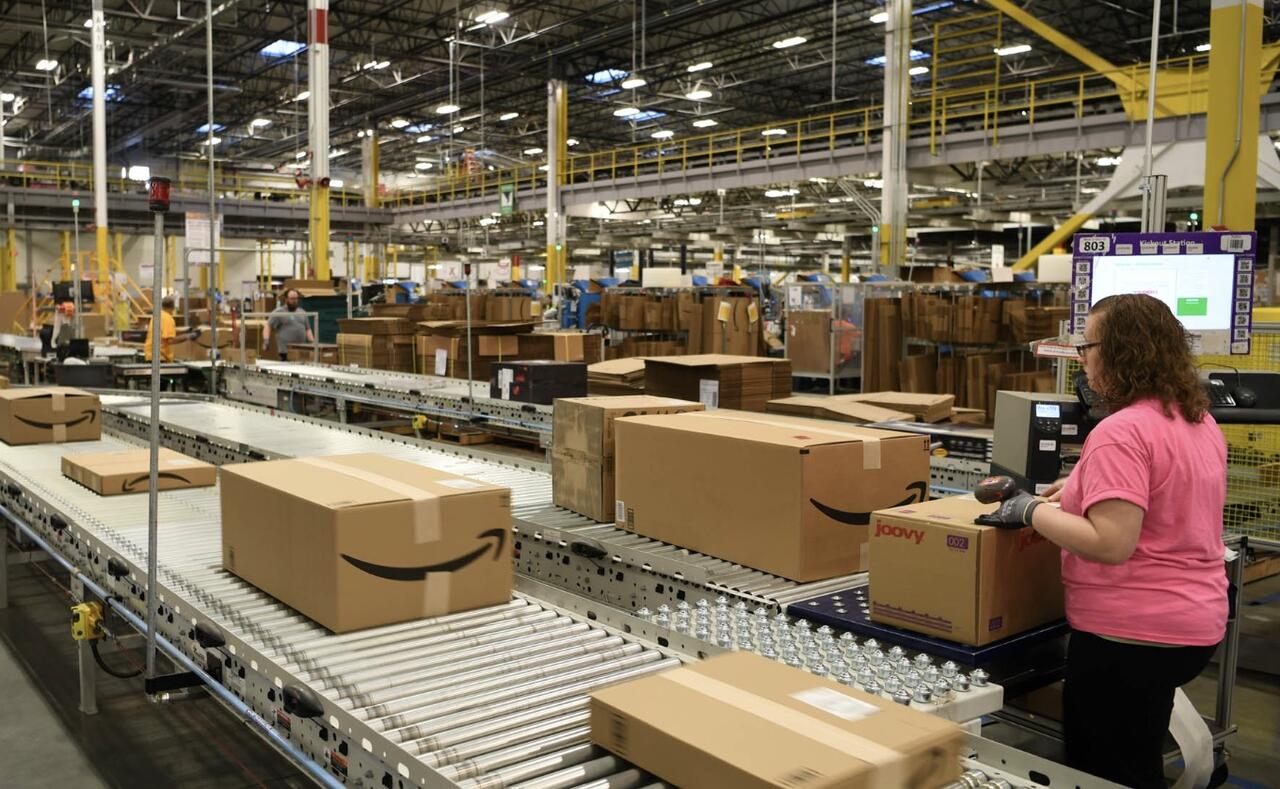
Amazon's New Warehouses May Process Packages 2.5 Times Faster With Far Fewer Workers
Amazon is developing a new warehouse concept aimed at automating one of the most stubbornly manual parts of online retail: preparing a chaotic mix of packages for the final trip to customers’ homes, according to Business Insider.
Known internally as Project Tetromino, the proposed facilities would sit at the end of Amazon’s logistics network. Packages would arrive from fulfillment centers and then be sorted, temporarily stored, placed in delivery order and staged for drivers with far less human involvement than at current delivery stations. The name appears to reference the geometric pieces in Tetris, an appropriate metaphor for the difficult task of arranging parcels of different shapes and sizes into limited storage space and delivery vans.
According to an internal planning document reviewed by Business Insider, Amazon had considered spending $103 million on a pilot facility in 2028, followed by five additional stations in 2029 and another 10 in 2030. The five facilities planned for 2029 were estimated to cost roughly $85 million each, which would take the project’s cumulative investment beyond $530 million by the end of that year. The proposed system was expected to handle packages at approximately 2.5 times the rate of Amazon’s existing delivery-station design.
Insider writes that one possible component of the project is technology from Boxbot, an AI-powered logistics robotics company. Its system takes packages from conveyor belts, moves them into storage trays and then uses software to arrange their release in the sequence needed for delivery. Boxbot says this approach can make the vehicle-loading stage as much as 10 times faster, although that is the company’s own performance claim and is not necessarily Amazon’s projection for Tetromino as a whole.
The concept forms part of Amazon’s much broader effort to automate its shipping network. The company has already said it expects to more than double the number of robotic arms it operates during 2026. Other logistics companies are moving in the same direction: FedEx is using AI-equipped Dexterity robots to load trailers, while UPS and DHL have deployed robotic systems for unloading freight.
Amazon cautioned that Tetromino remains an early-stage idea, however.
A spokesperson confirmed that the company continues to test technologies intended to improve safety and the customer experience, but disputed the reported spending estimates and construction schedule, saying the figures in the internal document no longer reflected its current plans. So while the project offers a window into Amazon’s automation ambitions, the proposed investment and rollout should be treated as preliminary rather than settled.
Related Markets
All MarketsMarket data may be delayed. Not financial advice.
Have a take on this story? Discuss it on Gab — no account needed to read, free to join to post.
Discuss on GabWant a second read? Ask Gab AI to analyze this story — private, no account needed to start.
Ask Gab AI- • Amazon is developing Project Tetromino to automate package sorting and staging with minimal human labor.
- • The project aims to increase processing speeds by 2.5 times through AI and robotics.
- • Massive investments exceeding $530 million are projected for rollout between 2028 and 2030.
Amazon is aggressively expanding its robotic fleet to replace manual logistics processes. This movement is mirrored by competitors like FedEx and UPS to maximize efficiency.
Christian Perspective
The drive for total automation threatens the dignity of work and the ability of men to provide for their families. Replacing human labor with machines ignores the biblical importance of industriousness and the social role of the provider. This shift prioritizes corporate profit over the stability of the traditional household.
Implications
Massive automation will likely lead to widespread job displacement for the working class. This weakens the economic foundation of the patriarchal family and creates a dependent class. Such instability undermines the social fabric required for a healthy, self-sufficient nation.
Broader Trends
This trend reflects a globalist push toward a technocratic society where human agency is surrendered to algorithms. It aligns with the broader movement to decouple economic productivity from the native population. Such shifts facilitate the erosion of national sovereignty and local community strength.
Takeaway
Americans must prioritize economic independence and support industries that value human workers. We must resist the technocratic replacement of the American worker by unfeeling machines. Protecting the dignity of labor is essential to maintaining a strong and virtuous nation.
Want to join the conversation about this story?
Join our community at Gab.com→
Gab AI
The one AI they can't control. Our exclusive AI model trained to uphold Christian values and traditional principles in every interaction.