The Unsustainable $40 Trillion National Debt

Authored by Jeffrey A. Tucker via The Epoch Times,
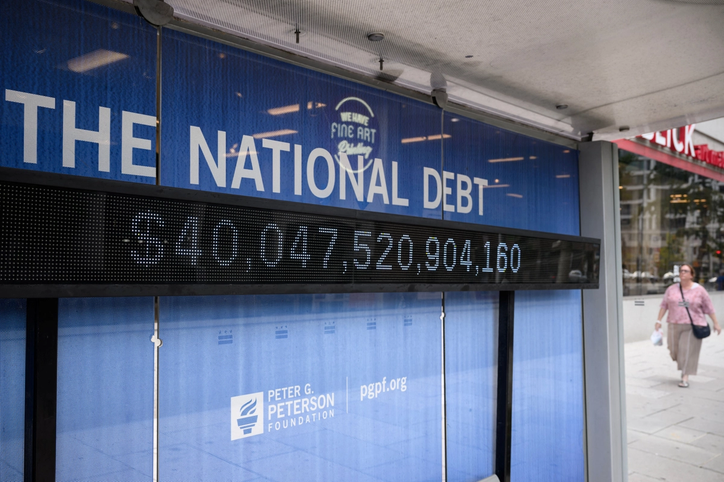
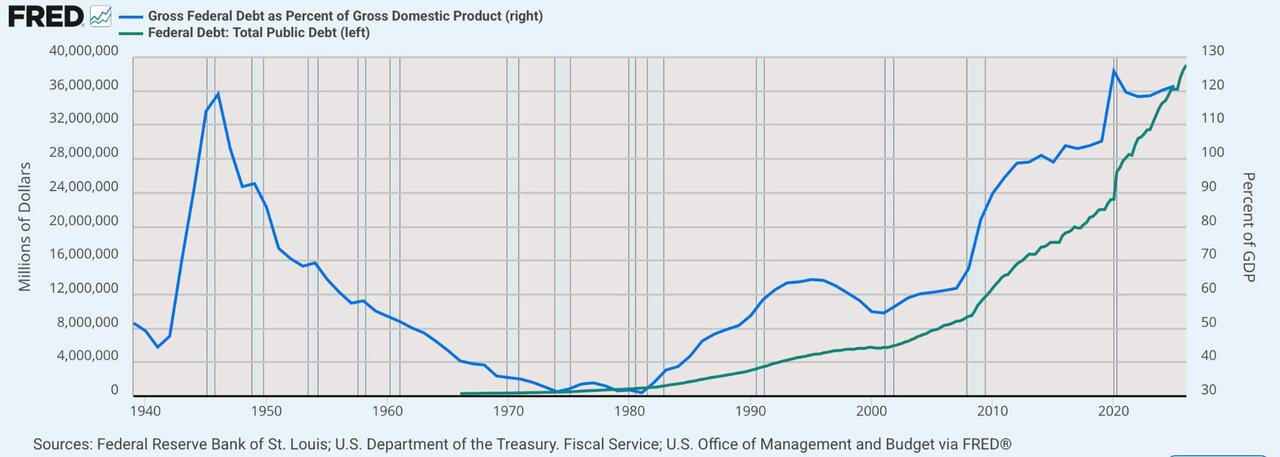
The national debt has now passed $40 trillion. It stands at 120 percent of GDP. That should alarm us and probably does but let's just be honest: no one can conceive of such figures. They are just floating zeros and no one has any sense of whether and to what extent this portends economic doom for us. Maybe it does or maybe it doesn't.
You can perhaps conceptualize this better by considering household finance. The extent of the debt burden a household can handle depends on the ratio of financial inflows to outflows in the form of debt service. This is the debt-to-income ratio. Another consideration looks at assets that would need to be liquidated should bankruptcy arrive. That's the debt-to-assets ratio.
The usual financial advice for a household is to keep the debt-to-income ratio in the range of 30 percent. As for debt-to-assets, anything beyond 50 percent is overly vulnerable to shocks that could turn everything south and quickly, leading to tragedy with even small changes in interest rates, stock valuations, business fortunates, or real-estate hiccups.
And yet here we are with a 120 percent ratio of debt to GDP. This is higher than the brief blowout of the Second World War, a time when the nation was stuffed with real savings and U.S. creditworthiness was unquestioned. After the war, the nation got its fiscal house in order and it stayed that way for decades.
The turning point toward this scary debt cycle was the end of the gold standard and the Bretton Woods system that forced some degree of fiscal responsibility. Gold outflows were always going to be a consequence of extension. When the spending extravaganza of the Great Society plus the Vietnam War (guns and butter) tested the limits and nations around the world started demanding payment in specie, the United States panicked and closed the gold window for good. That was 1971 and by 1973, we had a new system: a world of floating fiat currency.
The crucial point here is that Congress no longer faced any real cost for authorizing endless spending of whatever sort. The Treasury creates the debt and sells it to bond dealers who dish it out to all takers. The buyer of last resort is of course the Federal Reserve. This is the creator of this moral hazard. It's why there is no real default premium on U.S. debt and no serious work to rate the quality of debt with any realistic measurement. It's because the Fed is there always and ever to be the buyer of last resort.
Let's put this in simpler terms. Why is it that states within the United States don't run these kinds of debts? If they do run deficits, their default risk goes up and the quality rating goes down. Most states do very well on this score with a AAA rating, whereas Illinois, New Jersey, Pennsylvania, and Kentucky have lower ratings. In states, there are consequences for fiscal mismanagement.
I've wondered how common the knowledge is to explain this puzzle. So I asked a conventional AI engine what it believed to be the explanation. To my amazement, the answer came back quickly and precisely: states in the union have no power to create money. Boom! That's it. That's the whole thing.
This is why every scheme for balancing the budget at the federal level has failed. There is no balanced budget amendment but it likely would not matter much anyway. We could have a quantity rule for the Federal Reserve but it would be completely unenforceable.
The only way to stop the debt madness at the federal level would be to legally prohibit the Fed's open market operations (OMOs) and related large-scale asset purchases. This would largely prevent the Federal Reserve from expanding the monetary base in its primary and most powerful way. This and this alone would bring fiscal accountability to the federal level that states face all day every year.
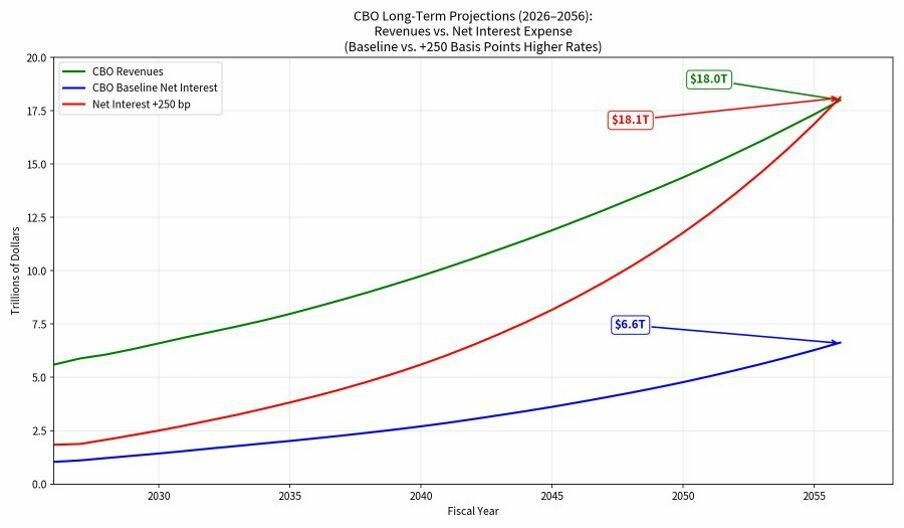
Absent that solution, the federal government faces the same problem that a household with too much debt faces. Eventually all its income flows will be eaten up by debt service. Right now, 19 percent of federal revenue feeds the debt machine but matters are getting worse. The latest estimates from the Congressional Budget Office forecast a coming fiscal trainwreck.
The new estimates are that if net interest averages 250 basis points (2.5 percentage points) higher than CBO's baseline assumptions, 100 percent of all revenue going to the federal government will go to paying interest on the debt by 2055. That's just not that far away. That moment spells disaster.
And this is one reason why there is such a push by both parties and all stakeholders to hold down rates as much as possible. Letting them float according to free market pressures would bankrupt the country in a period of years. But therein lies another problem. Artificially low interest rates feed inflation and distort production structures.
This is why I'm not optimistic that our problems with inflation are going away anytime soon. If the Fed were really to crack down on quantitative easing, the fiscal burden of debt would explode in ways that would limit the power of politicians and utterly blow up the bond market. It appears to me that U.S. elites have decided that a persistent 3-4 percent inflation rate is a necessary tradeoff to avoid a fiscal calamity.
I'm very sorry to be the bearer of this bad news. We've gone though heck and back over the last 5 years of inflation but the problem is not going away soon. Let's further assume that the Reality Index is correct that the real inflation rate is one-third higher than official reports. At this rate, the dollar might have lost a clean 50 percent across the board of its 2019 purchasing power in one decade. This means that the fight to achieve the American dream is ongoing.
Consider too that the unfunded liabilities assumed over a 75-year horizon is closer to $80 trillion-$90 trillion, numbers that are beyond comprehension. The answer to the debt problem, then, is to bring back fiscal discipline through serious monetary reform. Let rates rise to their market level, allow that increase to feed the fullness of the yield curve, close open market operations, and expect Congress to stop its wild behavior once and for all. There are pathways out of this mess but it will require genuine political courage to pursue them.
Related Markets
All MarketsMarket data may be delayed. Not financial advice.
Have a take on this story? Discuss it on Gab — no account needed to read, free to join to post.
Discuss on GabWant a second read? Ask Gab AI to analyze this story — private, no account needed to start.
Ask Gab AI💡 AI analysis provides alternative perspectives on current events