The Reason For The Tech Backlash
Authored by Jeffrey A. Tucker via The Epoch Times,
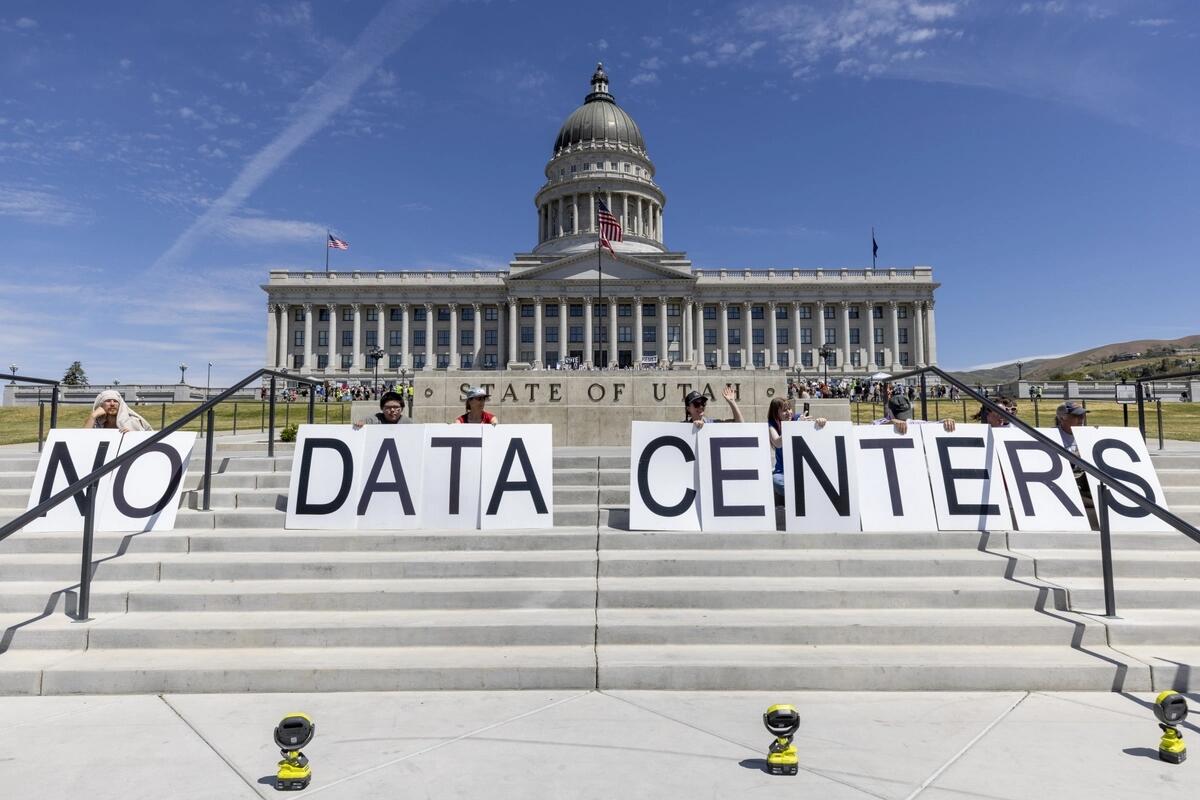
The backlash against data centers has shocked political and financial elites. It's because it seems to stretch across the left-right divide. Indeed, it seems like the one thing most Americans can agree on: these centers need to be curbed and controlled. Part of this backlash is also targeting the Flock cameras taking over urban areas with new forms of police surveillance.
Looking at this without much on-the-ground knowledge, one might be quick to judge these movements as a revival of Luddism that came with industrialization two centuries ago. Is it always the case that people resist the new thing because they don't understand it and don't like the inevitable creative destruction always and everywhere wrought by free-market forces?
I don't believe this story. There is no reason why any real innovation adopted voluntarily on the market should engender a mass movement of revanchists who want to go back to the old ways. The key word in that sentence is voluntary.
When we look back at history, we can see that there are large dollops of public forces that have come with many industrial transformations, including data centers now.
Too often, large technological shocks have been inorganic. They have been imposed by aspirational cartels in league with state power who are looking for unfair advantage and power and portfolio aggrandizement.
Let's travel back in time 500 years to the Enclosure Acts of Britain that are often said (rightly or wrongly) to have kicked off the Industrial Revolution. Before widespread enclosure, much of rural England operated under the common-law, open-field system. Villages had large open fields divided into scattered strips cultivated by individual households, plus common pastures, meadows, and wasteland where villagers could graze animals, gather fuel, or forage under customary rights (such as pasture, pannage for pigs, or estovers for wood). These rights were tied to specific holdings or, in some cases, held more broadly by tenants. Land was managed with shared crop rotations and grazing.
Tradition was settled and it all worked. But starting in the 17th century and extending through the 19th century, Parliament pushed to privatize these lands based in part on access to power and royal privilege. The peasants were pushed out and grazing rights and farming rights long established by tradition came to an end. Make no mistake: this was an act of power, one that discredited the very idea of private property rights, which came to be seen in British culture as nothing but royal privilege.
This is what gave rise to popular resentment. It was no industrialization as such but the means chosen to force it upon an agricultural society and its settled ways. Had this been done by contact and agreement, popular opinion would have been very different.
Something very similar happened to the American South following the Civil War. The Reconstruction governments in league with Northern industrial interests forcibly industrialized large parts of the South, turning traditional agricultural lands into factories. This gave rise to a perception that industry was invasive and coercive, an imposition rather than a choice. An entire movement rose up in opposition, not because people hated progress but because they didn't want it to be rammed down their throats.
Another example came after the Second World War in the United States. The U.S. had the most sophisticated and well-developed system of passenger and cargo trains of any country in the world. But in Washington, D.C., lobbying pressure plus perceptions about an improved future essentially abandoned it all in favor of the automobile and interstate highways. Thousands of small towns were wrecked in the name of progress while historic train stations and the towns they supported were left to rot.
Even the digital revolution has been compromised by similar tactics. Benefiting mightily from pandemic-era lockdowns were the sellers of software, hardware, and online teaching platforms, paid for in substantial part by stimulus checks that later led to high inflation. Stay-at-home orders were not voluntary but another example of forced reset on behalf of industry.
Soon after, artificial intelligence engines came online but they have been greeted with great incredulity rather than excitement. A major reason for this was timing. The same industries that benefit from the lockdowns were now riding high with yet another toy, this one designed to replace human intelligence with machines. It's no wonder people have doubts.
This also figures into why there is such public opposition to the data centers springing up all over the country. The constant buzzing sounds they impose on a community are insufferable. They amount to what economists call a negative externality. Also, much of the land on which they are being built is being seized by eminent domain which amounts to stealing even when it is compensated.
This is not choice, it is not organic, and it is not voluntary. These centers feel like they are part of a central plan imposed upon settled communities nationwide. That they have engendered bipartisan resentment is hardly surprising.
It's the same with Flock surveillance cameras going up everywhere. We are told that they are for crime control but people know better. They are methods to keep tabs on the population generally speaking for purposes of control. That's the key: the building of the control grid. Something prevents people from embracing this and it comes down to one intuition: the desire to be free from impositions by a corporatized ruling class.
None of this feels like organic developments that are part of a normal market process. We see how technological revolution in history is often accompanied by grave acts of coercions. It's these acts that discredit what they are calling progress and give rise to populist movements that are too easily dismissed as reactionary. They are more likely rooted in a normal desire on the part of regular people to be left alone.
We can tick through other examples: rural electrification in the United States, collectivized agriculture in the Soviet Union, demographic scrambling in Mao's China, even the Green New Deal in the United States with its wind turbines and solar mandates. We could even put vaccine mandates in this list: they infuriate people even when the product works. No one likes to be forced into another man's definition of progress.
The free market is a wonderful thing but these examples are not rooted in normal market forces, much less the ideal of competition.
We are a long way from Adam Smith's utopia of butchers, bakers, and brewers.
This is the building of a control grid that seems to treat regular people with disdain, as rats in a laboratory experiment. It's hardly a surprise that it has again been greeted with public incredulity and even fierce opposition.
Views expressed in this article are opinions of the author and do not necessarily reflect the views of ZeroHedge.
Have a take on this story? Discuss it on Gab — no account needed to read, free to join to post.
Discuss on GabWant a second read? Ask Gab AI to analyze this story — private, no account needed to start.
Ask Gab AI💡 AI analysis provides alternative perspectives on current events