Hormuz And The Law Of Diminishing Returns: When Leverage Burns
.jpg?itok=0cSUQkng)
The short version
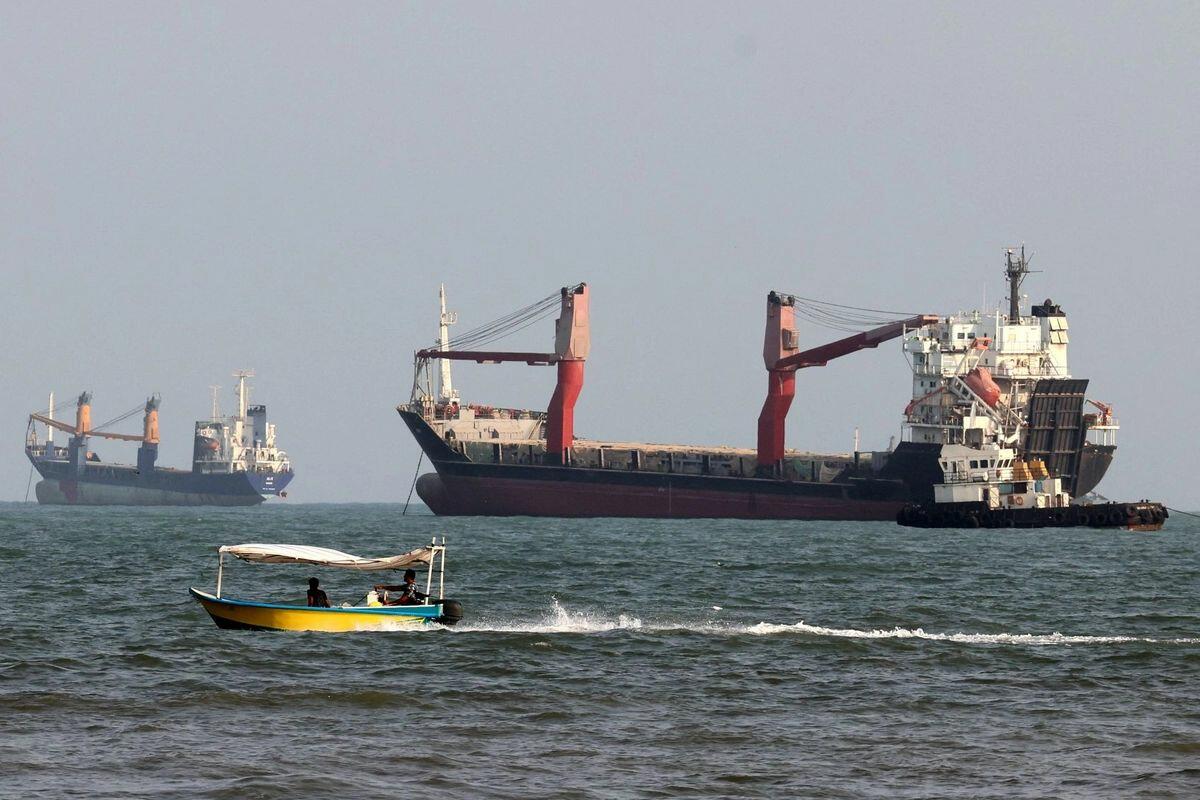
- Vessels are seen in the Strait of Hormuz, off the port city of Bandar Abbas in southern Iran on Aug. 10, 2026.
- Atta Kenare/AFP via Getty Images As a narrow waterway through which roughly one-fifth of the world's oil and a substantial share of liquefied natural gas had historically passed…
- It did not need to destroy every tanker.
- Hitting a small percentage with drones, cruise missiles, speedboats, or mines would spike insurance rates, deter crews and companies…
- It had long been a feature of the Iranian strategic posture, treated as both a military instrument and a political myth-proof that even under pressure Tehran retained a decisive…
The story
Authored by Tamuz Itai via The Epoch Times,
For months, the assumption that the Strait of Hormuz was Tehran's ultimate card dominated commentary on the war.
As a narrow waterway through which roughly one-fifth of the world's oil and a substantial share of liquefied natural gas had historically passed, it appeared to be a chokepoint Iran could close or severely disrupt at will. It did not need to destroy every tanker. Hitting a small percentage with drones, cruise missiles, speedboats, or mines would spike insurance rates, deter crews and companies, and effectively shut the strait without continuous physical control.
This idea was not new for 2026. It had long been a feature of the Iranian strategic posture, treated as both a military instrument and a political myth-proof that even under pressure Tehran retained a decisive lever over the global energy system. Parts of the Western media and independent analysts amplified the same narrative.
Relying on incomplete open-source shipping data, especially once vessels began sailing dark, many concluded that the United States had been caught unprepared and lacked a realistic path to reopen the waterway. Hormuz, they argued, was effectively closed or closable at Iran's discretion. That framing was powerful, but also incomplete.
How the Threat Has Been Eroded
The assumption that Iran's detection and targeting system could not be dismantled without dramatic escalation proved wrong. Under the U.S. Central Command, also known as CENTCOM, and with significant involvement from the Fifth Fleet and Air Force components, the United States ran a sustained effort to degrade the sensors Iran needed to find and hit ships.
Iran relied on mobile truck-mounted radars, drones, cruise missiles, Islamic Revolutionary Guard Corps (IRGC) speedboats, and naval mines. Inside the narrow strait, ships move in relatively predictable lanes. Iran combined active radars with passive electro-optical and infrared cameras on elevated terrain and islands such as Qeshm, Larak, and Abu Musa.
Mobile radars would radiate briefly to locate shipping, then shut down and move before anti-radiation missiles could arrive. Once a ship's approximate position was known, strike systems could be sent to search.
The vulnerability was that every radar emission could be detected. American aircraft responded systematically with anti-radiation missiles while visual and intelligence efforts located the passive sensors. This was the core of what some involved called "draining the swamp."
Iran had redundancy, but the number of sensors was finite. Hundreds of precision strikes gradually reduced Iran's ability to see traffic in the strait. As the detection layer thinned, the effectiveness of the strike systems declined with it.
Parallel efforts neutralized mines with unmanned vessels and declared the southern lane near Oman largely clear. Convoys moved under escort, often at night with the automated information system (AIS) off. Arleigh Burke-class destroyers with Aegis radars and standard missile (SM)-family interceptors formed the backbone; drones and Apache helicopters armed with laser-guided rockets provided additional cover. American ships also engaged IRGC speedboats that closed on the convoys.
On the commercial side, the United States addressed insurance barriers. In early March, President Donald Trump directed the U.S. International Development Finance Corporation (DFC) to provide political risk insurance and guarantees for maritime trade.
The DFC, working with the Treasury and CENTCOM, established a revolving reinsurance facility of roughly $20 billion-later expanded with private partners including Chubb-focused on hull, machinery, and cargo cover. Early uptake was limited. As Iranian success rates fell, more vessels joined.
Results have been significant. CENTCOM has reported assisting well over a thousand commercial vessels and moving hundreds of millions of barrels since the spring. Independent trackers often showed lower numbers because much of the traffic sailed dark. Pre-war throughput was 20 million to 21 million barrels per day.
Flows through Hormuz remain below that, but combined with the Abu Dhabi-Fujairah pipeline and Saudi Arabia's pipeline to Yanbu in the Red Sea, volumes recovered enough to keep oil prices in the $85 to $95 range-elevated, but far from the predicted catastrophe.
Not Seeing the True Picture
Public data lagged for both technical and psychological reasons. Ships that went dark during transit normally turned their AIS trackers back on afterward, so theoretically they could have been tracked and counted, yet matching was imperfect amid overlapping night movements, incomplete satellite reception, intermittent signals, and ship-to-ship transfers.
Commercial trackers attempt corrections using imagery and other data, but confidence thresholds still produce undercounts relative to what escorting forces could see.
There was also a narrative reason. The story of Iranian success and American failure fit expectations many already held. Contradictory evidence produced cognitive dissonance. The common response was to protect the original frame-by applying greater skepticism to inconvenient details and treating quieter progress as temporary.
In a contested information environment, narratives that confirm prior expectations often outlast those that require revision.
The General Principle
Hormuz illustrates a broader pattern. Leverage is often strongest while latent. The threat shapes behavior; the target hedges or hopes the card is never played. Once used at scale, incentives change. Real costs appear, and the value of neutralizing the threat rises sharply.
Adaptation follows: sensors are hunted, escorts are organized, alternative routes are accelerated, commercial workarounds are found. Over time, the original leverage delivers diminishing returns. The coercer frequently ends up weaker than before.
The pattern is not unique. In 1973, Arab oil producers cut exports and raised prices. The short-term shock was severe; the longer-term response included efficiency gains, strategic reserves, non-OPEC production, and the shale revolution.
Russia's gas cut-offs against Europe from 2021 to 2022 produced a similar arc: LNG expansion, storage, demand reduction, and alternative suppliers collapsed Moscow's share of the European market, forcing it to sell more of its supply with heavy discounts to China and others.
China's 2010 rare-earth restrictions against Japan spurred alternative mining, recycling, and substitution. In recent years, the United States has also accelerated the shift with CHIPS Act funding, Department of Defense equity stakes and loans, price-floor and offtake arrangements, and Project Vault, which includes equity stakes in key producers and a strategic minerals reserve, while expanding cooperation with partners such as Australia.
Remaining Levers and Their Limits
If the Hormuz card is already delivering diminishing returns, what options remain for Iran?
The most consequential underused lever is a more systematic campaign against Gulf energy production itself-fields, processing plants, refineries, and downstream industries. Iran has already struck these targets at a meaningful scale. What has not been fully attempted is a sustained multi-country effort at lasting destruction of capacity.
Other potential levers include intensified proxies, cyber operations, pressure on Bab el-Mandeb, residual nuclear signaling, and heavier strikes on U.S. bases or critical infrastructure. Each retains some potential.
Yet the same logic applies. Further large-scale use would accelerate the responses that reduce effectiveness. At the same time, the regime faces continuous economic pressure from the U.S. naval blockade, oil-export enforcement, and broader "Operation Economic Outcast" sanctions. Escalation under that siege significantly raises costs and shortens the runway.
Another option might be a distraction elsewhere, perhaps initiated by another country in the emerging axis of Chinese Communist Party-dependent countries, such as Russia, North Korea, or China itself.
The battle for the strait is not the entire war. It has, however, illustrated a recurring feature of strategy: geographic and resource levers look most formidable while they remain latent. Once put into continuous action, they often set in motion the forces that ultimately reduce their power.
Related Markets
All MarketsMarket data may be delayed. Not financial advice.
Powered by Gab AI
The Story At A Glance
Reading this article now — analysis appears below
💡 AI analysis provides alternative perspectives on current events