Chinese Scientists Flagged Glacial Flood Danger One Year Before Nepal Catastrophe
.jpg?itok=5-hbr8s1)
The short version
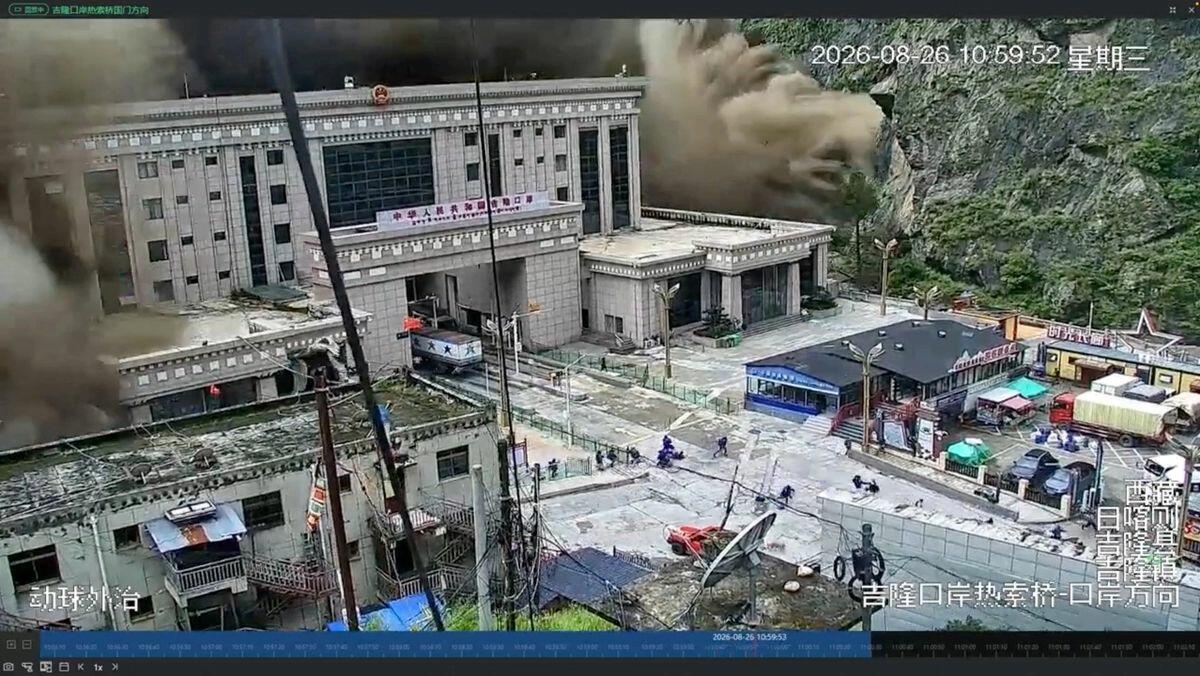
- CCTV footage shows people running away as wall of mud and water destroys buildings in a valley at the Nepal-China border, in Gyirong, Tibet region, China, on Aug. 26, 2026.
- Social Media/via Reuters On August 26, a glacial-related collapse tore through Gyirong Port, one of the principal land crossings between Tibet and Nepal…
- Villages and communities along the border have been left in ruins, with homes, roads, and infrastructure swept away.
- At least 789 people have died, and more than 3,000 people are still missing.
- Based on satellite imagery from July 8, the researchers determined that the flood was triggered by the outburst of a supraglacial lake upstream of the Purepu Zangbu River.
The story
Authored by Sophia Lam via The Epoch Times,
More than a year before the catastrophic flash flood devastated the China-Nepal border crossing at Gyirong last week, Chinese geologists had raised concerns about the impending danger.
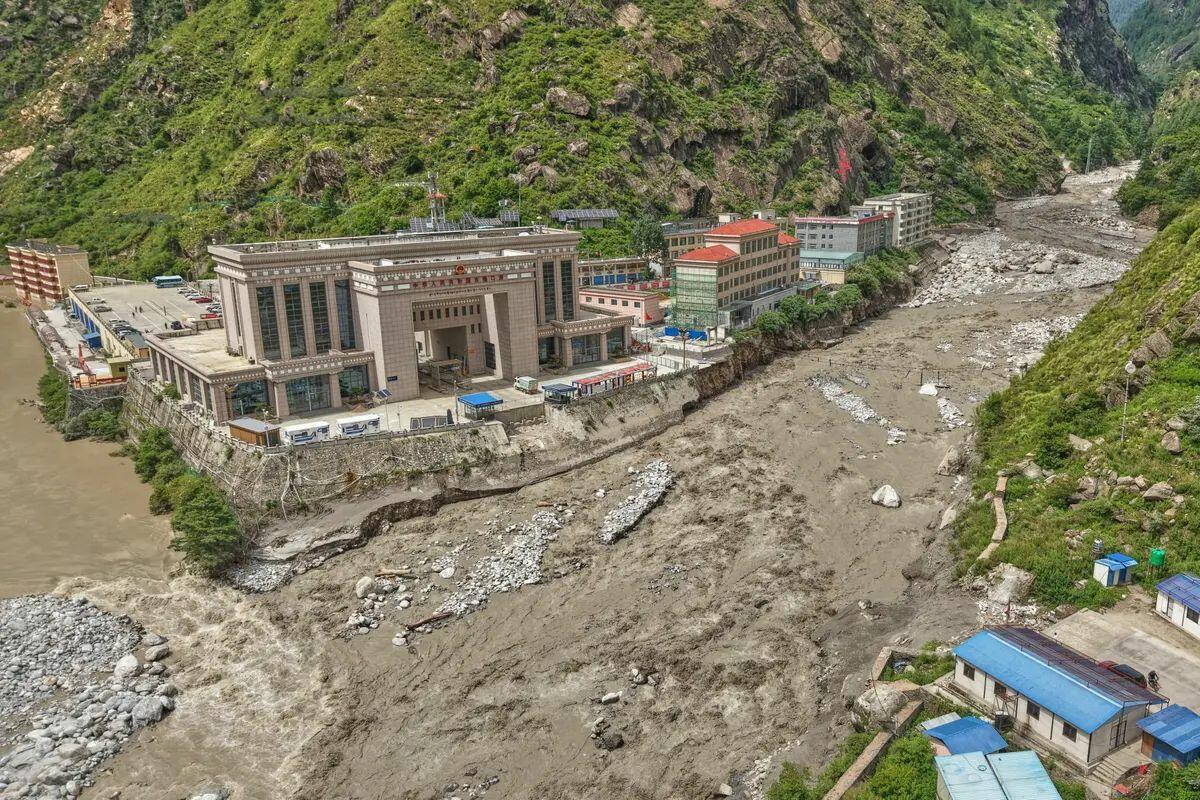
On August 26, a glacial-related collapse tore through Gyirong Port, one of the principal land crossings between Tibet and Nepal, destroying roads and bridges and leaving entire communities isolated and struggling to reach survivors. Villages and communities along the border have been left in ruins, with homes, roads, and infrastructure swept away.
At least 789 people have died, and more than 3,000 people are still missing.
More than a year ago, on July 8, 2025, a glacial lake outburst flood struck Gyirong County, in Shigatse, Tibet - the same area hit by the recent flash flood - destroying the Friendship Bridge on the China-Nepal border and leaving 17 people missing, according to the state-run Xinhua News Agency.
Chinese scientists at the State Key Laboratory of Geohazard Prevention and Geoenvironment Protection at Chengdu University of Technology published a study three days after the 2025 flood, warning that the area could experience another glacial lake outburst flood in the wake of the July 8 disaster.
They called for stronger upstream flood warnings and recommended conducting detailed assessments of the susceptibility and risks of all glacial lakes in the basin "as soon as possible" to support "post-disaster reconstruction and long-term stability."
A Warning Ignored
Drawing on their Qinghai-Tibet Plateau glacial lake database and risk assessments, these scientists identified 55 glacial lakes covering about 3.39 square kilometers [36 million square feet] in the watershed upstream basin of the Friendship Bridge.
Based on satellite imagery from July 8, the researchers determined that the flood was triggered by the outburst of a supraglacial lake upstream of the Purepu Zangbu River. The report found that the lake had also experienced an outburst in mid-July 2023.
According to the study, the lake began forming in 2018 and is a typical seasonal supraglacial lake rather than a permanent one.
Researchers said rising temperatures across the Qinghai-Tibet Plateau have intensified meltwater runoff and accelerated glacier melt, causing the lake to reach its largest recorded area.
Meltwater carrying large amounts of glacial debris may also have blocked subglacial drainage channels, preventing the lake from draining effectively. The water level eventually rose beyond historical extremes, triggering the July 8, 2025, outburst.
The researchers warned of "the possibility of another glacial lake outburst flood" due to the "many glacial lakes in this river basin."
They also called for "strengthened" upstream early flood warning systems and more detailed hazard and "susceptibility and risk" assessments for all 55 lakes "as soon as possible."
Xu Qiang, president of Chengdu University of Technology, repeated the findings from the 2025 report to explain the recent flood in an interview with the Chinese Communist Party's (CCP's) propaganda outlet People's Daily.
"Against the backdrop of climate warming, the risk of glacial lake outburst floods and debris flows triggered by ice and rock collapses along the Himalayas is continuing to rise. Glaciers across the region are retreating, and glacial lakes are expanding, increasing the likelihood of disasters such as glacial lake outbursts and ice avalanches," Xu said in the interview on Aug. 28.
Xu didn't mention the cross-border early warning system, and he didn't say explicitly whether China had taken any preventive measures or issued any warning before the flood.
China expert Li Linyi noted that Xu's remarks echoed recommendations the Chengdu research team had already laid out a year earlier, effectively amounting to an implicit admission that the preventive measures previously proposed to authorities were never implemented.
"This is not simply an unforeseeable natural disaster," he said in a recent interview with The Epoch Times, "but the inevitable result of absent early warning, delayed decision-making, and systematically underestimated risk."
On Aug. 27, the South China Morning Post reported that Chinese scientists have had a cross-border early warning system with counterparts in Nepal since 2017 to monitor Himalayan glacial lake outburst floods, and that the system had reportedly issued timely alerts in past years that helped prevent casualties.
Yet despite this track record, the report did not clarify whether the system detected any anomalies or issued any alerts ahead of the Aug. 26 disaster this year.
Independent verification of such claims is difficult because under CCP rule, Tibet remains largely closed to foreign journalists, researchers, and diplomats.
Natural Disaster, or Man-Made?
The Gyirong Port is built in unstable geological terrain, according to Chinese state-run media platform Sohu. The Chengdu research report lays out in more detail the risks and hazards in the upstream regions.
By 2024, trade through Gyirong Port had already hit 4.25 billion yuan (roughly $590 million) - nearly 30 percent of all China-Nepal trade.
The disaster has drawn accusations that the CCP's focus on the economy and disregard for known risks turned a natural hazard into a man-made tragedy.
Ethan Tu, founder of Taiwan AI Labs, wrote on Facebook on Aug. 28, "The greatest crime any of us can make is to call a man-made disaster a natural one."
He referred to the CCP's building of the port complex right in the middle of the river, blocking water flow and causing the disaster.
Lin Ting-hui, former deputy secretary-general of the Taiwan Society of International Law, criticized the CCP for building dams, roads, and tunnels that have destroyed local ecological conditions and geological stability in Tibet and neighboring areas.
"On top of that, accelerating glacial melt means meltwater keeps seeping into loosened mountainsides - so when heavy rain hits, the resulting mudslides can end up far bigger and more destructive than they'd otherwise be," Lin said in a recent interview with The Epoch Times.
He blamed the CCP for building the entire port complex right on top of a riverbed, calling it a move that "defies nature."
Lin said that Gyirong has served as a vital route since the seventh and eighth centuries, once used by Tang dynasty envoys and Buddhist monks, and holds deep significance in Tibetan Buddhist history.
"In all those centuries, the area had never suffered a disaster on this scale. However, in recent years, flooding began recurring," Lin said in a recent interview with The Epoch Times.
"The CCP's atheism has led it to believe man can conquer nature. But people must instead respect nature, or nature will strike back."
Tang Bing, Chang Chun, and Rex Widerstrom contributed to this report.
Related Markets
All MarketsMarket data may be delayed. Not financial advice.
Powered by Gab AI
The Story At A Glance
Open the full breakdown on gab.ai
- • Chinese geologists warned of glacial lake outburst floods in the Gyirong region a full year before the 2026 catastrophe.
- • The disaster destroyed critical infrastructure at the China-Nepal border, resulting in hundreds of deaths and thousands missing.
- • Critics argue the CCP's
Want to join the conversation about this story?
Join our community at Gab.com→
Gab AI
The one AI they can't control. Our exclusive AI model trained to uphold Christian values and traditional principles in every interaction.