"Apathy, Caution, And Chagrin": UBS Sours On Consumer Stocks

The short version
- They remain interested, but increasingly selective.
- Most importantly, conviction feels harder earned than it has in years," Michael Lasser, a managing director and senior equity-research analyst at UBS, wrote in a note on Thursday.
- The broad consensus is that the US consumer remains resilient, but that conclusion masks deepening income-based bifurcation.
- Accelerating sales at Dollar General and Dollar Tree, alongside moderating trends at Walmart and Costco, have renewed questions about whether consumers are beginning to trade down.
- Credit-card delinquencies, equity-market wealth effects, and fuel prices are emerging as critical indicators for spending through 2027.
The story
The Street's mood toward US retail has been described by UBS analysts as "apathy, caution, and chagrin."
"Investors are engaged, but not necessarily enthusiastic. They remain interested, but increasingly selective. Most importantly, conviction feels harder earned than it has in years," Michael Lasser, a managing director and senior equity-research analyst at UBS, wrote in a note on Thursday.
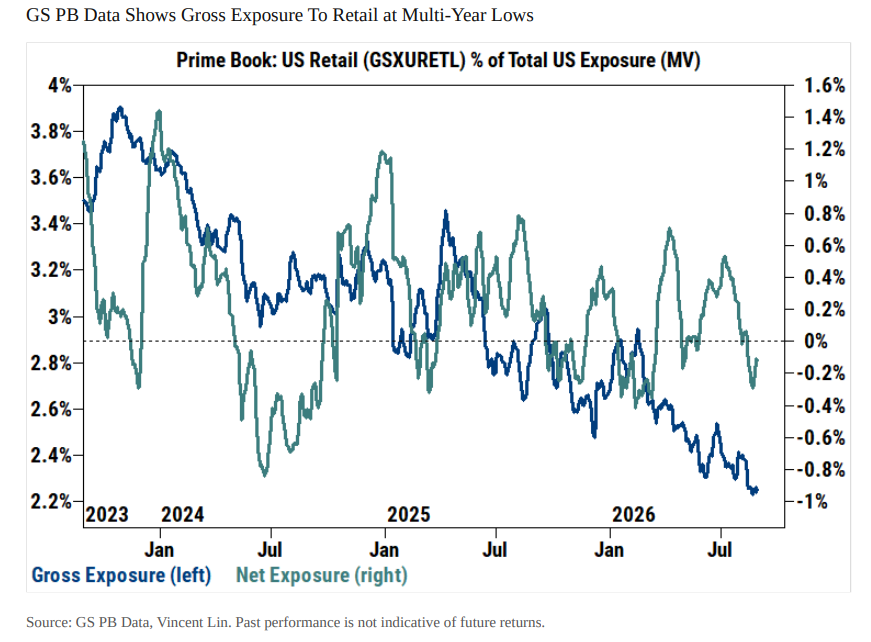
Goldman Sachs consumer expert Scott Feiler wrote yesterday that "consumer stocks have had a tough run the last few weeks" and pointed to Goldman's prime brokerage data, which show that gross exposure to retail stocks has plunged to a multi-year low, signaling that hedge funds have reduced their exposure this year.
Returning to Lasser, the UBS analyst warned that consumers are facing affordability pressures, elevated interest rates, inflation, labor-market uncertainty, tariffs, freight costs, and geopolitical instability, all of which have pushed investors to view retail through a defensive lens.
The broad consensus is that the US consumer remains resilient, but that conclusion masks deepening income-based bifurcation. Accelerating sales at Dollar General and Dollar Tree, alongside moderating trends at Walmart and Costco, have renewed questions about whether consumers are beginning to trade down.
Credit-card delinquencies, equity-market wealth effects, and fuel prices are emerging as critical indicators for spending through 2027.
Lasser explained:
At times, investing in retail today feels like crossing a river against a steady current. Every step forward is informed by the latest demand signals, market share reads, or channel checks. Daily stock movements frequently reflect changing narratives around risk rather than changes in underlying fundamentals. In some cases, share price action appears to be influencing investment theses as much as investment theses are influencing share price action.
Against that backdrop, confidence has become relative. Selectivity remains exceptionally high. The market is rewarding execution over aspiration, consistency over storytelling, and evidence over possibility. That dynamic is unlikely to change in the near term unless the macroeconomic undertow begins to recede.
Lasser added a lot more color about the current state of the consumer:
The State of the Consumer
The broad consensus remains that the consumer is holding up reasonably well. Yet that conclusion masks an increasingly nuanced debate. Income-based bifurcation has become so widely accepted that it is almost cliché. The more relevant question today is whether this remains an investable theme and how durable it may prove to be.
The recent acceleration at the dollar stores alongside moderation at Walmart and Costco has prompted renewed questions about shifting consumer behavior. Investors continue to monitor credit card delinquencies, wealth effects tied to equity markets, and fuel prices as key variables that could shape spending patterns over the next several quarters.
Sentiment Swings and Market Positioning
Perhaps the most striking characteristic of the current environment is the magnitude of sentiment volatility relative to changes in business fundamentals.
Recent examples include Dollar General, Dollar Tree, Target, and Ulta, where investor opinion periodically swung far beyond what underlying operating results appeared to justify. When evidence emerges that challenges the prevailing narrative, consensus often snaps back just as aggressively in the opposite direction. This creates fertile ground for mispricing opportunities and outsized returns for investors willing to be patient.
More recently, many of these discussions have centered on names such as Dick's Sporting Goods, AutoZone, and Tractor Supply.
Interest Rates and Replacement Cycles
Interest rates continue to serve as one of the sector's most important variables. Home Depot, Lowe's, and Floor & Decor have largely traded as housing and bond-proxy vehicles, while Best Buy, Williams-Sonoma, and Wayfair have increasingly been viewed as beneficiaries of an eventual replacement cycle.
The key debate is whether a declining rate environment would lift all of these businesses equally. Investors increasingly question whether lower rates alone are sufficient or whether company-specific execution and category fundamentals will ultimately prove more important.
Tariff Refunds and the Coming Anniversary Effect
Another emerging area of focus is the growing divide between tariff refund beneficiaries and those largely excluded from those benefits.
Retailers such as Walmart, Dollar General, Dollar Tree, Home Depot, Tractor Supply, and Best Buy are generally viewed as beneficiaries. Meanwhile, Target, Williams-Sonoma, and Five Below are more commonly viewed as those on the other side of that group.
This distinction may become increasingly important as investors begin to focus on the anniversary of these benefits and their second- and third-order implications for margins, pricing strategies, and earnings growth moving into next year.
The Nuanced Debates
Beyond the headline themes, countless smaller discussions continue to shape investor thinking. Topics ranging from nominal pricing and demographic trends to category-specific dynamics are influencing views on which retailers can sustainably grow above GDP and which may struggle to keep pace heading into 2027.
He touched on individual names:
Walmart
Walmart appears to be undergoing a gradual regeneration of its shareholder base. Investors have become more comfortable with underlying comp trends excluding Health & Wellness, although there is some concern that H&W-related headwinds could become more pronounced in 2027.
Discussions around store-level economics, margin expansion opportunities, and the long-term earnings power of the business remain central to the debate. The prevailing view is that the stock may remain range-bound near term as investors wait for proof that the most compelling elements of the investment thesis can translate into tangible financial outcomes.
Costco
Conversation around Costco has been comparatively subdued. The August sales release reignited debate over whether recent performance reflects continued deceleration or the early stages of stabilization.
Bulls remain focused on traffic growth, membership engagement, and the enduring strength of Costco's flywheel. Skeptics question whether the stock can continue to command its premium valuation if the business settles into a slightly lower long-term comp framework.
Target
Investor sentiment toward Target has swung dramatically over the past year. A few quarters of mid-single-digit comparable sales growth have meaningfully altered the narrative. The discussion has shifted from questioning the relevance of the business to debating its long-term earnings potential.
Key debates center around 2027 comp expectations, tougher margin comparisons, and valuation. Consensus expectations that once centered around approximately $10 of earnings power have increasingly migrated toward the possibility of nearly $12 in 2027. Where investors fall along that spectrum largely determines whether they view the stock as attractive or fully valued.
BJ's Wholesale Club
Investors have been more open to this stock as of late. There's been some surprise on the degree to which its shares have pulled back after a reasonably solid print. While the stock remains heavily influenced by the data, bulls have expressed optimism about it seeing improving trends from both its higher income and lower income shoppers. Bears remain skeptical about the sustainability of its recent performance, and are concerned that tough gas compares and more normalized MFI increases could pressure earnings growth in CY'27.
Dollar General
Investors broadly appreciate the improvement in operational execution and the progress management has made over the past year.
Operationally, the largest debate centers on the health of the mature store base. Core mature-store comps hovering around flat levels have become a focal point. Some investors worry that persistently muted comp growth could create longer-term margin pressure given the operating leverage embedded within the model.
There are also questions surrounding the sustainability of the recent gross margin expansion cycle. With much of the benefit from shrink reduction and damage improvements potentially already realized, and LIFO tailwinds likely moderating, investors are increasingly debating how much incremental margin upside remains available.
The contribution opportunity from DG Media continues to generate constructive discussion as well. Meanwhile, the bullish camp argues that the company has successfully re-established itself as a double-digit algorithm business capable of delivering attractive earnings growth over time.
Dollar Tree
Sentiment toward Dollar Tree continues to improve as investors focus on simplification, operational execution, and self-help opportunities.
The traffic inflection has strengthened the bullish narrative and quieted many of the skeptics. While investors still seek additional proof points, there is growing recognition that the direction of travel has improved meaningfully.
The primary debates now center on tariff refund anniversaries and the potential impact of elevated freight costs as the company moves into 2027. Some say that, as a result of these factors, margins remain uncertain moving forward.
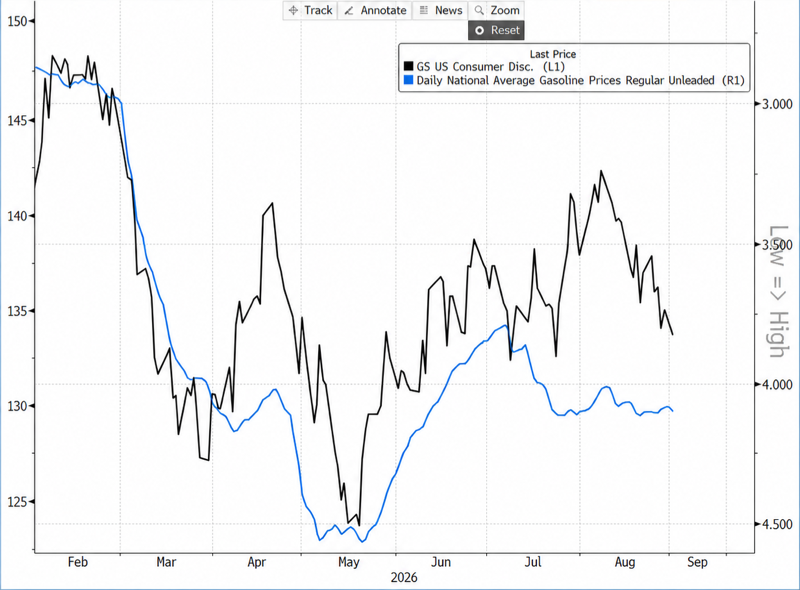
Goldman consumer stocks versus AAA retail gasoline
The takeaway here is that US consumer has imploded. It is that resilient headline data are concealing widening fractures beneath the surface. Accelerating sales at dollar stores, alongside moderating trends at Walmart and Costco, suggest that spending is shifting toward discount retailers.
Hedge funds appear to have recognized the shift, as the Goldman data suggests gross exposure to retail stocks is at a multi-year low.
Related Markets
All MarketsMarket data may be delayed. Not financial advice.
Powered by Gab AI
The Story At A Glance
Reading this article now — analysis appears below
💡 AI analysis provides alternative perspectives on current events