Online Betting Adoption Goes Parabolic: First-Timers Triple, Gen Z Overtakes Millennials, And Football Season Hasn't Even Begun

The short version
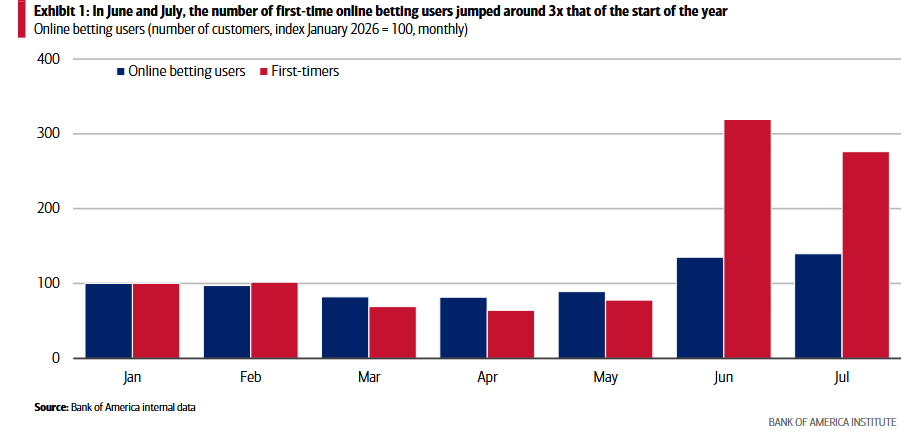
- The number of online bettors is up 40% since the start of the year .
- The number of first-time bettors in June and July was more than triple the January level.
- The bank credits the summer spike to the World Cup and "promotions and buzz" around prediction markets , and fair enough: every adoption curve has a catalyst.
- What matters is what the base looks like once the catalyst passes, and here the seasonal pattern is instructive.
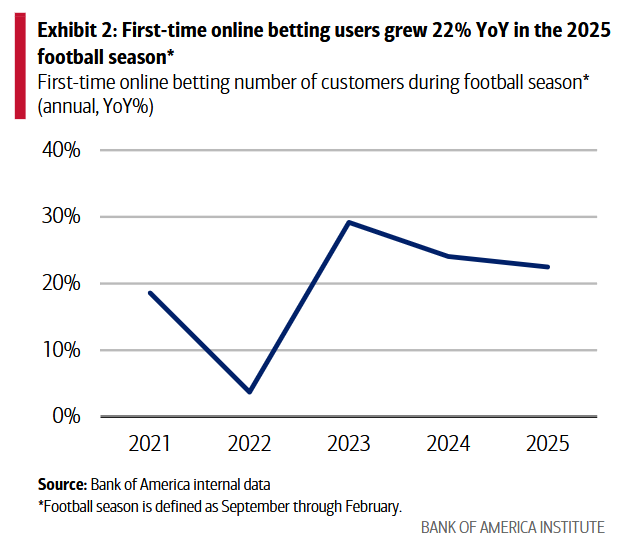
- First-time users jump with every major sports season, and the 2025 football season - which the bank defines as September through February, so it sweeps in the NFL…
The story
Online betting is off to the races - and this summer the adoption curve started looking like a hockey stick.
According to a new analysis by Bank of America - which can see every ACH, debit and credit card payment its customers make to and from sportsbooks, horse-racing platforms and prediction markets their own customers make:
- Roughly 5% of BofA customers sent money to an online betting platform in July.
- The number of online bettors is up 40% since the start of the year.
- The number of first-time bettors in June and July was more than triple the January level.
The bank credits the summer spike to the World Cup and "promotions and buzz" around prediction markets, and fair enough: every adoption curve has a catalyst. What matters is what the base looks like once the catalyst passes, and here the seasonal pattern is instructive. First-time users jump with every major sports season, and the 2025 football season - which the bank defines as September through February, so it sweeps in the NFL, college ball and most of the NBA and NHL - produced 22% more first-timers than the year before. Each season enrolls a larger freshman class. The class that enrolled this summer was three times the size of January's, and it arrived right before the busiest stretch of the calendar.
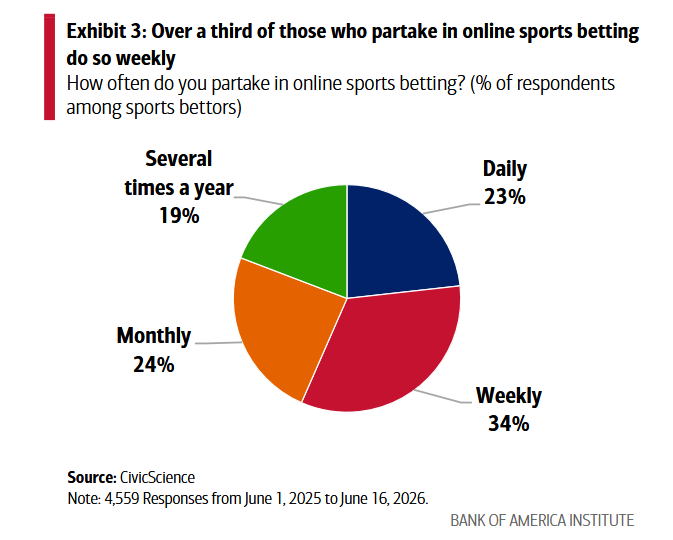
Nor is this something people try once and forget. Per a CivicScience survey cited in the note, 34% of online sports bettors wager weekly and 23% bet daily; fewer than one in five are the several-times-a-year Super Bowl crowd. That is the engagement profile of a social app, not a lottery ticket.
The turning point
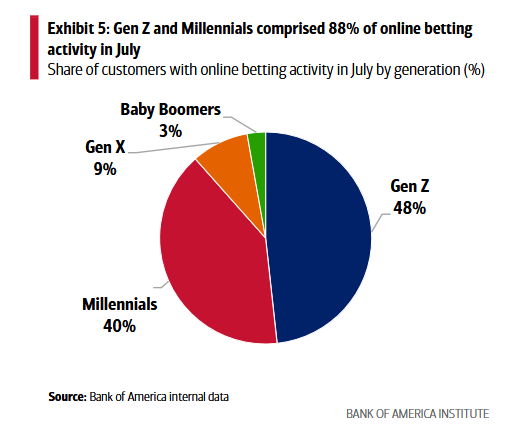
By generation, Gen Z (48%) and Millennials (40%) accounted for 88% of online betting activity in July. Gen X managed 9%; Baby Boomers, 3%. And as recently as this spring, Millennials were the larger group. Gen Z overtook them this summer - a shift BofA describes as a "turning point" in the composition of online bettors.
BofA defines Gen Z as anyone born after 1995, which means the oldest members are turning 30 this year and the cohort came of age alongside legal, app-based sports betting. BofA points out that younger consumers have consistently been first to adopt every emerging digital platform - crypto, BNPL, online marketplaces - and that betting appears to be following the same script.
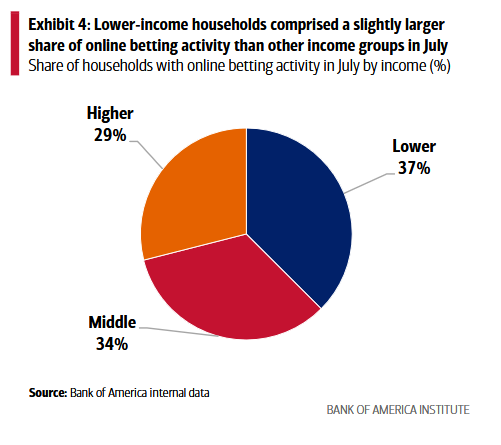
When it comes to income - betting activity is split almost evenly across terciles - 37% lower, 34% middle, 29% higher.
Oh it's investing!
According to a BofA survey conducted in March, 20% of respondents said they consider sports betting a form of investing, with Gen Z twice as likely as everyone else to say so. Across every generation, buying event contracts on a prediction market was more likely to be classified as investing than placing a sportsbook wager.
Prediction markets have listed contracts on almost anything - whether a politician sips water on camera during a speech, how many flu cases the year will bring - dressed in the language of derivatives: standardized, exchange-traded, resolved at a point in time. BofA notes that prediction markets, crypto, retail trading and sports betting all share "community participation and real-time pricing," which is a polite way of saying they share a user interface. To a generation raised on the Fed put, zero-day options and a community tab, a football game is simply another underlying.
And then there's the red tape...
Naturally, the regulators have noticed - and, naturally, their first move is a jurisdictional fight. The CFTC's position, per BofA's public-policy team, is that certain event contracts traded on federally regulated exchanges are derivatives under the Commodity Exchange Act and therefore federal turf. State and tribal regulators counter that contracts tied to sports and entertainment are gambling with extra steps and belong under existing state gaming, licensing and consumer-protection law. Lawmakers from both parties and both chambers have filed bills. The CFTC has also opened a rulemaking on perpetual futures and issued an advisory warning event-contract venues away from sweepstakes-style rewards and prizes "based on pure chance" - the sort of promotional program that helped fill the summer's freshman class - and, per BofA Global Research, is trying to draw a brighter line between prediction markets and sportsbooks by targeting in-house market making, incentive programs and "casino style odds."
None of it slows adoption. Arguing over whether a contract is a "derivative" or a "wager" is an argument over who gets to regulate and tax the growth, not whether the growth happens. By the time the rulebook is written, the users will already be there. Most of them already are.
And it's not even football season yet...
Related Markets
All MarketsMarket data may be delayed. Not financial advice.
Powered by Gab AI
The Story At A Glance
Reading this article now — analysis appears below
💡 AI analysis provides alternative perspectives on current events