"Three For Two": CENTCOM Destroys Iranian Tankers Near Kharg Island After IRGC Targets US Warships
The short version
- CENTCOM provided details: Following Iran's failed attacks, CENTCOM permanently disabled the IRGC crude oil carriers M/T Downy off the coast of Kharg Island and M/T Stark 1 near…
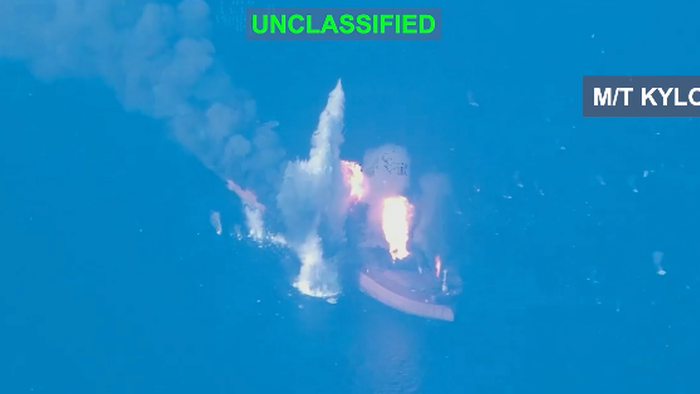
- American forces also completely destroyed the unladen crude oil carrier M/T Kylo (also known as the "Noxen") in the Gulf of Oman…
- The three Iranian crude oil tankers are part of a multibillion-dollar shadow network that funds the IRGC and its regional proxies.
- Iran has no means by which to defend them.
- Brad Cooper stated: Let the message to the IRGC be clear: If you shoot at two of our ships, we will impose an even higher economic cost —taking out three of yours.
The story
Summary:
- CENTCOM Confirms Iranian Tankers Hit Near Kharg Island
- Iranian Tanker Reportedly Hit By Missiles Near Kharg Island
CENTCOM Confirms Strikes
US Central Command confirmed on X that US forces struck three Iranian oil tankers after the Islamic Revolutionary Guard Corps launched ballistic missiles toward two US Navy warships.
CENTCOM provided details:
Following Iran's failed attacks, CENTCOM permanently disabled the IRGC crude oil carriers M/T Downy off the coast of Kharg Island and M/T Stark 1 near Jask. American forces also completely destroyed the unladen crude oil carrier M/T Kylo (also known as the "Noxen") in the Gulf of Oman, striking the vessel in multiple critical locations to render it inoperable after the crew was directed to abandon ship.
The three Iranian crude oil tankers are part of a multibillion-dollar shadow network that funds the IRGC and its regional proxies. Iran has no means by which to defend them.
CENTCOM commander Adm. Brad Cooper stated:
Let the message to the IRGC be clear: If you shoot at two of our ships, we will impose an even higher economic cost —taking out three of yours.
We will not hesitate to defend American forces, and if necessary, destroy Iran's limited and exposed oil fleet.
— U.S. Central Command (@CENTCOM) September 5, 2026
The key question heading into Sunday evening is how Brent crude futures will price the US strikes on Iranian tankers near Kharg Island.
Iranian Tanker Reportedly Hit By Missiles Near Kharg Island
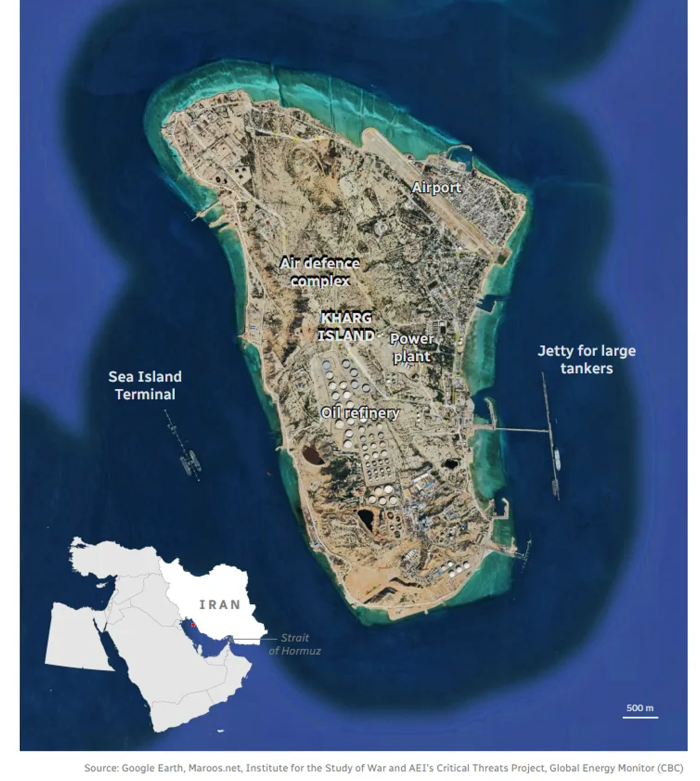
Iranian state media reported early Saturday that US forces had struck an oil tanker near Kharg Island. Although the US military has not confirmed the maritime incident, the attack, if verified, would mark a significant escalation near Iran's most important crude-export terminal and increase the risk of further disruptions to Persian Gulf energy flows.
Tasnim News Agency, which is affiliated with the Islamic Revolutionary Guard Corps, said several missiles hit the tanker early Saturday and published images purportedly showing black smoke rising from the ship.
Video of the Iranian oil tanker which was reportedly hit this morning by the US near the Iranian Kharg Island. pic.twitter.com/217O0lLn09
— Mehdi H. (@mhmiranusa) September 5, 2026
Kharg Island is the jugular vein of Iran's oil economy. The deepwater terminal handles about 90% of the country's crude exports, connecting Iran's major onshore fields to global markets, specifically China.
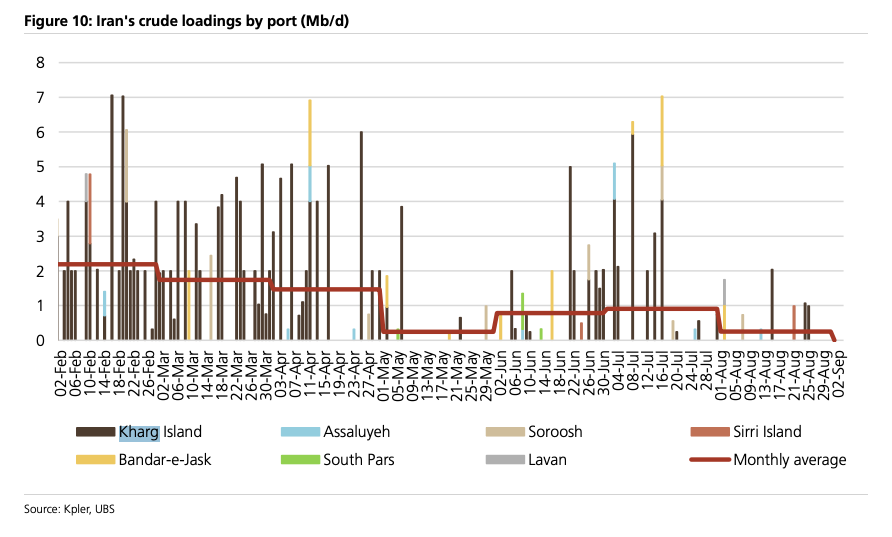
Henri Patricot, CFA, a Paris-based energy equity research analyst at UBS, published Kpler data showing that crude loadings at major Iranian export terminals, including Kharg, have been significantly reduced over the course of the six-month conflict.
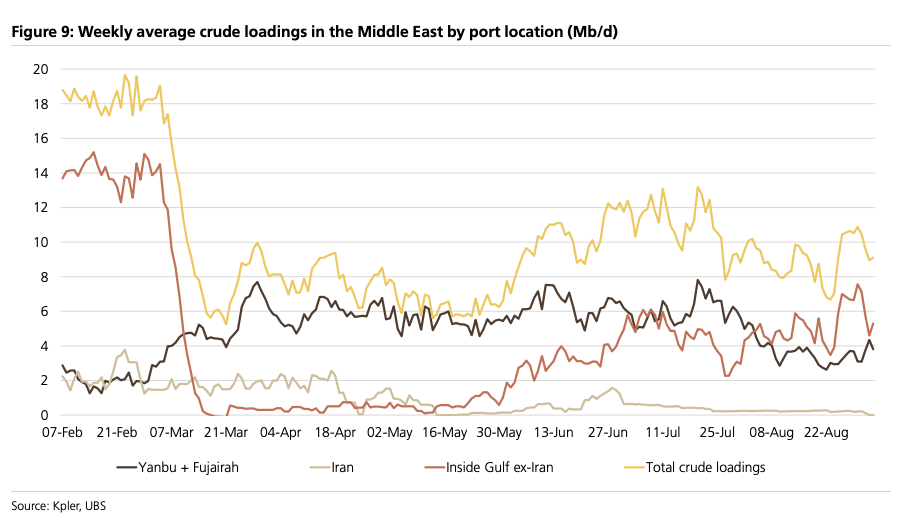
Weekly average crude loadings in the Middle East by port location also show a slight recovery on an ex-Iran basis across the major Gulf producers.
Average flows through Kharg have ranged from 1.5 million to 2 million barrels per day, although the data above show that those volumes collapsed to roughly 220,000 to 255,000 barrels per day in August under the US naval blockade. The island also contains massive storage facilities, pipelines, and loading berths. Any attack by US forces, whether kinetic through air-delivered munitions, or offensive cyber operations, could cripple Tehran's largest moneymaker.
President Trump warned Friday that the US could soon attack Pickaxe Mountain, a suspected Iranian nuclear facility.
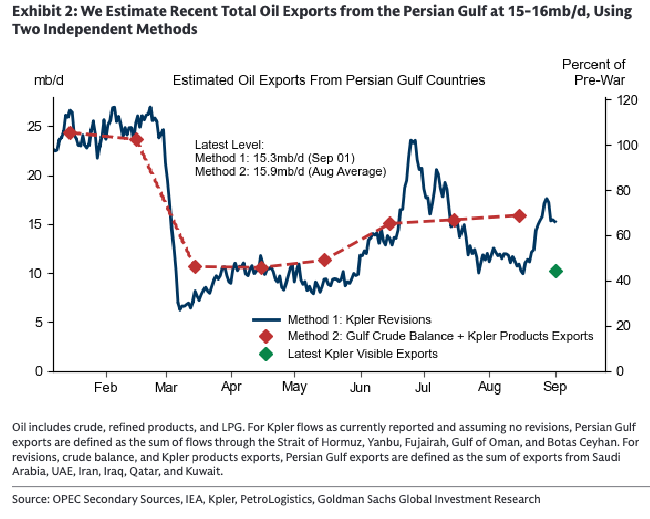
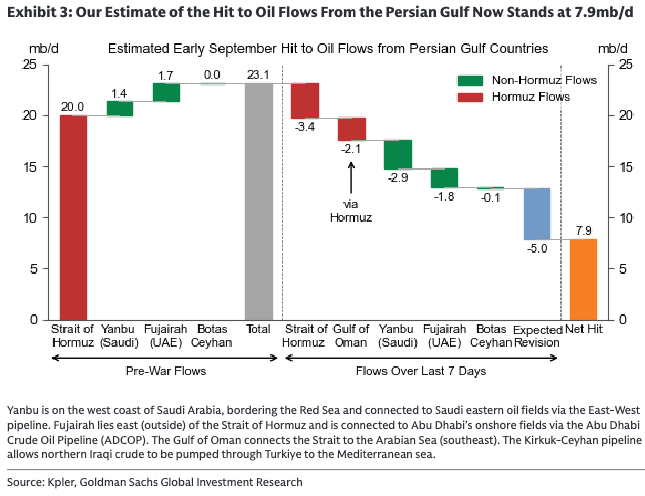
As for Hormuz flows, Goldman commodities strategist Yulia Zhestkova Grigsby and her team said this week that they had to revise tanker-flow estimates sharply higher (full note available here for pro subs), suggesting that Tehran's ability to control the strategic maritime chokepoint has been significantly degraded.
Grigsby and her team told clients on Wednesday that Gulf oil exports had recovered to between 15 million and 16 million barrels per day, roughly two-thirds of prewar levels.
However, Grigsby pointed out that visible tanker data show flows of only about 10 million barrels per day on a seven-day moving average. That 5 million-barrel-per-day gap reflects what Goldman's energy team called the "rise of dark transits." In other words, tankers are switching off their Automatic Identification System transponders to avoid detection by Iran.
Net hit to Persian Gulf flows of 7.9mb/d now
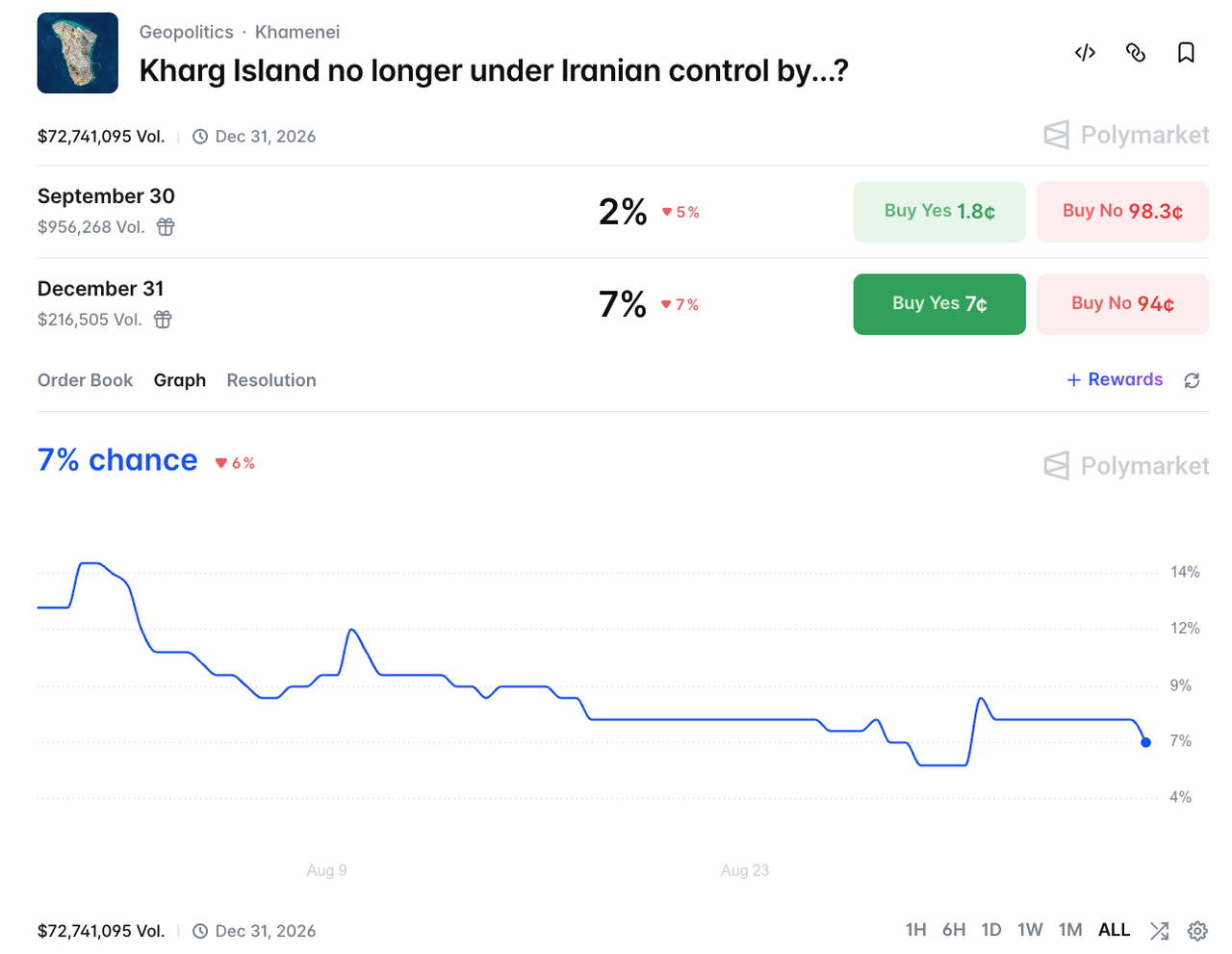
Polymarket odds that Tehran will lose control of Kharg Island stand at 2% by Sept. 30 and just 7% by year-end.
What the Trump administration decides to do with Kharg remains the energy market's billion-dollar question.
Related Markets
All MarketsMarket data may be delayed. Not financial advice.
Powered by Gab AI
The Story At A Glance
Reading this article now — analysis appears below
💡 AI analysis provides alternative perspectives on current events