The Bond Selloff Isn't Fiscal Armageddon, It's The End Of A Decade Of Financial Repression; Deutsche Bank

The short version
- As concerned as I am by this issue in the longer term, the recent bond market weakness at the moment should be seen more as a continuation of the long normalisation from the…
- That was a decade of financial repression with central banks buying trillions in government debt, benchmark policy rates sitting near zero…
- Had you been on a desert island for a couple of decades, the level of yields today would look perfectly normal at the end of your sabbatical from the world, not at crisis levels.
- In the US, inflation has now been above the Federal Reserve’s 2 per cent target for more than five years.
- There is also some positive news that has supported higher yields.
The story
Authored by Jim Reid, Deutsche Bank global head of macro research,
The latest global bond sell-off has revived the idea that markets are fretting over unsustainable public finances. As concerned as I am by this issue in the longer term, the recent bond market weakness at the moment should be seen more as a continuation of the long normalisation from the historic anomaly of the 2010s.
That was a decade of financial repression with central banks buying trillions in government debt, benchmark policy rates sitting near zero, and sovereign borrowing costs held down for years. Had you been on a desert island for a couple of decades, the level of yields today would look perfectly normal at the end of your sabbatical from the world, not at crisis levels.
At Deutsche Bank, our house view has consistently been in recent years that yields would rise due to heavy government issuance, the retreat of quantitative easing programmes of bond buying by central banks and inflation levels that have been persistently higher and more volatile than the pre-pandemic period. In the US, inflation has now been above the Federal Reserve’s 2 per cent target for more than five years.
There is also some positive news that has supported higher yields. Global growth has held up better than most expected since the conflict with Iran began. US nominal GDP growth in the second quarter was 6.6 per cent year on year, which, outside the Covid-19 bounceback period, was the highest level since 2005. Clearly, part of this reflects higher energy prices and inflation, but there is no doubt that real growth is also holding up, partly thanks to the continuing AI boom. This has also increased corporate debt supply, which has competed with government bonds for investor demand in recent months. European growth, meanwhile, is also performing better than many thought possible in the face of an all-too-familiar energy shock for the continent.
And make no mistake, fiscal concerns are real and higher borrowing costs potentially worsen debt arithmetic, especially if growth fades.
The big shift, though, is that the equilibrium rate for bond yields is higher than markets became accustomed to in the ultra-loose era.
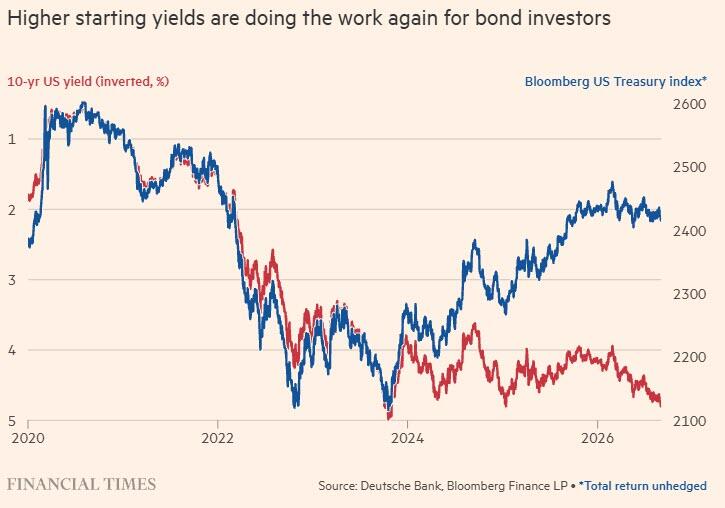
This has raised understandable concern, but one thing has been under-reported: returns for investors are starting to stabilise and, in many cases, have been positive over recent months and years.
This has been a welcome change from the early 2020s, when low starting yields offered no protection from the bear market. Rolling five- and 10-year total returns are still around their lowest on record across many government bond markets. However, the worst of the negative-return period is probably behind us.
Over the past year, the Bloomberg US Treasury Total Return index delivered a positive return even as 10-year yields rose by about 0.60 percentage points. From current levels, the 10-year yield would need to rise to roughly 5.5 per cent over the next year, or 6.4 per cent over two years, before total returns turned negative. An investor who bought 10-year Treasuries at the October 2023 yield peak of 4.99 per cent would now have a total return of more than 16 per cent. It is a useful reminder of how much starting yield now matters.
The UK provides an even clearer example, given the constant negative headlines. Ten-year gilt yields are now about 0.65 percentage points above the peaks reached during the 2022 mini-Budget crisis. Yet the broad gilt index has returned roughly 12 per cent since those crisis highs. There hasn’t been any prolonged period of negative returns in gilts over those four years.
This does not mean the secular adjustment is complete. Outside of a material downgrade to growth expectations or an external shock, the forces encouraging yields to move upwards are unlikely to disappear, but at least we’re in the ballpark of normal again. Over the past 100 years, a period with regular and large swings in prices, inflation has averaged 3 per cent in the US and 4 per cent in the UK — a higher level than that seen since 1990 but lower than current long-dated yields.
After years in which returns depended heavily on capital gains, more normal levels of yields are again providing income that can compound over time, which is helping to cushion volatility and steadily reward patience. The pressures will remain, and it’s hard to see spectacular returns, especially in real terms, but at least bonds have become bonds again, and investors should bear this in mind when the next inevitable bad headline comes through.
Related Markets
All MarketsMarket data may be delayed. Not financial advice.
Powered by Gab AI
The Story At A Glance
Reading this article now — analysis appears below
💡 AI analysis provides alternative perspectives on current events