Green Steel: ArcelorMittal Finally Pulls The Plug

The short version
- That ArcelorMittal, one of the green economy’s poster boys, threw in the towel at the end of the week and announced that it would end steel production at its Duisburg site is the…
- From October next year, ArcelorMittal will completely close the Duisburg steelworks and will also cease operating the billet rolling mill…
- Around 550 employees could be affected by the closure.
- The semi-finished products required to operate it will in future be sourced from other ArcelorMittal sites and external producers.
- But the fact that, ultimately, even conventional steel production is gradually having to retreat from Germany is tragic…
The story
Submitted by Thomas Kolbe
In the end, economic reality prevails. Green steel has no future in Germany, regardless of how much funding may continue to flow through the channels of the green subsidy machine: At Germany’s overregulated, energy-policy-driven and increasingly sidelined industrial location, industrial production is becoming less and less profitable.
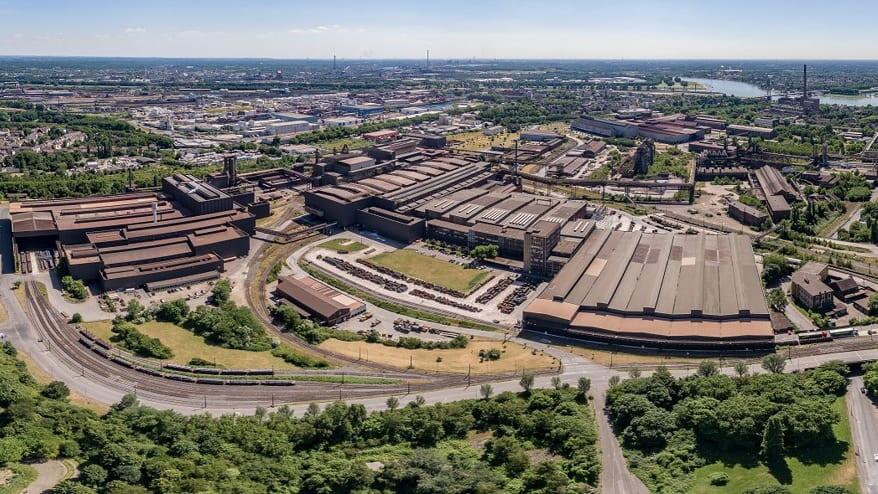
That ArcelorMittal, one of the green economy’s poster boys, threw in the towel at the end of the week and announced that it would end steel production at its Duisburg site is the latest painful blow to the proponents of the green transformation ideology.
From October next year, ArcelorMittal will completely close the Duisburg steelworks and will also cease operating the billet rolling mill, where around 800 employees are currently employed. Around 550 employees could be affected by the closure. Only the wire rod mill is to remain. The semi-finished products required to operate it will in future be sourced from other ArcelorMittal sites and external producers.
The news carries a double weight: That green steel — meaning steel produced through a production route in which hydrogen is used instead of carbon as the reducing agent — would not be able to compete in the face of significantly lower production costs at other locations is hardly surprising. But the fact that, ultimately, even conventional steel production is gradually having to retreat from Germany is tragic — a resounding no from business to the ideologically contaminated energy and location policies of the slowly crumbling industrial heart of Europe.
The basic materials industry is a fundamental component of industrial value chains. Particularly in view of geopolitical tensions, national control over raw materials and primary products is becoming increasingly important. Since the best year, 2018, crude steel production in Germany has fallen from 42.4 million tons to 34.09 million tons in 2025, a decline of around 20 percent — a dramatic indication of the complete failure of Germany’s energy and industrial location policies.
The green transformation is crumbling before our eyes while Germany’s industrial base is being deindustrialized. Capital seeks better returns, regardless of how rosy the world of the green transformers surrounding former Economy Minister Robert Habeck, the spiritus rector of the ecological central planners, may have been.
For Habeck, green steel “Made in Germany and Europe” was indispensable. The Green politician was convinced that steel produced with coal would have no future on the world market. How wrong one can be!
Representatives of this transformation ideology are presumably looking on at developments in the industry in bewilderment. Where is the traitor? they will ask themselves. After all, limitless subsidies, credit assistance and artificially imposed cost disadvantages through the CO₂ mechanism were all made available to traditional competitors in order to push this artificial product forward.
ArcelorMittal is by no means the only corporation pulling back. Previously, thyssenkrupp and Salzgitter also abandoned the misguided notion that they would one day be able to produce green steel in Germany.
Ultimately, everyone has to ask themselves: What does it actually cost to produce one ton of green steel? And who will compensate for the loss-making operation in the face of substantially cheaper, considerably more cost-effective competition, for example from India or China? Will these companies have to remain dependent on the taxpayer forever?
The cost gap is enormous: Depending on the calculation and production conditions, green steel increases production costs by around $100 to $500 per ton. For the European steel industry, the conversion to low-carbon production methods is estimated to entail additional costs of 35 to 100 percent per ton. This simply cannot work.
Green steel was one of the political pet projects of the Green Deal. Companies that decided — or were politically encouraged — to convert their production were supposed to be supported through two subsidy channels.
On the one hand, there was the classic subsidy payment. In the case of ArcelorMittal, around €1.3 billion in funding was earmarked for converting the plants in Bremen and Eisenhüttenstadt; the overall project was estimated at around €2.5 billion. Direct reduction plants and electric arc furnaces were planned, with everything ultimately intended to run on hydrogen. Then came the surprise withdrawal: On June 19, 2025, ArcelorMittal announced the end of the projects. According to the Ministry of Economic Affairs, the €1.3 billion was never drawn down. What a blow to green ideology: Even massive public funding could not make the project profitable.
A second subsidy channel for green cronyism runs through the CO₂ emissions trading system. Energy-intensive producers such as the steel industry receive free certificates to protect them against international competitors with lower climate-related costs. If a company emits less CO₂ than permitted by its freely allocated certificates, it avoids purchasing additional allowances and can sell surplus pollution rights to other companies. Conventional steel production is made relatively more expensive by this allocation mechanism — everything possible is being done to keep the industrial homunculus of green steel somehow breathing.
Since January 1, 2026, the CBAM mechanism is supposed to provide additional protection for industry. It is not a formal tariff barrier, but it serves a similar function: CO₂-intensive imports such as steel are now subject to comparable regulatory costs imposed by the EU climate machine. Yet even this market barrier cannot change the fact that industrial production in Germany has simply become unprofitable.
Along the entire value chain — from conversion subsidies and free certificates to protection against foreign competition — the state is playing every card in its hand to impose its centrally planned environmentalism on the private sector.
Brussels and Berlin are thus providing an impressive demonstration of the internal contradictions and high costs of a centrally planned state economy. Everyone can now see what happens when the state interferes with price formation and dictates technology and the actions of individual companies: It becomes expensive for the taxpayer. Costs do not simply disappear; they are merely redistributed and concealed through subsidies. When the state repeatedly intervenes in the economy, scarce resources no longer flow to where competition would generate the greatest benefit. Instead, they flow into the pockets of those whose ingenuity lies in hunting for grants and subsidies. This is how the final chapter of the market economy begins.
* * *
About the author: Thomas Kolbe, a German graduate economist, has worked for over 25 years, he has worked as a journalist and media producer for clients from various industries and business associations. As a publicist, he focuses on economic processes and observes geopolitical events from the perspective of the capital markets. His publications follow a philosophy that focuses on the individual and their right to self-determination.
Related Markets
All MarketsMarket data may be delayed. Not financial advice.
How this story developed
Full timelineAlto has tracked this across 2 days of coverage from 1 outlet.
- Green Steel: ArcelorMittal Finally Pulls The PlugYou are here
Powered by Gab AI
The Story At A Glance
Reading this article now — analysis appears below
💡 AI analysis provides alternative perspectives on current events