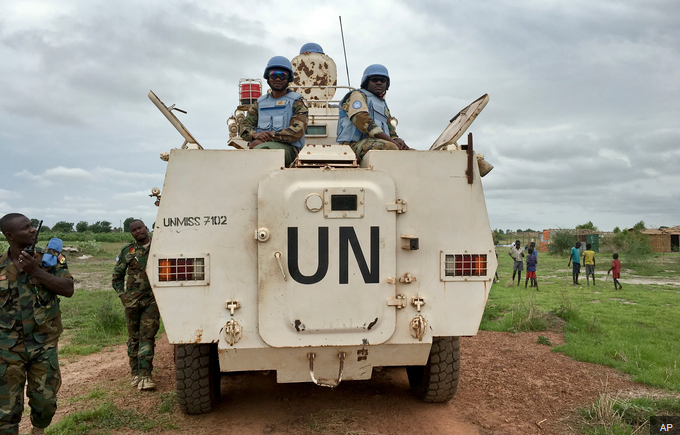
The UN Arms Embargo On Sudan Is Broken. America Has A Plan To Fix It

The short version
- America Has A Plan To Fix It Authored by Hussain Abdul-Hussain via RealClearWorld , The U.S. is rightly pushing the UN Security Council to expand the Sudan arms embargo before it…
- Outlined by Ambassador Mike Waltz and Senior Advisor Massad Boulos, the proposal would expand restrictions nationwide to cover all territory and warring factions.
- A comprehensive countrywide ban eliminates regional geographic loopholes used by illicit traffickers and provides the legal teeth necessary to choke off foreign weapons…
- To pass the resolution, America needs nine affirmative votes from the Council's 15 members.
- Alongside permanent members France and the UK, Washington's draft enjoys the support of Denmark, Greece, and Latvia.
The story
Authored by Hussain Abdul-Hussain via RealClearWorld,
The U.S. is rightly pushing the UN Security Council to expand the Sudan arms embargo before it expires this Saturday. Outlined by Ambassador Mike Waltz and Senior Advisor Massad Boulos, the proposal would expand restrictions nationwide to cover all territory and warring factions. A comprehensive countrywide ban eliminates regional geographic loopholes used by illicit traffickers and provides the legal teeth necessary to choke off foreign weapons, especially drones, fueling Sudan's devastating civil war, now in its fourth year.
To pass the resolution, America needs nine affirmative votes from the Council's 15 members. Alongside permanent members France and the UK, Washington's draft enjoys the support of Denmark, Greece, and Latvia. Panama and Bahrain could raise supporters to eight, one short of a majority.
Conversely, opponents include Somalia and Pakistan, two allies of Turkey and Saudi Arabia whose governments plan to continue arming the Sudanese Armed Forces (SAF). Two other African Council members, Liberia and Congo, are leaning "no," joined likely by Colombia. Together with the permanent members Russia and China, the total no votes add up to seven, enough to block the resolution without forcing a Russian or Chinese veto.
Opponents of the full embargo argue that the SAF is the legitimate "state institutions" and should be allowed to arm itself while starving its rivals. This position aligns with SAF's chief, General Abdel Fattah al-Burhan, who believes he can eliminate the Rapid Support Forces (RSF).
However, America correctly argues that the war in Sudan is a stalemate. Neither faction is strong or well-resourced enough to overcome its rivals, prevail, and govern the enormous Sudanese territory, an area larger than Texas, California, Montana, and New York combined.
Sudan is the third-largest nation in Africa, and its population of 53 million comprises over 500 distinct groups speaking more than 400 languages. While Arabic-speaking Sunni Muslims form the largest heritage group, they are fragmented into distinct regional and tribal confederations.
Historically, the Arab Riverine tribes - the Ja'alin, Shaigya, and Danagla - dominated Khartoum politically and economically, forming the backbone of Omar al-Bashir's former regime and the mainstay of the SAF today. In contrast, the nomadic Baggara Arab tribes from Kordofan and Darfur serve as the demographic base for the RSF. Meanwhile, non-Arab, indigenous African communities include the pastoralist Beja of the Red Sea hills, the Nuba of the central mountains, and the sedentary Fur, who gave the Darfur region its name.
Since gaining independence in 1956, Sudan has been ruled by military autocrats and the Muslim Brotherhood. By the 1990s, severe droughts and desertification pushed nomadic Arab herders south into lands traditionally owned by sedentary, non-Arab African farmers.
In 2003, non-Arab Sudanese launched a rebellion. Khartoum organized Arab militias - the Janjaweed, predecessor of the RSF - to engage in widespread atrocities alongside SAF. These brutal, raid-based tribal tactics are being repeated in the current civil war.
Since independence, Sudan has experienced only four brief stints of democracy. The last began in 2019, when labor unions toppled the Islamist Bashir regime and began rebuilding a democracy underwritten by SAF's Burhan and RSF's Mohamed Hamdan Dagalo (Hemedti).
By 2021, the two generals deemed the civilian government redundant and dissolved it to rule jointly. However, former regime elements of the Muslim Brotherhood engineered a comeback by driving a wedge between the two men, convincing Burhan he could become the country's undisputed ruler. Civil war erupted in April 2023. Burhan claimed the mantle of the legitimate government and declared the RSF an illegal militia. The RSF fought back, and the war continues to rage.
The U.S. State Department has already accused both sides of committing war crimes and has imposed targeted sanctions.
The Quad - comprising America, Saudi Arabia, Egypt, and the UAE - drafted a plan to end the war, requiring both generals to step down and restore civilian rule. Burhan, however, rejected the settlement, insisting the war will only end with the SAF's total military victory.
As the conflict unfolded, the Quad clung to its toothless plan while the UN Security Council unanimously renewed an arms embargo every September that failed to stop foreign powers from supplying various factions. Now, America is coming to the UN with a plan that has teeth: a blanket arms embargo on all armed Sudanese factions.
The ongoing civil war has completely upended the alliances of Sudan's past conflicts. The SAF alliance is heavily dominated by Arab and Muslim Brotherhood factions, earning it the backing of Turkey, Qatar, and Saudi Arabia.
Conversely, the RSF positions itself as anti-Islamist, receiving sponsorship from predominantly Christian and non-Arab Ethiopia, Kenya, and Uganda, alongside Chad and the UAE.
Treating all warring factions inside Sudan as equal aggressors and starving them of weapons is the best course of action.
A total embargo will lower the tempo of death and destruction, shut down the backdoor war economy, and might finally convince all parties that a military victory is impossible, leaving a negotiated political settlement as the only way forward.
Powered by Gab AI
The Story At A Glance
Reading this article now — analysis appears below
💡 AI analysis provides alternative perspectives on current events