Industry Leaders Warn Chinese EV Imports Will Undercut Canada's Auto Sector, Bring Major Security Risks
.jpg?itok=KgO5SES6)
The short version
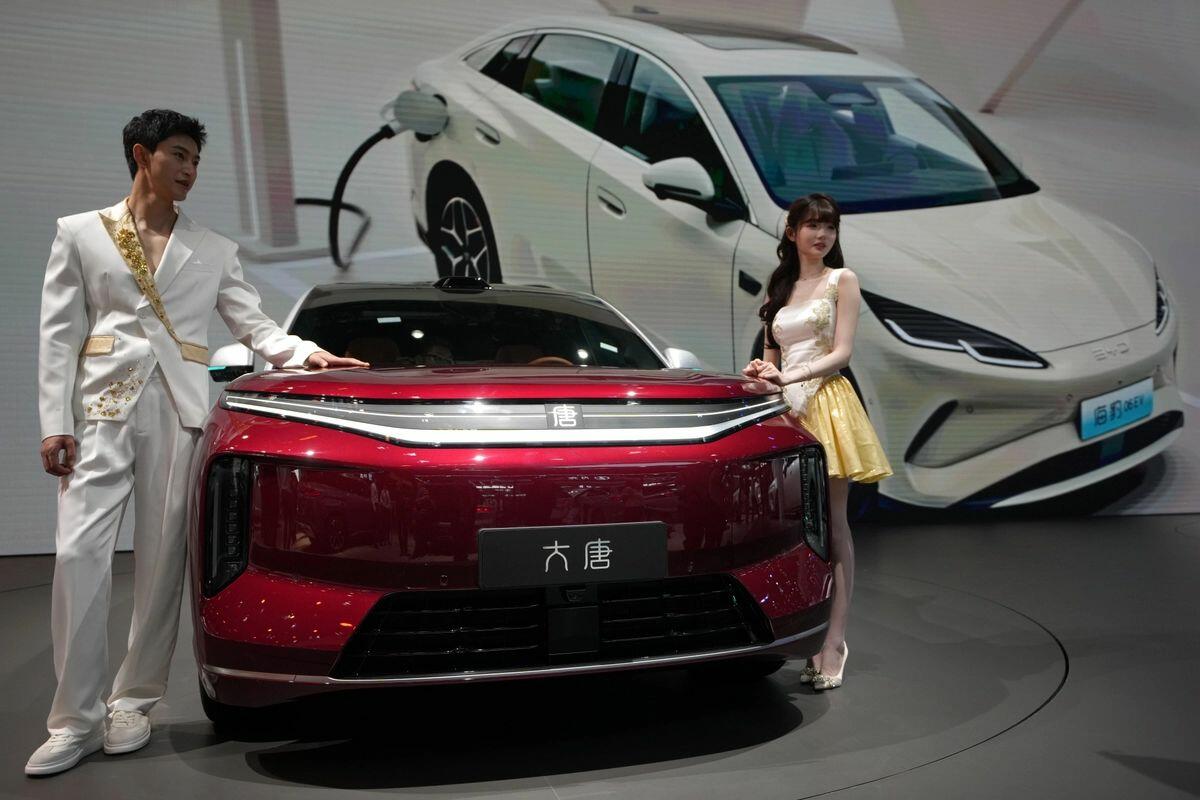
- Models stand next to a latest EV car from Chinese automaker BYD showcased at the Auto China 2026 in Beijing on April 25, 2026.
- EV Deal The import of Chinese-made EVs comes under the terms of an agreement between Ottawa and Beijing signed in January of this year that allows the import of up to 49,000…
- Ottawa has indicated the quota could rise to approximately 70,000 vehicles per year over the next five years.
- As part of the agreement, Beijing moved to cut tariffs on Canadian agricultural exports, slashing tariffs from 84–100 percent on Canadian canola products to 15 percent and…
- Ottawa also said it expects China will invest in the Canadian auto sector and possibly set up auto manufacturing inside Canada as part of the wider agreement.
The story
Authored by Paul Rowan Brian via The Epoch Times (emphasis ours),
A number of industry leaders and policy experts are warning that the government’s permission of importing Chinese-made electric vehicles (EVs) into Canada at low tariff rates will undermine Canada’s auto sector and cause a number of substantial national security risks.
The warnings came in testimony before the House Committee on Industry and Technology, where the speakers said that Ottawa’s quota-based access to Chinese EV makers will make Canada vulnerable to unfair trade practices from Beijing, hollow out the country’s already-struggling auto industry, and bring along a host of security risks associated with data collection and surveillance.
“Let’s be clear, this is not the approach Canada wanted,” Michael Kovrig, head of the Global Network for Strategic Effects, said while testifying May 4 before the committee.
EV Deal
The import of Chinese-made EVs comes under the terms of an agreement between Ottawa and Beijing signed in January of this year that allows the import of up to 49,000 Chinese-made EVs in the first year at a tariff rate of 6.1 percent, down from 100 percent.
Ottawa has indicated the quota could rise to approximately 70,000 vehicles per year over the next five years.
As part of the agreement, Beijing moved to cut tariffs on Canadian agricultural exports, slashing tariffs from 84–100 percent on Canadian canola products to 15 percent and relaxing restrictions on other products including seafood and peas.
Ottawa also said it expects China will invest in the Canadian auto sector and possibly set up auto manufacturing inside Canada as part of the wider agreement.
Canada opened permits for Chinese-made EVs on March 1, under which 24,500 will be allowed until August under the 6.1 percent tariff rate. Permits are issued by Global Affairs Canada and last 60 days before expiry. Importers are required to be Canada-based automakers or agents of them, and vehicles must comply with Canadian safety standards.
Ottawa said it plans to review and potentially change how the import system works after the first six months.
‘Trifecta of Risks’
Kovrig said that allowing Chinese-made EVs into Canada causes a “trifecta of risks,” which he described as creating “structural dependence” on China, along with “unfair competition [that] erodes industrial capacity” and imposing a “systemic pressure” on government policy going forward.
“The real question is not, ‘don’t we want cheaper EVs?’” Kovrig said. “It’s whether Canada wants to be a producer in the future auto economy, or merely a consumer market for vehicles produced by China’s industrial system.”
Kovrig’s concerns were echoed by Brian Kingston, president and CEO of the Canadian Vehicle Manufacturers’ Association.
“There are no guardrails in this agreement to ensure a level-playing field for manufacturers that have invested in Canada, or to protect Canadians from cybersecurity risks,” Kingston told MPs.
Kingston added that demand for EVs is closely tied to government incentives rather than free-market forces, and that serious harm could be done to the North American auto supply chain.
“Demand for EVs is directly related to rebates, and we saw it when the previous federal government rebate went away, we saw demand for EVs decline quite significantly,” he said, adding that import of Chinese-made EVs “will undermine the auto sector and presents risks to the North American auto supply chain.”
Canada’s auto sector remains a major part of the economy and directly employs roughly 125,000 workers, the majority of whom are employed in Ontario. More than 90 percent of Canadian-made vehicles are exported to the United States.
Kingston also said that keeping access to the U.S. market is crucial for Canada and “there is no industry without U.S. access,” saying that opening up to Chinese imports could undermine North American integration.
In mid-January, U.S. Trade Representative Jamieson Greer said Canada’s deal with China was “problematic.” This was followed on Jan. 24 by U.S. President Donald Trump threatening to put 100 percent tariffs on Canadian goods in response to the deal.
Controls
Several Liberal MPs on the committee asked questions about the economic and security issues related to importing Chinese-made EVs, stating that it could help Canadian consumers access more affordable vehicles and move Canada closer to climate goals.
For her part, Liberal MP Lisa Hepfner asked whether Canada could put conditions on Chinese firms, such as on domestic labour, security, and standards, in order for them to be allowed to import the vehicles.
Kingston said such an approach won’t work.
“If you say that you have to have a local supply chain and use local unionized labour, the response from a Chinese OEM [Original Equipment Manufacturer] is, ’thanks, but no thanks,'” he said.
“The moment they want more access, they will restrict our exports of canola. They'll come up with other reasons to leverage more access into the market. This is the Chinese trade playbook. You can see it in sector after sector in different countries,” he added.
Kovrig shared this view, saying that Beijing tends to use a quota as a “ratchet” to force more market access.
“What begins as a capped quota becomes a ratchet that only expands. Concentrated sectoral economic dependence also constricts federal policy-making autonomy,” he said.
“The PRC [People’s Republic of China] weaponizes technology, supply chains, and market access to coerce independence to its geopolitical agenda.”
He added that “forced labour” is also part of the Chinese EV supply chain and cited evidence from Sheffield Hallam University linking forced labour of China’s ethnic Uyghur population to key battery and EV production stages.
Kingston added that even if China were to build a factory in Canada, it would likely be a human rights and economic disaster.
“If they build a plant, they bring in labour from China. And as we’ve seen in Hungary, the conditions have been characterized as slave-like conditions,” he said, referring to a Chinese-operated factory in Hungary.
Benefits of EVs
Several industry leaders who testified before the committee said EVs would be a net positive for Canada.
Jeff Turner, director of Mobility at Dunsky Energy and Climate Advisors, said EVs would help Canadians in various ways, including by bringing “almost $2,000 per year in fuel savings per household and reductions of GHG emissions and other emissions that have significant health impacts for Canadians.”
Cherith Sinasac of the Electro-Canada Foundation also emphasized her view of the positive role that EVs could have and said their origin is much less important than infrastructure readiness.
“Canada needs a strong long-term EV charging infrastructure strategy,” she said, adding that there must be a coordinated investment strategy by provinces and economic sectors.
“EVs and their battery storage have the potential to be a national energy asset for our grid,” Sinasac said.
Security Risks
Kingston and Kovrig both said that in addition to economic damage, bringing in Chinese-made EVs could pose security risks, including potential data access concerns and dangers to national security.
“China’s 2017 National Intelligence law compels any Chinese firm, including from overseas operations, to share data with Beijing on demand,” Kovrig said. “There’s no judicial review and no challenge mechanism.”
Kovrig described Chinese-made EVs as “a rolling computer with cameras” that are “state-linked data platforms.”
This echoed similar concerns from Conservative Leader Pierre Poilievre, who stated his opposition to allowing Chinese-made EVs into Canada this past January, writing on X that such vehicles “function like roving surveillance systems on our streets [and] should not be allowed in Canada - collecting data, tracking Canadians and exposing us to a foreign regime.”
How other outlets covered this
Compare allAlto found this story at 2 outlets. Same event, different framing — compare the headlines.
How this story developed
Full timelineAlto has tracked this across 7 days of coverage from 2 outlets.
Powered by Gab AI
The Story At A Glance
Reading this article now — analysis appears below
💡 AI analysis provides alternative perspectives on current events